Symposium · Existentialism · Pl. 3Martin Heidegger · 1889–1976
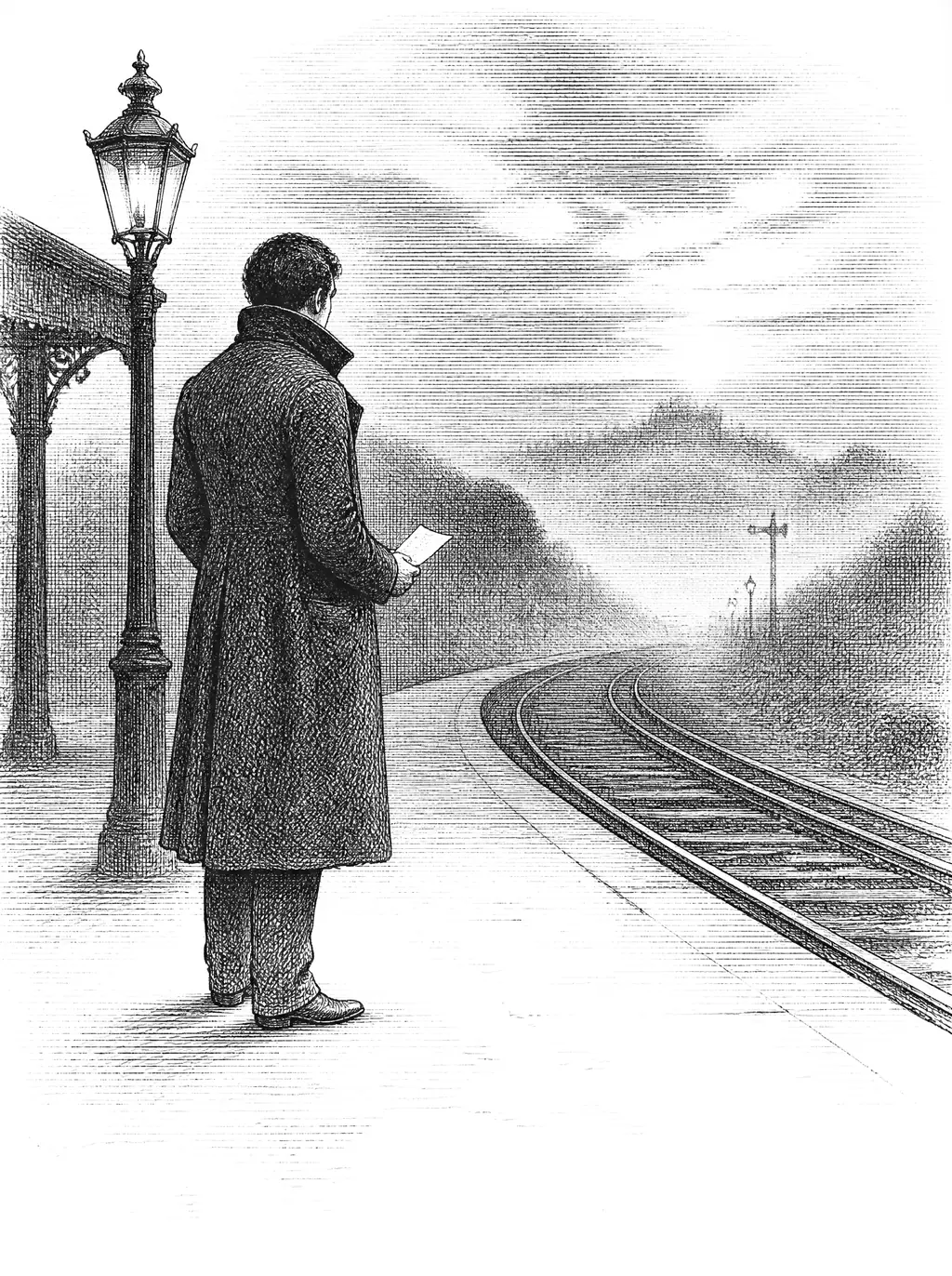
Being-Toward-Death
A possibility no one can take from you
Someone else can take almost anything from you: your job, your reputation, even, in extreme cases, your freedom. Heidegger noticed one thing that structurally cannot be transferred: your own death. No one can die it for you, stand in for you, or absorb it on your behalf. That plain, oddly overlooked fact became the foundation of his entire analysis of what it means to exist. The analysis appears in the second division of Being and Time, published in 1927, and it is the pivot of the book: everything before it describes a self lost in the everyday, and everything after describes what it takes to get it back.
The world it came from
Martin Heidegger was born in 1889 in Messkirch, a small Catholic town in southern Germany, and trained first for the priesthood before turning to philosophy under Edmund Husserl. Being and Time was published in 1927, unfinished, to secure him a chair at Marburg; it made him the most famous philosopher in Germany within a few years. The death analysis draws on Kierkegaard and on Tolstoy's The Death of Ivan Ilyich, which Heidegger cites in a footnote as the exact portrait of the everyday evasion he describes. Six years later he joined the Nazi party and served as rector of Freiburg, a fact that has shadowed his work ever since. The problem he set himself in 1927 was what makes a human existence a whole.
The idea
Being-toward-death names the way a genuinely honest relationship to your own mortality shapes existence, not as a distant fact scheduled for later, but as a live possibility hanging over every present moment. Most daily life, Heidegger argues, is organized around avoiding this awareness, treating death as something that happens to people in general while quietly exempting yourself from its full weight. Heidegger's phrase for the evasion is that one dies: das Man, the anonymous they, always dies, and never me, not yet. Being-toward-death is the reversal in which the possibility becomes mine, and stops being anyone's.
How the reasoning runs
Start with what Heidegger calls Dasein, the kind of being that has its own existence at issue, which is to say, you. Ask what makes such a being a whole. Every other thing is complete when it is finished, but Dasein is never finished while it exists; there is always something outstanding, always a not-yet. Death is the not-yet that cannot be outstripped. Second step: this end is not an event you will attend but a possibility you carry at every moment, and its three marks are that it is ownmost, non-relational, and not to be outstripped. Third: to live toward it honestly is to run ahead into it, and that running-ahead is what pulls a self out of the anonymous they and hands it back its own possibilities.
Seen in life
Your phone shows a message from a friend you keep meaning to call. You will call next week; there is time. That sentence, there is time, is the everyday evasion in three words. It is true of people in general and false of you in particular, because nobody has told you how much. Heidegger is not asking you to brood on the date. He is pointing out that the friend, the unfinished work, the conversation with your father, are all being held in a present that quietly assumes an unlimited supply of later. Run ahead once, in his phrase, to the possibility that there is no later, and watch which of the postponed things suddenly acquires an order. That order is what he means by authenticity.
Why it matters
Facing this squarely, rather than fleeing into distraction and the comfortable anonymity of doing what everyone does, is what Heidegger calls authenticity. It does not mean morbid obsession with dying. It means letting the fact that your time is finite and entirely your own actually inform which possibilities you commit to, instead of drifting through an indefinitely postponed present. Authenticity, in Heidegger's sense, is not a moral achievement but a kind of ownership: your possibilities become yours instead of the ones anybody would have. Death is the fact that makes the ownership real, because it is the one possibility nobody else can hold for you.
“Death reveals itself as that possibility which is one's ownmost.”
From the source
In Being and Time, working through what makes death different from every other possibility Dasein faces, Heidegger writes: “Death reveals itself as that possibility which is one's ownmost.” No one else's death can substitute for it, and no achievement or relationship can transfer the fact of it away from the person who has to face it. The full description gives three marks. Death is ownmost, because it is the one possibility that belongs to no one else; it is non-relational, because in facing it every tie to others falls away; and it is not to be outstripped, because no further possibility lies past it. Macquarrie and Robinson's 1962 translation, quoted here, coined the English for all three terms.
The pushback
Isn't constant awareness of death simply a recipe for paralysis or dread, the opposite of a functional life? Heidegger's authenticity is not meant as constant morbid fixation; it is closer to a background clarity that resets what actually matters, the way knowing a deadline is real, rather than abstract, changes how seriously you treat the time before it. Epicurus put the older objection: where death is, I am not, so it is nothing to me, and a philosophy organized around it has built on air. Levinas added a moral one: it is the death of the other, not my own, that first makes a claim on me.
The reply
Heidegger's answer to the first objection is that anticipation is not dread; the mood he describes is a sober anxiety that frees rather than paralyzes. To Epicurus he would say that death as an event is indeed nothing to me, which is exactly why he analyzes it as a possibility, present now, rather than a future state. Levinas is the objection the tradition has not fully answered. Heidegger's death is non-relational; it strips away every tie. A reader who believes that grief at another's death teaches more about finitude than any anticipation of one's own will find that Being and Time has no chapter on grief, and the omission is not an accident of length.
Where it went next
Sartre took over the structure and disagreed with the conclusion: death for Sartre is not my ownmost possibility but the absurd end of all possibilities, which comes from outside and gives nothing. Levinas built his whole ethics as a reply. Derrida's Aporias in 1993 turned the analysis on itself, asking whether anyone can be said to face a death that is by definition never experienced. In psychotherapy, Irvin Yalom made death anxiety one of the four givens of existential treatment, and hospice literature often echoes the language of owning one's death without citing its source. The Nazi years permanently complicated the reception; Levinas and Sartre both read the death chapter through them. It remains the most influential thing written about mortality in the last century.
Where this leads
Memento mori reaches a strikingly similar conclusion from an entirely different tradition centuries earlier, using the same plain fact, that you could die at any moment, to sharpen rather than dull your attention to how you are actually living right now. Is life worth living is the question Heidegger's analysis declines to ask. Camus put the possibility of ending one's life at the start of philosophy; Heidegger treats death as what gives a life its shape from within, and never as a choice. The two books face the same fact and walk away from it in opposite directions.