Symposium · Stoicism · Pl. 11Marcus Aurelius · 121–180 AD
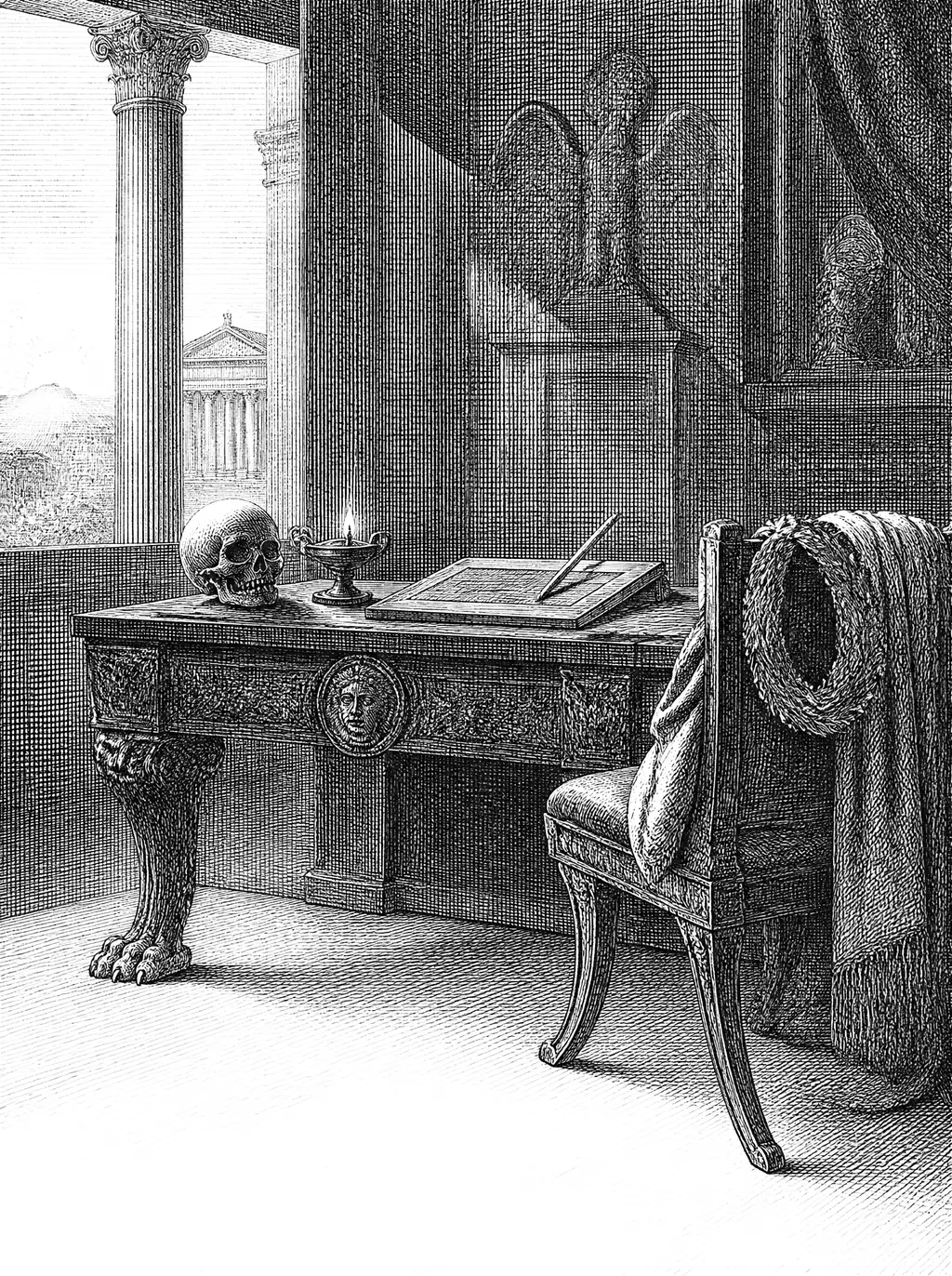
Memento Mori
A note to himself
The most powerful man in the Roman world kept a private notebook that no one else was meant to read. In it he reminded himself, over and over, that he might die before the sentence he was writing was finished. He used the thought not to despair, but to sharpen exactly what he did with the sentence. The reminder was not new. Rome had a habit of putting death next to triumph. What Marcus added was the timing: every task, before it began, and not only the large ones.
The world it came from
Marcus wrote the Meditations in his fifties, on campaign against the Marcomanni and Quadi on the Danube, in a decade when the Antonine plague was killing a large share of the empire's population. Death was not an abstraction in his camp. He had already buried most of his children, and his co-emperor Lucius Verus had died suddenly in 169. The Stoic training he had received from Rusticus and from Epictetus's Discourses made the rehearsal of death a standing exercise, and Seneca had written a century earlier that we should go to sleep each night as if we might not wake. Rome had its own version: the general in a triumph rode with a slave beside him, reminding him that he was mortal.
The idea
Memento mori means remember you will die. Treat every act, every plan, every project as something you are doing as one who might depart this life at this very moment. The point is not morbid dwelling on death. It is using death's plain fact to strip away whatever in your day was not worth the time it was taking. The instruction is a filter, applied before an act, not a mood carried through the day. Ask whether this is worth doing by someone who might not finish it. If yes, do it fully. If not, you have just found something to drop.
How the reasoning runs
The argument is short and hard to escape. First, you will die, and you do not know when. Second, most of the things you postpone, half-do, or resent are postponed, half-done, or resented on the assumption that there is more time. Third, that assumption is false in exactly the case that matters: the last day looks like any other from the inside. So every act you undertake as if time were unlimited is undertaken on a false premise. Fourth, therefore, the only way to act on true premises is to act, each time, as someone who may not get another chance. This does not make the act frantic. It makes it complete, since a complete act needs no tomorrow to finish it.
Seen in life
You have been meaning to call your father for three weeks. Not because anything is wrong; because nothing is, and the call can happen any time. Tonight, before you open the laptop instead, run Marcus's filter. Suppose this were the last evening you had. Would the email you were about to answer survive the test? Would the call? The question is not meant to make you morbid; it is meant to make you honest about which of the two you were actually choosing. Make the call. Twenty minutes later you have the same laptop, the same email, and one fewer thing you would have to explain to yourself later.
Why it matters
You act differently when you believe you have unlimited time than when you remember you do not. Unlimited time excuses postponement, grudges, and half-hearted effort, since there is always tomorrow to fix it. Remembering death removes that excuse and forces the question that actually matters: is this worth doing with the time you can already feel running out? Death is the only deadline that cannot be extended, which is why it is the only one that sorts your day truthfully. Every other deadline can be negotiated, and most people spend a surprising share of their lives negotiating them instead of doing the thing.
“Whatsoever thou dost affect, whatsoever thou dost project, so do, and so project all, as one who, for aught thou knowest, may at this very present depart out of this life.”
From the source
In Book II of the Meditations, Marcus Aurelius wrote: “Whatsoever thou dost affect, whatsoever thou dost project, so do, and so project all, as one who, for aught thou knowest, may at this very present depart out of this life.” He set that standard for himself before every task, however small. The passage continues with the reason the thought should not terrify. If the gods exist, he argues, leaving the company of men is nothing to fear, since they would not put you in harm's way; and if they do not exist, or do not care, why cling to a world without them? Either way the fear is misplaced, and the instruction stands.
The pushback
Doesn't constantly picturing your own death just breed anxiety instead of clarity? The Stoic reply separates two very different uses of the thought: dwelling on death as a source of dread, which they also warn against, and using it once, briefly, as a filter before you act. The filter is meant to be quick, not a lingering fixation. There is a practical objection too. A person who really treated every act as possibly their last would never plant a tree, save for retirement, or start anything that takes ten years. The filter seems to punish exactly the long projects that make a life worth remembering.
The reply
The anxiety objection is answered inside the practice: the Stoics prescribed the thought as a brief, deliberate exercise, and Marcus in the same passage argues that death is not to be feared, so the exercise was never meant to leave dread behind it. The long-projects objection needs a more careful reply, and the tradition gives only part of one. Marcus's instruction is about how to do a thing, not how long a thing to choose: plant the tree as someone who might not see it grow, which means plant it well and without needing the credit. That answers most of it. It does not fully answer whether to start the ten-year project at all. For that the Stoics would point to duty, not to death.
Where it went next
The Christian Middle Ages made memento mori a whole visual language: skulls on tombs, the dance of death painted on church walls, and, in the seventeenth-century Netherlands, the vanitas still life, where a skull sits among fruit and instruments. Montaigne titled an essay in 1580 with Cicero's claim that to philosophize is to learn to die, and filled it with Seneca. Heidegger built being-toward-death into his analysis of human existence in 1927. Steve Jobs told Stanford's graduating class in 2005 that remembering he would soon be dead was the most important tool he had ever found for making big choices. There is now an app that reminds you five times a day. Marcus, who kept a notebook, would have understood.
Where this leads
Seneca's essay on the shortness of life makes the same point from the opposite direction: it is not that you are given too little time, but that you spend so much of what you have on things that were never worth spending it on in the first place. Amor fati is the other side of the coin. Memento mori strips the day down to what matters, and amor fati asks you to want the day you were left with, exactly as it is, rather than the longer one you had been assuming. Marcus practiced both in the same notebook, often on the same page, because each one needs the other to stay sane.