Symposium · Logic & Paradoxes · Pl. 2Lewis Carroll · 1832–1898
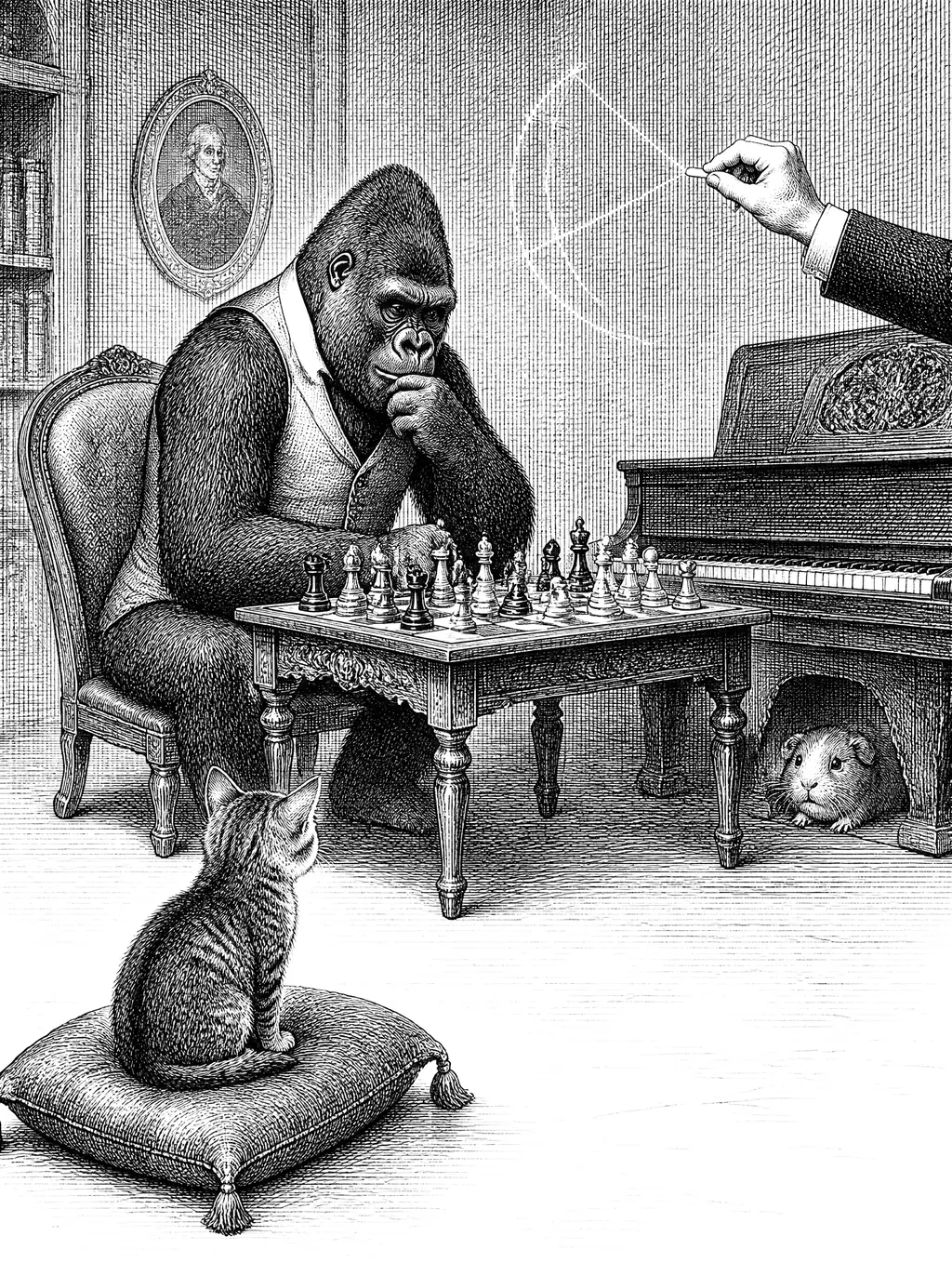
The Kitten Syllogism
Absurd premises, airtight logic
Carroll, a mathematician by trade under his real name Charles Dodgson, wrote a logic textbook built almost entirely from whimsical premises about talking animals, convinced that formal reasoning taught through nonsense would stick far better than the dry textbook syllogisms students usually memorized and instantly forgot. The result, Symbolic Logic, Part I, appeared in 1896 with a preface addressed to the reader who wants a mental recreation, and its exercises have been copied into logic textbooks ever since.
The world it came from
Charles Dodgson lectured in mathematics at Christ Church, Oxford, from 1855 to 1881, and spent his last decade on logic. He had watched the subject change: George Boole had turned it into algebra in 1847, and John Venn's diagrams appeared in 1880. Dodgson invented his own diagram method, published The Game of Logic in 1886 with a board and counters, and taught it to schoolgirls at Oxford High School. Symbolic Logic, Part I, came out in 1896 under the Carroll name. Part II was in proof when he died in 1898 and was lost until William Warren Bartley III found and published it in 1977. The puzzles about kittens, gorillas, and guinea pigs come from the exercises on soriteses, chains of syllogisms whose conclusion must be found.
The idea
No kitten, that loves fish, is unteachable; no kitten without a tail will play with a gorilla; kittens with whiskers always love fish; no teachable kitten has green eyes; no kittens have tails unless they have whiskers. Chain these five absurd premises together correctly, and a single, perfectly valid conclusion about green-eyed kittens and gorillas necessarily falls out the other end. Carroll's answer, worked through in the book, is that no kitten with green eyes will play with a gorilla. Nothing in any single premise says so.
How the reasoning runs
Rewrite each premise as a rule. One: a kitten that loves fish is teachable. Two: a kitten without a tail will not play with a gorilla. Three: a kitten with whiskers loves fish. Four: a teachable kitten has no green eyes. Five: a kitten with a tail has whiskers. Now start from a green-eyed kitten and follow the chain. By four, it is not teachable. By one, it does not love fish. By three, it has no whiskers. By five, it has no tail. By two, it will not play with a gorilla. Conclusion: no green-eyed kitten will play with a gorilla. Each link is a contrapositive of a premise, and the middle terms, teachable, fish, whiskers, tail, cancel out in turn until only the two ends remain.
Seen in life
You are trying to find out whether a customer qualifies for a discount. The rules are spread across five pages of a handbook. Accounts opened before March are legacy accounts. Legacy accounts are not eligible for the spring offer. Customers not eligible for the spring offer keep the old rate. Customers on the old rate are not billed quarterly. Only quarterly-billed customers receive the discount. No page says whether she qualifies, and the person who wrote page one never met the person who wrote page five. You lay the rules end to end, cancel the middle terms, and read off the result: an account opened before March gets no discount. That is Carroll's sorites with the kittens removed, and it is how eligibility gets decided every day.
Why it matters
This demonstrates something easy to forget: the validity of an argument depends entirely on its logical structure, never on whether its subject matter sounds serious or silly. A chain of premises about kittens and gorillas is exactly as rigorous, or exactly as flawed, as the identical structure dressed up in solemn philosophical vocabulary instead. Carroll made the point by removing every reason to trust the content. When the premises are about gorillas, nothing but the structure can carry you to the conclusion, and you notice for the first time that structure is what was carrying you all along.
“No kitten, that loves fish, is unteachable; no kitten without a tail will play with a gorilla; kittens with whiskers always love fish.”
From the source
Carroll poses the puzzle as a chain of premises to be combined: “No kitten, that loves fish, is unteachable; no kitten without a tail will play with a gorilla; kittens with whiskers always love fish.” Two more premises follow: “no teachable kitten has green eyes; no kittens have tails unless they have whiskers.” The exercise appears among the soriteses in Symbolic Logic, with the instruction to find the conclusion that follows from all the premises together. Carroll's method is to name each term, sort the premises so that each shares a term with the next, and eliminate the shared terms one by one. The book's other exercises run to gardeners, opera-goers, and sane persons who can do logic, and the answers, like this one, are always a single, sober universal statement.
The pushback
Doesn't dressing serious logic up in nonsense risk making it feel like a game with no real stakes, rather than a discipline that matters for reasoning about genuinely consequential things? Carroll's own reply, implicit in decades of readers who learned formal validity through his puzzles, is that the playful form is exactly what makes the underlying structure easiest to actually absorb. A second objection is empirical: people reason better about familiar content than about abstract form, so practice on kittens may not transfer to arguments that matter.
The reply
The second objection has evidence behind it. Peter Wason's selection task, from 1966, showed that most people fail an abstract rule-checking problem and pass it when the rule is about drinking ages or postage. Carroll's nonsense sits in the abstract camp, so the transfer is not automatic. But that cuts both ways. If content helps you reason, it also helps you reason badly: a familiar conclusion feels valid whether or not it follows. Carroll's method is training against exactly that comfort. Both are needed: structure practiced until visible, then applied to content that resists it. On the first objection, the stakes are real: eligibility rules, contracts, and legislation are soriteses, and people are refused things on the strength of them.
Where it went next
The Carroll diagram, his two-by-two sorting grid, is taught in British primary schools under his name. Symbolic Logic, Part II, recovered in 1977, showed him working on problems of the barbershop kind that anticipated debates about the material conditional. Raymond Smullyan's puzzle books from 1978 onward carried the tradition of logic taught as play, and Douglas Hofstadter's Gödel, Escher, Bach borrowed Carroll's characters. In computing, a sorites is a small satisfiability problem: a solver like Prolog resolves the chain by the same elimination of middle terms Carroll did by hand, and rule engines that evaluate eligibility are industrial versions of the kitten exercise.
Where this leads
What the Tortoise said to Achilles shows this same playful author turning from the mechanics of valid chains toward a deeper worry about what actually compels anyone to accept a conclusion once its premises are already sitting on the table. The methods of agreement and difference sit nearby as the other half of logic. Carroll's chains show what follows once premises are granted; Mill's methods are about how a premise gets granted in the first place, from evidence rather than from a textbook.