Symposium · Logic & Paradoxes · Pl. 13Eubulides of Miletus · 4th century BC
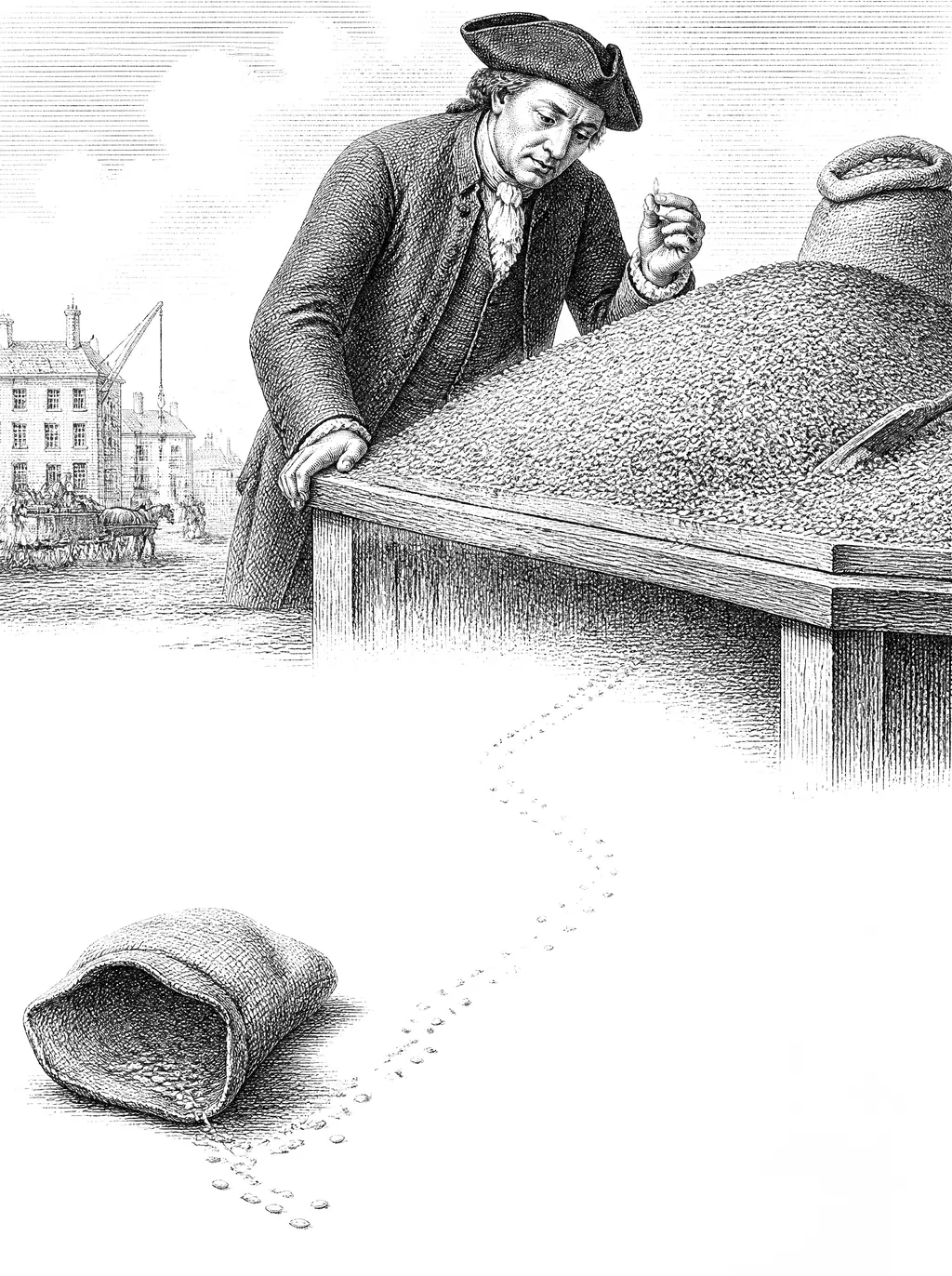
The Heap Paradox
A rule that never breaks, until it does
Eubulides of Miletus built a puzzle out of a rule almost no one would deny: removing a single hair never turns a man from not-bald into bald. Apply that harmless rule once, twice, a thousand times, one hair at a time, and eventually every hair is gone. Somewhere along that path, bald had to arrive. The puzzle is that no single step can be blamed for it. Eubulides would not tell you where. He only needed you to grant the rule and to grant that a hairless man is bald, and then to watch you try to hold both.
The world it came from
Eubulides of Miletus led the Megarian school in the fourth century BC and built puzzles to embarrass Aristotle's logic, which required every statement to be true or false. Sorites comes from soros, a heap, and the original asks how many grains make one. The Stoics inherited the problem and Chrysippus took it more seriously than anyone. Cicero reports that when a sceptic ran him grain by grain up the series, Chrysippus would fall silent before the danger point and refuse to answer further, which the sceptics took as an admission that he could not say where the line fell. The puzzle stayed a weapon in the long war between Stoic dogmatists and Academic sceptics who denied that anything could be known for certain.
The idea
The bald one is a kind of Sorites; pulling one hair out of a man's head will not make him bald, nor two, nor three, and so on till every hair in his head is pulled out. Sorites means heap: grain by grain, no single grain turns a non-heap into a heap, yet a heap plainly exists once enough grains are piled together. The rule that one grain makes no difference is called tolerance, and every vague word seems to obey it. That is the whole engine.
How the reasoning runs
Premise one: one grain of sand is not a heap. Premise two: if some number of grains is not a heap, then one more grain is not a heap either. Apply premise two to premise one and two grains are not a heap. Apply it again: three. Apply it ten thousand times, each application a plain case of if-then, and ten thousand grains are not a heap. But ten thousand grains plainly are. So something is false. Premise one is safe. The rule of inference, modus ponens, is the last thing anyone will give up. That leaves premise two, and denying it means asserting that there is some exact number such that that many grains are not a heap and one more grain is. Nobody believes that either.
Seen in life
You are writing the company's absence policy. Excessive absence is a disciplinary matter, the draft says, and legal asks you to define excessive. One day a year is not excessive; everyone agrees. If some number of days is not excessive, one more day is hardly the difference between fine and fireable. Now pick the number. Whatever you write, twelve, say, you have declared that eleven days is acceptable and the twelfth is misconduct, and the first employee to be disciplined will ask what changed on day twelve. Leave it undefined and managers apply it unevenly. Every threshold in a rulebook, the speed limit, the tax bracket, the age of majority, is a grain that somebody decided must count, and the sorites is the argument that no such grain exists.
Why it matters
This targets an assumption baked into ordinary language: that vague terms like bald, heap, tall, or rich have some hidden sharp boundary, one exact grain or hair where the category flips. The paradox suggests either that no such precise boundary exists, which strains classical true-or-false logic, or that one exists but can never be located, which is nearly as strange. Most words in a natural language behave this way. If classical logic cannot handle them, then either logic covers less of language than it claimed, or language is less coherent than it looks, and both conclusions are unwelcome.
“The bald one is a kind of Sorites; pulling one hair out of a man's head will not make him bald, nor two, nor three, and so on till every hair in his head is pulled out.”
From the source
Diogenes Laertius only lists the puzzle by name among Eubulides's traps; the explanation is his translator's, in a footnote: “The bald one is a kind of Sorites; pulling one hair out of a man's head will not make him bald, nor two, nor three, and so on till every hair in his head is pulled out.” The catalogue is the point: Eubulides had a set of them, and the sorites was the one that the later schools argued over longest. Cicero, in the Academica, describes the Stoic and Academic debate around it, and Galen treated the heap as a standing problem in medicine, where a physician must call a patient feverish or not on a scale that changes by fractions of a degree.
The pushback
Doesn't ordinary life handle this perfectly well without any logical crisis, since everyone manages to use words like bald and heap successfully despite their fuzzy edges? That practical ease is exactly what makes the paradox interesting: the words work fine in daily use, and only fall apart once logic demands a sharp yes-or-no answer at every single step along the way. A further objection: perhaps vagueness is in our knowledge, not in the world. There is a grain that makes the heap; we simply cannot know which, because knowing it would require a precision our words never had.
The reply
No solution commands agreement, and the options are well mapped. Epistemicists, led by Timothy Williamson since the 1990s, take that last objection as the answer: there is a sharp line, classical logic is untouched, and our ignorance of the line is unavoidable. Supervaluationists, following Kit Fine, say a vague word has many acceptable sharpenings, a sentence is true if true on all of them, so there is a line comes out true although no particular line does. Degree theorists, drawing on fuzzy logic, let truth come in fractions, so each step in the series loses a little. Others deny that heaps exist at all. Each view saves the argument at a different point, and each pays by giving up something assumed about truth.
Where it went next
Chrysippus's silence became a proverb. The puzzle slept through most of the medieval period and returned when logic became formal. Russell argued in 1923 that all language is vague and logic applies only to an ideal one. Lotfi Zadeh's fuzzy set theory of 1965 built a mathematics for degrees of membership that now runs in control systems and appliances. Michael Dummett's 1975 paper on Wang's paradox, Kit Fine's supervaluations the same year, and Williamson's Vagueness in 1994 made the topic a major field of philosophy of language. Every legal threshold and every classifier that must output a label from a continuous score inherits the problem, and lawyers and machine-learning engineers both draw the line somewhere and defend it after.
Where this leads
The horned one shows this same restless Eubulides delighting in a very different kind of trap, one built not from vague, fuzzy boundaries at all but instead from a sly, deliberately misleading turn of perfectly ordinary, everyday phrasing about simple possession. The Liar attacks the same classical assumption, that every sentence is true or false, by a different road: not a gradual slope but a single sentence that refuses both values at once. Read side by side, the two puzzles mark the two ways a two-valued logic can fail, by having no place for the middle and by having no place for the loop.