Symposium · Logic & Paradoxes · Pl. 15Lewis Carroll · 1832–1898
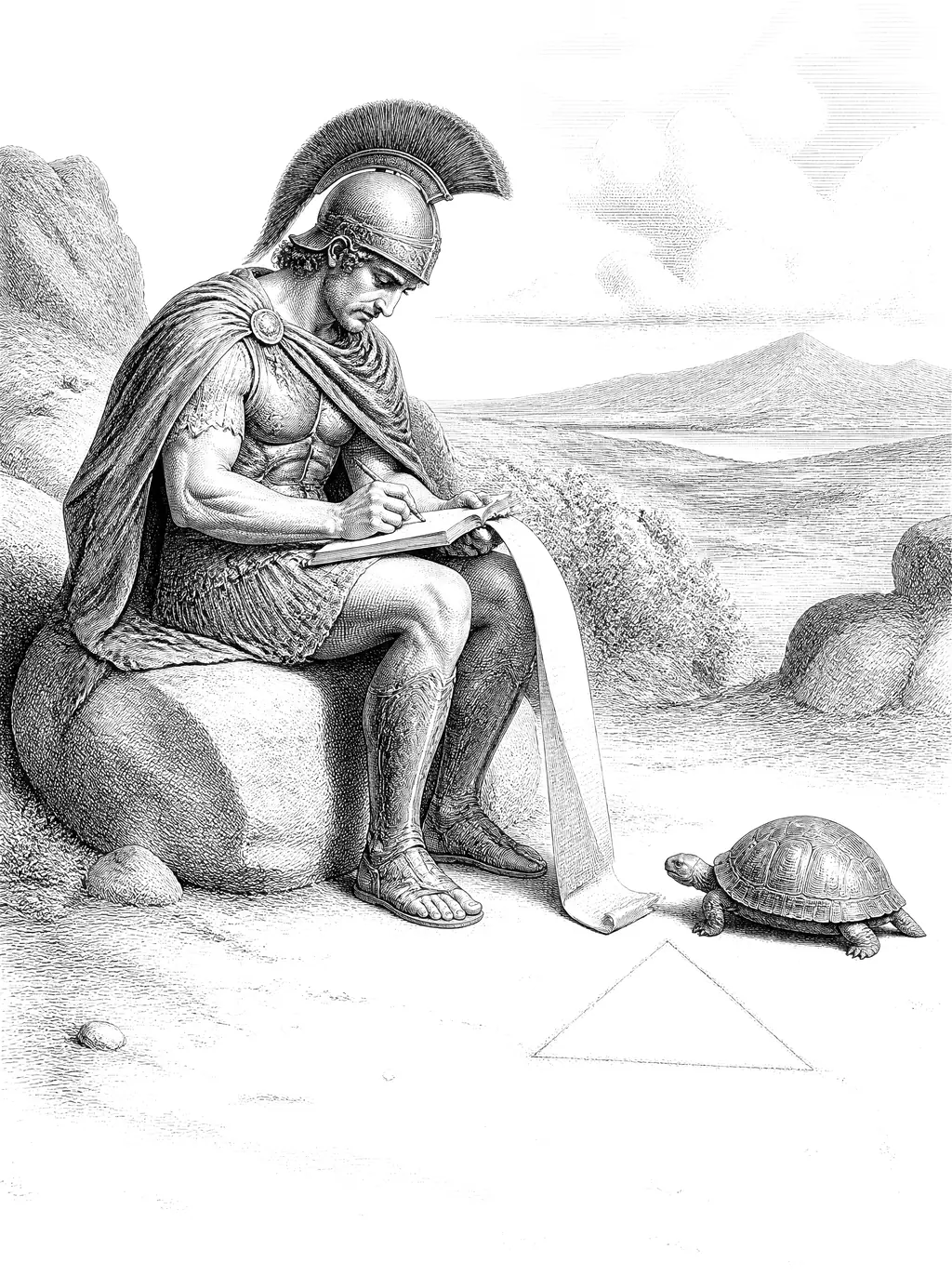
What the Tortoise Said to Achilles
A race Achilles cannot finish this time either
Carroll borrows Zeno's two famous racers for an entirely different kind of chase. The Tortoise happily accepts two simple premises about a triangle, and even agrees the conclusion logically follows from them. Then he asks Achilles for one more thing: force him, logically, actually to accept the conclusion, not merely to agree that it follows. Achilles, confident, takes out his notebook. The dialogue that follows is four pages long, and by the end the notebook holds a thousand and one premises, the Tortoise has accepted every one of them, and the conclusion is still sitting on the table, unaccepted, exactly where it started.
The world it came from
Lewis Carroll was Charles Dodgson, a mathematics lecturer at Christ Church, Oxford, and the dialogue appeared in the philosophy journal Mind in April 1895. He was then writing Symbolic Logic, a textbook meant to make formal reasoning a game. The premises he gives the Tortoise come from the first proposition of Euclid: things equal to the same thing are equal to each other, and the two sides of this triangle are equal to the same thing. Logic itself was being rebuilt around him. Boole had turned it into algebra, Frege had published a new notation in 1879, and mathematicians were asking what, exactly, a proof compels. Dodgson's dialogue is a joke aimed at that question, and the joke has never been answered to everyone's satisfaction.
The idea
Achilles adds the missing link as a new premise, if A and B are true, Z must be true, and asks the Tortoise to accept it. The Tortoise happily writes it down as premise C, and then asks to be forced to accept Z on the basis of A, B, and C together, requiring yet another premise to bridge that gap, and then another, forever. The point is not that the Tortoise is slow. It is that a rule of inference, the thing that carries you from premises to conclusion, cannot be one of the premises. Written down, it becomes another sentence waiting to be used, and something else must do the using.
How the reasoning runs
Set the pieces out. A: things equal to the same thing are equal to each other. B: the two sides of this triangle are equal to the same thing. Z: the two sides are equal to each other. The Tortoise grants A and B. He also grants the hypothetical, that if A and B are true, Z must be true. Call that C. Achilles now has A, B, and C. The Tortoise asks why Z follows. If A, B, and C are true, Z must be true: call that D, and he grants it too. Nothing has changed. Each new premise is a sentence, and a sentence can only sit there. The step from sentences to Z is an act, not another sentence, and no list of sentences performs it.
Seen in life
You have seen the Tortoise in a meeting. The data shows the feature is losing users; everyone agrees. If a feature is losing users, we should cut it; everyone agrees to that too. Then someone says, fine, but does it follow that we should cut this feature? You add a line to the slide: if both of the above hold, we cut it. Agreed. And does that settle it? The trick is that agreeing to a rule is not the same as applying it. A rulebook that only gets longer never decides anything. At some point a person has to stop adding lines and act on the ones already there, and no line in the document can make them.
Why it matters
This exposes a gap between accepting premises and being logically compelled by them that ordinary reasoning quietly glosses over. No matter how many linking premises Achilles adds, the Tortoise can always ask for one more, revealing that the force of logical inference cannot itself be reduced to just another premise sitting inside the argument. That matters for anyone who wants logic to be self-contained. If the rules of a system must be applied from outside the system, then some part of reasoning is a practice rather than a proposition, something you do rather than something you know. Every formal system since has had to keep its rules of inference separate from its axioms, for exactly this reason.
“I want you to consider me as a reader of the second kind, and to force me, logically, to accept Z as true.”
From the source
The Tortoise states his challenge plainly: “I want you to consider me as a reader of the second kind, and to force me, logically, to accept Z as true.” Achilles supplies premise after premise, and the Tortoise accepts each one while still, each time, asking to be forced to draw the conclusion. The readers of the first kind, in the dialogue, accept Z once they accept A and B. Readers of the second kind accept A and B and the hypothetical, and stop there. Carroll gives the last word to the Tortoise, who suggests that Achilles rename himself Taught-Us, and that the Tortoise might be called A Kill-Ease. The puns are the surrender flag. The argument has no ending, so the story gets one instead.
The pushback
Isn't the Tortoise just being willfully obtuse, refusing in bad faith to do what any reasonable person does automatically, draw the obvious conclusion once the premises are on the table? That may be true of the character, but the logical gap he is exploiting, between accepting premises and being compelled by them, is a genuine structural feature of formal inference, not merely stubbornness. A harder objection: the regress only starts if you demand that every step be justified by a premise. Drop that demand and the puzzle dissolves. But then say what does justify the step, and why a Tortoise who will not take it is making a mistake rather than a choice.
The reply
Most logicians accept the lesson and change the bookkeeping. A rule of inference is not a premise; modus ponens lives in a different category from the sentences it operates on, and every formal system keeps its rules on a separate list from its axioms. Gilbert Ryle, in the 1940s, read the dialogue as showing that knowing how to infer is not knowing that some further proposition holds. Quine used the same regress against the view that logic is true by convention: you would need logic to apply the conventions. What remains open is why the Tortoise is wrong. If the rule cannot be stated as a premise, the person who declines to follow it contradicts nothing he accepted, and that part nobody has fully answered.
Where it went next
Quine's 1936 paper on truth by convention leaned on the regress, and Ryle's work on knowing how followed. Wittgenstein's later remarks on following a rule circle the same problem: no rule contains the instructions for its own application. Douglas Hofstadter reprinted the dialogue in full in Gödel, Escher, Bach in 1979 and wrote his own dialogues in its shape. The clearest echo is in computing. A rule stored as data does nothing; a rule engine or interpreter must run it, and the interpreter cannot itself be one more entry in the database it reads. Every programmer who has written a program that reads its own configuration has met the Tortoise's point in practice.
Where this leads
The kitten syllogism shows this same playful Carroll working the opposite side of formal logic entirely, delighting instead in long, whimsical chains of premises that genuinely do force a single, inescapable conclusion out the very other end at long last. Zeno's original race, Achilles and the tortoise, is the other neighbour, and the borrowing is deliberate. Zeno's tortoise stays ahead by dividing distance forever; Carroll's stays unconvinced by dividing inference forever. Both puzzles turn an infinite series of small, reasonable steps into a wall that no finite runner can get past.