Symposium · Stoicism · Pl. 3Cleanthes · c. 330 – c. 230 BC
The Philosopher Who Carried Water
The water-carrier
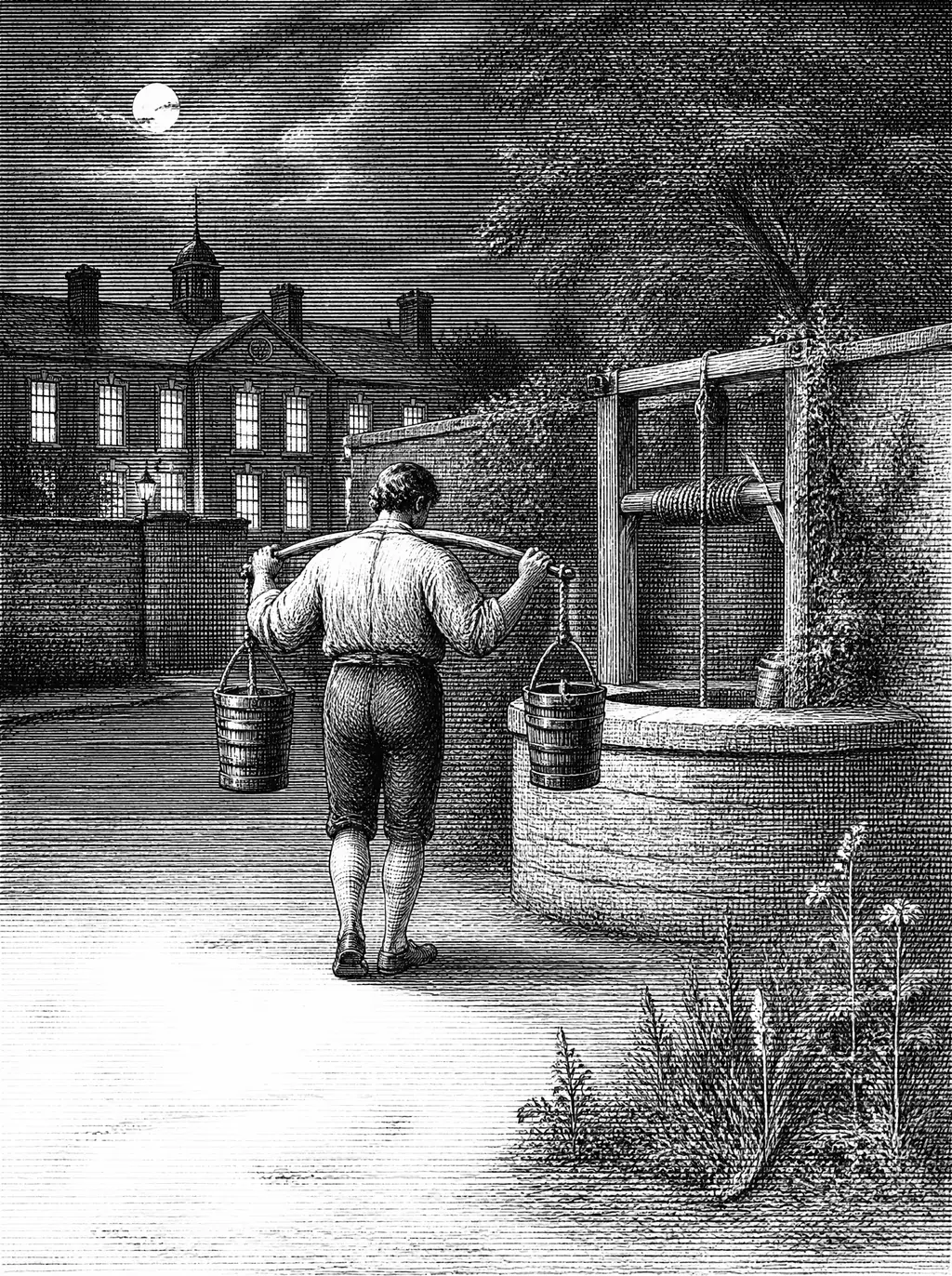
Cleanthes arrived in Athens a former boxer with four drachmas to his name, and attached himself to Zeno's teaching anyway. Too poor to study by day without income, he drew water in gardens by night, then sat in Zeno's classes with no visible means of support, until suspicious officials hauled him into court to explain where his money came from. The officials wanted to know how a man with no visible income managed to stay so healthy. The answer embarrassed nobody but them.
The world it came from
Cleanthes came from Assos, a town on the coast of Asia Minor, and had been a boxer before he reached Athens around 280 BC. He joined the school Zeno had founded on the Painted Porch in the Athenian marketplace, and stayed with it for roughly nineteen years as a student. Athens then was a city of competing schools: Epicurus's garden, Plato's Academy, Aristotle's Lyceum, all within walking distance, all drawing young men who could pay. Cleanthes could not. The Stoics taught that virtue was the only good and that external goods were indifferent. His life was the test of whether the doctrine could be lived by someone who had none of the externals. When Zeno died in 262, the school chose the water-carrier to succeed him.
The idea
Brought before the court, Cleanthes called the gardener and the mealseller he worked for as witnesses, and the judges, astonished, voted him a cash award for his industry. Zeno told him to refuse it. The lesson underneath the story is Stoic to its core: dignity was never in what work paid or how it looked, only in whether it was honestly and thoroughly done. Diogenes Laertius adds a detail that makes the point sharper: Cleanthes was so poor he took notes on ox bones and potsherds because he could not afford papyrus. The school's second head learned its doctrine on scrap.
How the reasoning runs
The reasoning is Stoic through and through, though Cleanthes never wrote it as a syllogism. First: the only real good is virtue, which means acting well from a right judgment. Second: money, comfort, and reputation are indifferent, neither good nor bad in themselves; they can be preferred, but they cannot make a life good or ruin it. Third: if that is true, then the conditions under which you pursue philosophy cannot matter to whether you are a philosopher. Only the pursuit matters. Fourth: so a man who carries water by night and studies by day is not a philosopher despite the water. He is a philosopher in the water, because the water is exactly where the doctrine is being tested, and passing.
Seen in life
You are writing a novel on the train. Forty minutes each way, laptop on your knees, between a shift you did not choose and a flat you share with two people who think the novel is a hobby. The story you tell yourself some nights is that the real writing will start when the circumstances allow: a grant, a room, a year off. Cleanthes says the circumstances are not in the way of the work. The circumstances are where the work is. The novel written on the train is not a lesser novel waiting for a better one. It is the novel, and the train is the proof that you meant it.
Why it matters
It is easy to treat philosophy, or any serious pursuit, as something that requires comfortable circumstances first. Cleanthes inverts that: the water-carrying was not an obstacle standing between him and philosophy, it was the exact discipline that let him keep doing it, and a Stoic education without that discipline attached would have taught him nothing worth learning. Most people postpone the thing that matters until conditions improve, and conditions rarely improve on schedule. The water-carrier removes the excuse. If he could do philosophy on four drachmas and no sleep, the thing you are waiting for is not a condition. It is a decision.
“Do I do nothing beyond drawing water? Do I not also dig, and do I not water the land, and do all sorts of things for the sake of philosophy?”
From the source
Diogenes Laertius records Cleanthes' own answer when a pupil asked why he still drew water: “Do I do nothing beyond drawing water? Do I not also dig, and do I not water the land, and do all sorts of things for the sake of philosophy?” Diogenes also preserves the tone of the man. He was slow and patient, and when the other students called him an ass he said that he alone could carry Zeno's load. Zeno compared him to a hard writing tablet: difficult to write on, but what was written stayed. He led the Stoa for more than thirty years.
The pushback
It is tempting to romanticize hardship as automatically noble, when for most people poverty is simply an obstacle, not a secret teacher. Cleanthes himself was mocked for being slow-witted and called an ass by his fellow students; the story is not that hardship improves everyone; it is that he refused to let his circumstances decide whether he counted as a philosopher. There is a second, sharper version. The Athenian court gave Cleanthes money for his industry, and Zeno told him to refuse it. That looks less like dignity than like a teacher enforcing poverty on a student who could finally have eaten. Doctrine can become a cage.
The reply
On the romance of hardship, the tradition is more careful than the anecdote. The Stoics never said poverty was good; they said it was indifferent, which is different. Cleanthes did not seek the water. He accepted it as the price of the thing he did want, and the story is about the wanting, not the water. On the refused award, the honest reply is partial. Zeno's motive is not recorded; the likeliest is that a philosopher paid by the state for being poor would have become a spectacle, and the school could not afford that. Whether Cleanthes agreed is not recorded either. He stayed, and succeeded Zeno, which is some evidence that he did.
Where it went next
Cleanthes trained Chrysippus, who turned the Porch's teachings into the vast system that later Stoics inherited, so the water-carrier stands between the founder and the philosopher who secured the school. His Hymn to Zeus is the longest surviving piece of early Stoic writing, and his short prayer to fate, lead me, Zeus, and you, Destiny, was still being quoted by Seneca and Epictetus three centuries later. The pattern of his life recurs. Spinoza ground lenses for a living while writing the Ethics. Modern readers who juggle a day job and a vocation reach for Cleanthes because he is the one Stoic who worked nights, and the one whose philosophy was paid for by the hour.
Where this leads
Live according to nature is the doctrine Cleanthes was carrying water to study, and later carried forward as Zeno's own successor, proof that the principle survived contact with an actual poor student's actual nights, rather than staying a comfortable idea for comfortable people. The dichotomy of control explains why the court and the mealseller could not touch him: his income was theirs to decide, his study was his, and he never once confused the two. That is the whole of Stoic ethics in a single biography, and it is why the later Stoics, who mostly had money, kept telling his story.