Symposium · Stoicism · Pl. 9Zeno of Citium · c. 334 – c. 262 BC
Live According to Nature
A shipwreck and a bookshop
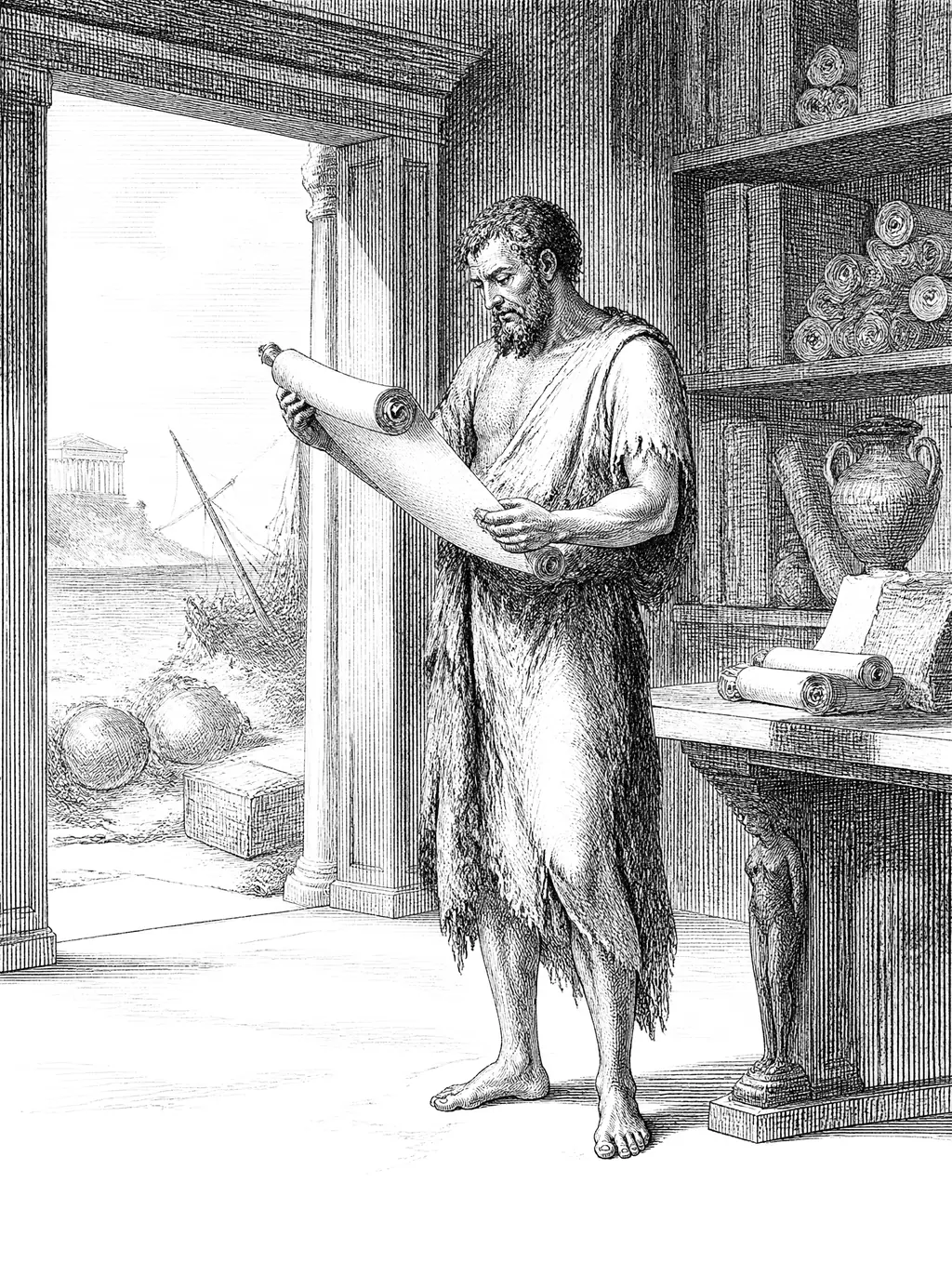
Zeno was a merchant from Citium whose cargo went down in a wreck off the coast of Greece. Left with nothing, he wandered into Athens, found a bookshop, and picked up a volume on Socrates. He asked the shopkeeper where to find men like that. The shopkeeper pointed at a passer-by, and Zeno's second life, as founder of Stoicism, began there. The passer-by was Crates the Cynic. The philosophy that grew from that meeting outlasted Athens, Rome, and most of what came after them.
The world it came from
Zeno came from Citium on Cyprus, a city with a Phoenician population, and arrived in Athens around 312 BC, a decade after Aristotle's death. The city was full of rival schools: Plato's Academy, Aristotle's Lyceum, and, from 306, Epicurus's garden, which taught that pleasure was the goal of life. Zeno studied with Crates the Cynic, who held that convention was worthless and only virtue counted, and then with the Megarians and the Academy. Around 301 he began teaching on the Painted Porch in the marketplace, the Stoa Poikile, and the school took its name from the building. His answer to Epicurus was a rival account of the goal: not pleasure, but a life in agreement with the rational order of the world.
The idea
Zeno taught that the chief good, the single aim worth organizing a life around, is to live according to nature. This means living according to your own rational nature and in step with the nature of the whole universe at once, since the two are not separate systems but one system seen from two sizes, your own reason being nature's clearest tool inside you. The formula is compact because it is meant to be carried. Ask, of any act, whether it agrees with reason, and you have asked whether it agrees with nature, since nature in you is reason, and nothing else is.
How the reasoning runs
The argument runs from what a living thing is for. Every creature, the Stoics observed, is born attached to its own constitution: a plant reaches for light, an animal seeks what preserves it and flees what harms it. That is nature's first instruction, and it is not chosen. In a human being, reason develops on top of instinct, and once it has developed, reason itself becomes the thing the human is attached to. So nature's instruction to a human is: live by reason. Now, reason in you is the same reason that orders the whole cosmos, on the Stoic view. So to live by your own reason is to live in agreement with the whole. Virtue is the name for doing this consistently.
Seen in life
You are standing in the supermarket with a choice between the thing you want and the thing you know. The instinct is old: sugar, now. The knowledge is newer: what this does to a body over years, what it does to a mind that always chooses now. Zeno would say both are natural, but not equally. Instinct was nature's instruction to you at two. Reason is nature's instruction to you at forty, and the second was always meant to take over from the first. Living according to nature here does not mean obeying the craving because it is natural. It means doing the thing a rational animal does when it can see the whole shelf, and the whole decade.
Why it matters
This gives Stoicism its foundation stone: every later Stoic idea, the dichotomy of control, amor fati, the discipline of desire, is really just this single principle worked out into daily practice. Reason is how nature operates in a human being, so a life run by clear reason, rather than by appetite or fear, is simply a life in agreement with the way things actually are. It also explains why Stoic advice never quite sounds like self-help. The reason you should do the right thing is not that it will make you feel better, though it often does, but that it is what a being like you is for.
“Zeno was the first writer who, in his treatise on the Nature of Man, said, that the chief good was confessedly to live according to nature; which is to live according to virtue, for nature leads us to this point.”
From the source
In his Lives of Eminent Philosophers, Diogenes Laertius records the doctrine directly: “Zeno was the first writer who, in his treatise on the Nature of Man, said, that the chief good was confessedly to live according to nature; which is to live according to virtue, for nature leads us to this point.” Diogenes goes on to explain the phrase: the nature we must follow is both our own and the nature of the universe, and the virtue of a happy person is a life in which everything is done in agreement with the reason that pervades all things. He adds that Cleanthes and Chrysippus each refined the wording, which is how a slogan becomes a doctrine.
The pushback
"Live according to nature" can sound like it licenses whatever feels natural, including cruelty or laziness, since those occur in nature too. Zeno's Stoics meant something narrower: nature specifically as rational order, not nature as raw instinct, so living by it means living by reason's demands, which often run directly against instinct rather than excusing it. A more modern objection cuts deeper. Since Hume, philosophers have doubted that any is can yield an ought. Even if nature does run on reason, why should the way things are tell you how you should live? Describing the cosmos correctly is one job. Deciding what to do is another.
The reply
Zeno's reply to the instinct objection is built into the doctrine: the nature you follow is your developed nature, which is rational, and reason overrides instinct whenever the two conflict. Cruelty occurs in nature; so does the reason that condemns it, and only the second is yours to follow. The is-ought objection is harder, and the tradition's reply is only partial. The Stoics did not separate fact and value in the modern way; for them the cosmos was rational and good by its constitution, so describing it correctly already told you what to do. Reject that picture and the formula loses its metaphysical support. What survives is the narrower claim that a rational creature does best by using its reason, which most readers still accept.
Where it went next
Zeno's students carried the formula for five centuries. Cleanthes and then Chrysippus refined it; Cicero explained it to Rome in On Ends around 45 BC; Seneca, Epictetus, and Marcus Aurelius lived by it. Its longest afterlife was in law. The Stoic idea that reason is a law of nature binding on everyone, everywhere, passed through Cicero and the Roman jurists into the natural law tradition, and from there into Aquinas in the thirteenth century and the founding documents of the modern republics. The phrase itself is still argued over. Every dispute about what is natural for human beings, from diet to sexuality to work, is fighting over the ground Zeno marked out, usually without knowing whose it was.
Where this leads
Cleanthes, Zeno's own student, spent years drawing water by night to fund his study of exactly this principle, proof that living according to nature was meant as a daily discipline for a poor man, not a slogan admired from a comfortable distance by everyone else. The dichotomy of control is the same formula turned inward. Living according to nature means, in practice, keeping your reason on what reason can move and leaving the rest to the whole, which is what Epictetus was teaching four centuries later when he told his students to sort the world into what is up to them and what is not.