Symposium · Stoicism · Pl. 4Epictetus · c. 55–135 AD
The Dichotomy of Control
A slave who was free
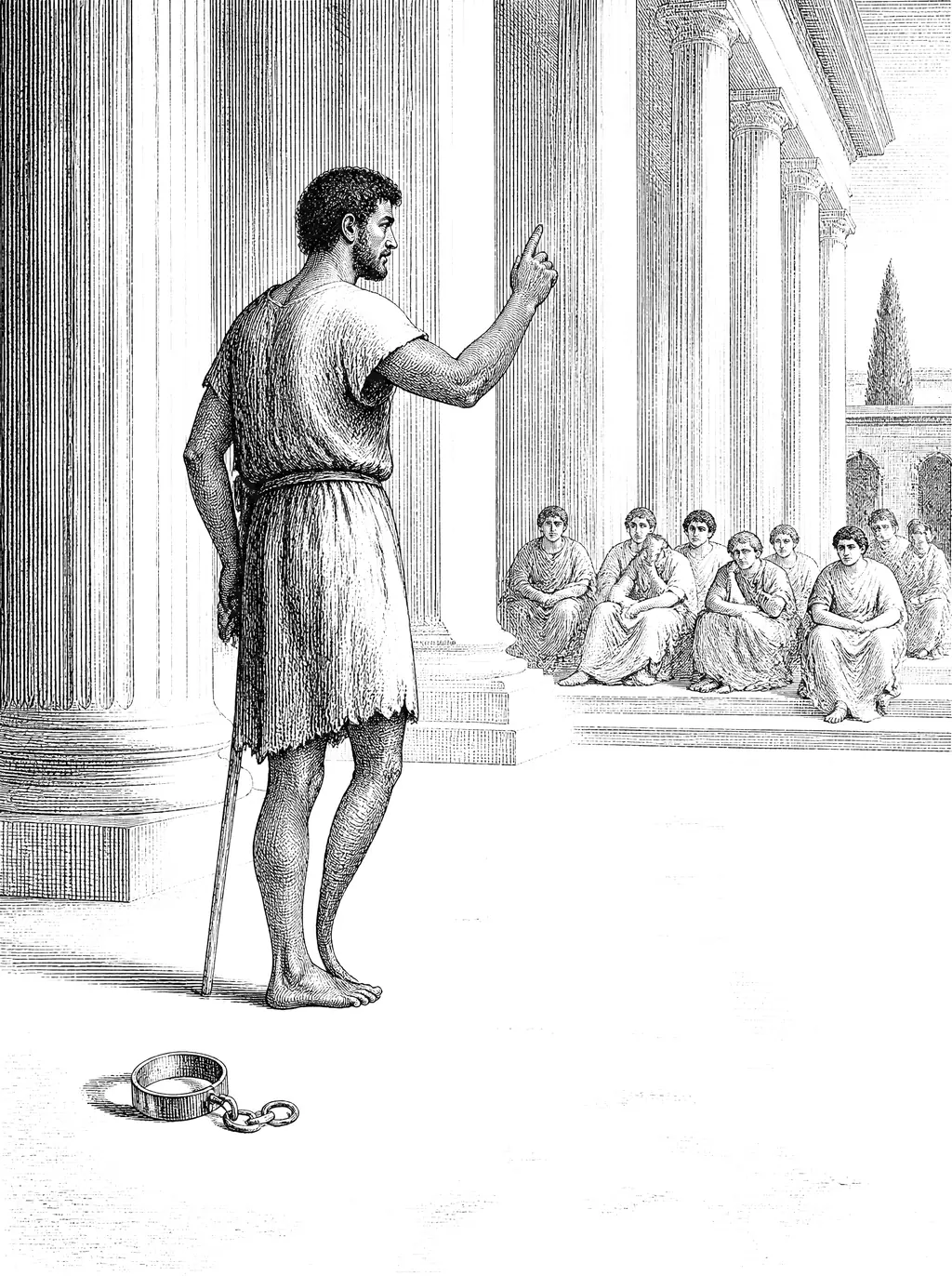
Epictetus was born a slave in the Roman empire. His master, a freedman of Nero, could beat him, sell him, or break his leg, and one ancient story says he did exactly that. Epictetus limped for the rest of his life. He also became, by the account of those who heard him teach, the freest man in Rome. Not free from pain, poverty, or exile: he suffered all three. Free in the only sense he thought could not be taken from him. His secret was a single distinction, drawn once and then applied to everything, every day, until it became a reflex.
The world it came from
Epictetus grew up in Rome under Nero, owned by Epaphroditus, one of the emperor's own freedmen. While still enslaved he was allowed to study with Musonius Rufus, the leading Stoic teacher of the day. He was freed, taught in Rome, and then lost even that: around 93 AD the emperor Domitian expelled the philosophers from the city, and Epictetus moved to Nicopolis in western Greece and opened a school there. He wrote nothing down. His student Arrian recorded the lectures that became the Discourses and the Enchiridion. The problem he was answering was practical: how does a person stay sane and decent under an emperor who can take anything, from anyone, at any time?
The idea
Divide everything into two classes: what is up to you, and what is not. Your judgments, your desires, your impulses to act, and your refusals are up to you. Your body, your property, your reputation, and your office are not. That is the whole distinction. The first class is by nature free, unhindered, and yours. The second is weak, servile, and belongs to others, however much effort you pour into it. Epictetus opens the Enchiridion with exactly this sorting and treats everything that follows as commentary on it. Freedom is not getting what you want in the second class. It is refusing to let the second class decide anything that lives in the first.
How the reasoning runs
Start with a fact: no amount of wanting makes your body immune to illness or another person's opinion of you obedient. So those things are not yours. Next, notice what is: whether you assent to an impression, whether you want something, whether you act. Nobody can reach inside and do those for you. Third step: distress comes from wanting what is not yours to secure, because such wants can always be frustrated. Fourth: a want aimed only at what is yours cannot be frustrated by anyone else. Therefore, if you keep desire inside the first class and treat the second class as material to work with rather than something to demand, you become impossible to enslave, whatever happens to your body.
Seen in life
You send the application on Tuesday. By Friday you have checked your inbox forty times, rewritten the cover letter in your head, and decided the silence means rejection. Run the sort. The quality of the application was yours: the research, the honesty, the care. It is done, and it was good. Whether a stranger reads it before lunch, what mood she is in, how many other candidates applied, whether the role is quietly filled by a cousin: none of that was ever in your class. You cannot move it by refreshing the page. What remains yours today is the next application, and the way you spend the afternoon. That is where Epictetus tells you to put your attention.
Why it matters
Suffering comes from staking your peace on things outside your control. Move the stake. Care intensely about your choices, and hold everything else loosely. This is not a counsel of low ambition. You can still want the promotion, the recovery, the reconciliation; you simply stop making your composure depend on getting them. The practical payoff is enormous. Most of the energy people spend each day goes to rehearsing outcomes they cannot influence: what someone will say, how a vote will go, whether the scan will be clean. Redirect that energy toward the one thing that is always available, your next action, and you recover both your peace and a surprising amount of effectiveness.
“Men are disturbed not by things, but by the views which they take of things.”
From the source
The Enchiridion is a short handbook compiled by Arrian from the lectures. The dichotomy itself opens chapter 1; its fifth chapter states the corollary: “Men are disturbed not by things, but by the views which they take of things.” — Epictetus, Enchiridion, 5. Epictetus goes on with an example that has lost none of its force. Death is nothing terrible, or Socrates would have thought so; what is terrible is the opinion that death is terrible. So when we are hindered or grieved, he says, we should never blame others, but only our own opinions. To blame others is the mark of an uneducated person. To blame yourself is the beginning of education. To blame neither is the finished work.
The pushback
Critics say this breeds passivity: if outcomes are not up to you, why act? The Stoic reply: action is exactly what is up to you. Only the result is not. But the pushback does not stop there. The split looks too clean, since almost nothing falls wholly into either class: you cannot control your health, but you can eat well and sleep; you cannot control your reputation, but your conduct shapes it. Filing every partial influence under “not up to you” seems to hand the world away too cheaply. And there is a political edge. A philosophy that tells slaves and subjects to find freedom inside their own heads is exactly the philosophy a master would want them to hold.
The reply
Take the objections in turn. Passivity: Epictetus never told anyone to stop acting; he told them to act with reservation, doing everything in their power while adding, silently, “if nothing prevents it”. Partial influence: the Stoics called health, wealth, and reputation preferred indifferents, worth pursuing, worth working for, never worth staking your peace on. Eat well, and do not despair when you fall ill anyway. The political objection is the one the tradition answers least well. Epictetus's freedom is real, and it has steadied prisoners and the dying, but it is not the same thing as liberation. A reader is right to want both, and to notice that the Enchiridion offers only one.
Where it went next
Marcus Aurelius read Epictetus in notes lent to him by his teacher Rusticus, and the Meditations are soaked in the distinction. Christian monks copied the Enchiridion and adapted it for the cloister, swapping Socrates for Paul. Eighteen centuries later the distinction became a therapy. Albert Ellis, founder of rational emotive behavior therapy in the 1950s, quoted Enchiridion 5 as the basis of his method, and Aaron Beck's cognitive behavioral therapy rests on the same claim: it is your interpretation, not the event, that you can work on. James Stockdale, shot down over Vietnam in 1965, credited Epictetus with getting him through seven years in a prison camp. The Serenity Prayer says it in three lines.
Where this leads
Amor fati asks you to go further: not only accept what you cannot control, but love it. The dichotomy sorts the world into two piles and tells you which one to care about. Marcus Aurelius picks up the pile you were told to hold loosely and asks a harder question: what if you welcomed it? The discipline of desire and the inner citadel both grow from the same root, one turning the distinction into a daily training of what you want, the other into a place to stand when the outer class turns hostile. Read them as three angles on one move: the same line, drawn between what is yours and what is not.