Symposium · Pragmatism · Pl. 2John Dewey · 1859–1952
Active, Persistent, and Careful
Not all thinking is thinking
Dewey distinguishes idle daydreaming, half-examined belief, and simple imaginative wandering from something rarer and more disciplined: reflective thought, deliberately triggered by genuine doubt and sustained by a real effort to examine a belief's grounds rather than simply accepting or rejecting it on impulse. Watch your own mind for a minute and you will see what he means. Most of it is drift: a memory, a worry, a scrap of a song, a plan for lunch. None of that is wrong, but none of it is thinking in his sense. Thinking starts when something stops you, and you decide not to walk past it.
The world it came from
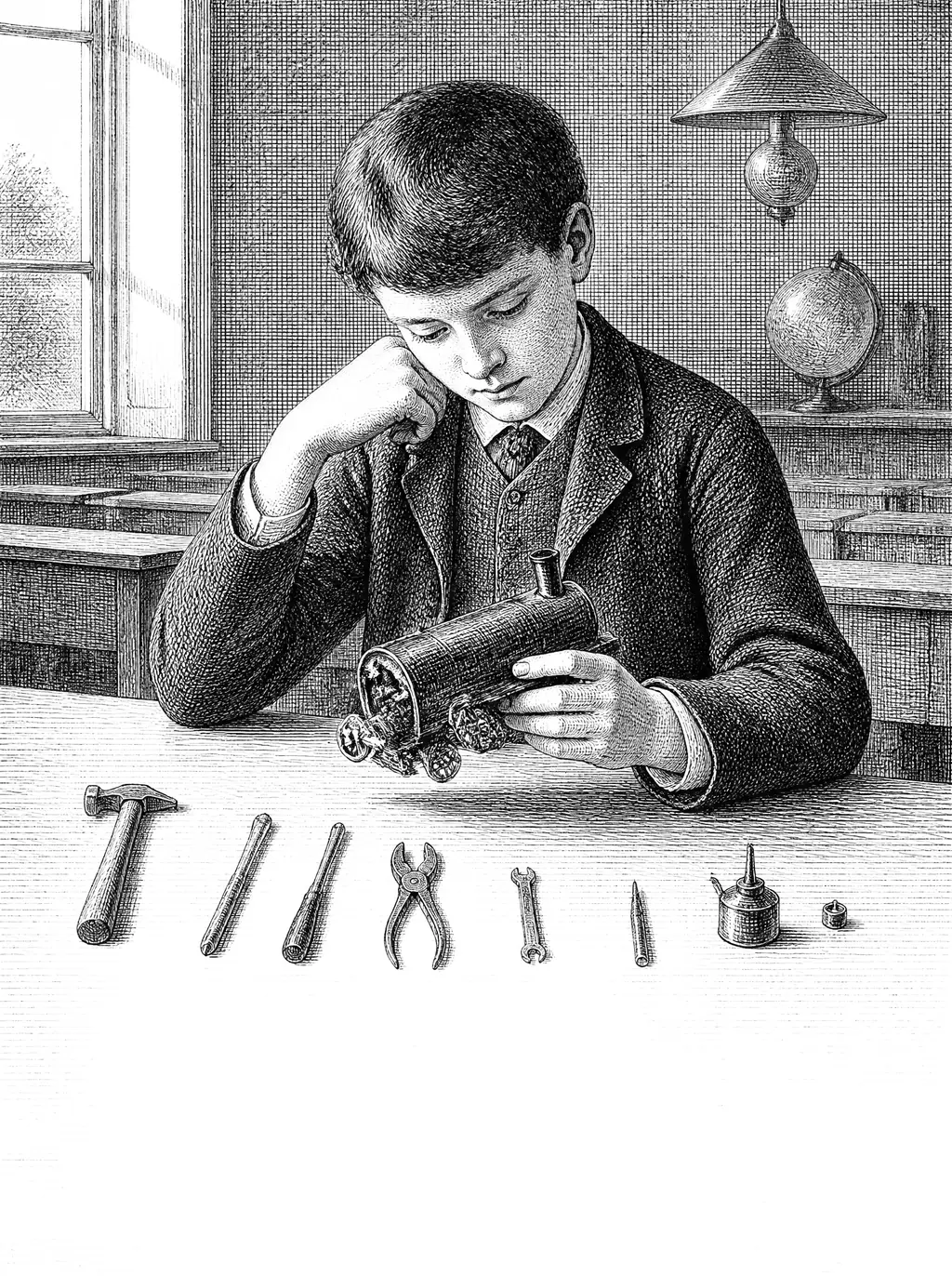
How We Think was published in 1910, when Dewey was fifty and had been at Columbia for six years. Behind it lay the Laboratory School he had run at the University of Chicago from 1896 to 1904, where he and his wife Alice tested the idea that children learn by pursuing problems rather than by memorizing answers. The book was written for teachers. Dewey's targets were the recitation method, in which pupils repeated what the book said, and the psychology of faculties, which treated thinking as a muscle to be exercised on any material. His problem was practical: if thinking is a skill, what exactly is the skill, and how do you teach it?
The idea
Active, persistent, and careful consideration of any belief or supposed form of knowledge in the light of the grounds that support it, and the further conclusions to which it tends, constitutes reflective thought. This kind of thinking is deliberately chosen and sustained, unlike the passive stream of associations that fills most ordinary mental life without any such discipline. Each adjective in the definition does work. Active: you go looking for grounds instead of waiting for them. Persistent: you stay with the question past the first comfortable answer. Careful: you check the belief against what it implies, not only against where it came from. Reflective thought looks both ways, backward to evidence and forward to consequences.
How the reasoning runs
Step one: thinking begins in a felt difficulty, a situation where habit fails. Step two: the difficulty must be located and defined; a vague unease becomes a question. Step three: possible solutions suggest themselves, and here the mind leaps. Step four: each suggestion is developed by reasoning, working out what would follow if it were true. Step five: the most promising is tested, by observation or experiment, and accepted, rejected, or revised. Dewey's claim is that these five phases are not a method imposed on thinking from outside. They are what thinking is, whenever it is reflective rather than idle, the same in a child and a scientist. Teaching thinking means giving pupils real difficulties and letting them run the sequence.
Seen in life
You are a new manager and one of your reports has stopped speaking in meetings. The unreflective responses are ready: disengaged, shy, fine. Dewey would have you stop at the felt difficulty and define it. What changed, and when? Three suggestions surface: a conflict with a colleague, a workload she is hiding, a new hire who talks over her. You work out what each would imply. If it is workload, her tickets will show it; if it is the new hire, the silence will track his attendance. You look. The tickets are normal, and she goes quiet only when he is in the room. Now you have a belief that earned its place. That sequence, felt difficulty to tested conclusion, is the whole book in an afternoon.
Why it matters
This gave educators a concrete, teachable definition of genuine thinking, distinct from memorization or passive belief, and made reflective thought itself the central goal of Dewey's influential theory of education. It shaped classroom practice by treating disciplined inquiry, not mere information transfer, as the actual purpose of schooling. For you the value is a self-check. When you believe something, ask whether you arrived by the five phases or by drift. Most beliefs arrive by drift, which is fine for lunch and fatal for decisions. Dewey's definition tells you what it would take to turn a drifting belief into a reflective one, and it is never more than a difficulty honestly stated and a test honestly run.
“Active, persistent, and careful consideration of any belief or supposed form of knowledge in the light of the grounds that support it, and the further conclusions to which it tends, constitutes reflective thought.”
From the source
Dewey states his working definition of reflective thought directly: “Active, persistent, and careful consideration of any belief or supposed form of knowledge in the light of the grounds that support it, and the further conclusions to which it tends, constitutes reflective thought.” Ordinary belief, by contrast, is accepted with far less scrutiny. The definition opens the first chapter. Dewey later illustrates it with three cases drawn from students' own reports: a man working out how to reach an appointment on time, a passenger wondering what a long pole on a ferryboat's deck is for, and someone puzzling over the bubbles that formed around tumblers being washed. Each moves from a puzzle to a tested conclusion, and none uses the word logic. Dewey revised the book substantially in 1933.
The pushback
Isn't demanding this much deliberate scrutiny for every belief simply impractical, given how many judgments people must make quickly, on habit or instinct, just to function through an ordinary day without pausing to interrogate each one? Dewey's answer is that reflective thought is reserved for beliefs genuinely in doubt, not a standard meant to apply to every routine judgment. The harder objection is that the five phases describe how thinking looks after it has succeeded, not how it happens. Real problem-solving is messier: suggestions arrive before the difficulty is defined, tests get run on hunches, and the felt difficulty is often only recognized in hindsight. If the sequence is a tidy reconstruction, teaching it as method may teach pupils to fake the record rather than to think.
The reply
Dewey conceded the point in the 1933 revision. The phases, he wrote there, are not fixed steps in a set order; any one can be expanded, two can merge, and the sequence often runs back on itself. What he kept was the claim that reflective thought has these five kinds of work in it somewhere, and that a thinker who skips one has not finished. That saves the account as a description of what complete thinking contains. It weakens it as a recipe, and Dewey's followers in education often lost the distinction. The honest reply is that the book gives a standard for judging whether thinking has happened, not a procedure guaranteed to produce it, and Dewey was clearer about that at seventy-four than at fifty.
Where it went next
How We Think became the foundation of progressive education. The five phases reappeared as the scientific method taught in American schools, a formula Dewey had not intended. His Logic: The Theory of Inquiry in 1938 restated the account for philosophers, replacing felt difficulty with the indeterminate situation. Within psychology, the problem-solving tradition from Karl Duncker to Herbert Simon owes it a debt. The critical-thinking movement of the 1980s took Dewey's definition of reflective thought as its charter; Robert Ennis and Richard Paul both cite it. Design thinking's loop of define, ideate, prototype, and test is the five phases in new clothes. Every classroom that gives pupils a real problem before a textbook answer is running Dewey's experiment from 1896.
Where this leads
The irritation of doubt shows Charles Peirce supplying the psychological starting point Dewey's whole account of reflective thinking presupposes, describing the felt discomfort of genuine doubt as the actual trigger that gets this demanding, disciplined kind of thought going in the first place. Philosophy recovers itself is the same argument at the scale of a civilization. There Dewey asks what philosophy should do once it stops chasing Ultimate Reality, and answers: clarify the felt difficulties of its own age. How We Think is that program for one mind; Reconstruction in Philosophy is it for a whole culture. Read them together and the ambition becomes clear.