Symposium · Aesthetics · Pl. 5John Dewey · 1859–1952
The Enemy of Art Is the Humdrum
No wall around the museum
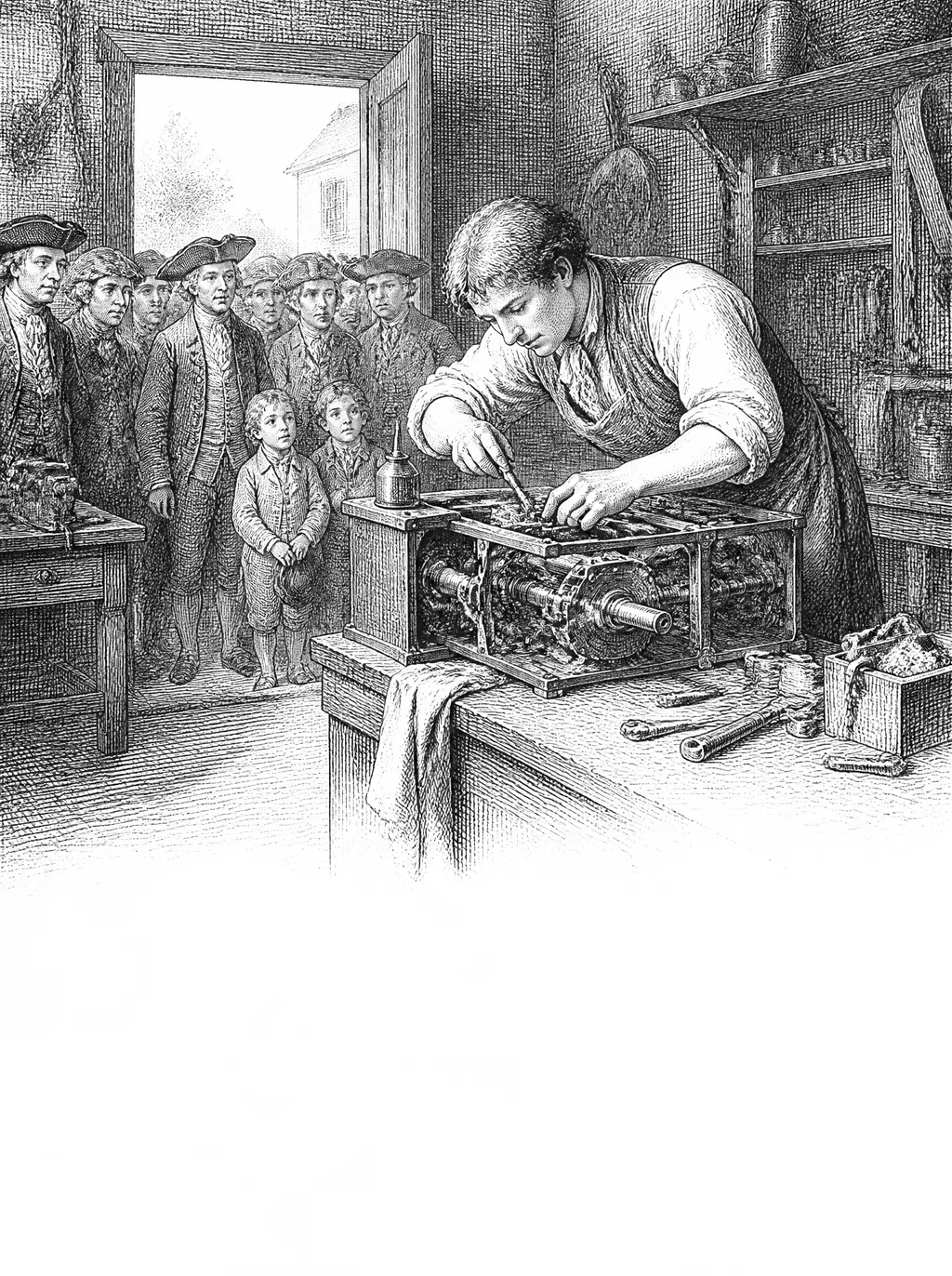
Most aesthetic theory before Dewey drew a sharp line between fine art, framed and hung in galleries, and ordinary experience, the daily business of working, cooking, and getting through the day. Dewey rejected that wall outright, arguing that the aesthetic quality prized in great paintings is a quality any well-formed experience can reach. His examples are pointed: a crowd around a fire engine, a mechanic absorbed in an engine, a ball game watched by people who care. He asks why the same people who feel those things go cold in a museum, and answers that the museum, not the people, has cut art off from the soil it grows in.
The world it came from
John Dewey gave the lectures that became Art as Experience at Harvard in 1931 and published the book in 1934, at seventy-four, after a career as America's leading philosopher of education and democracy. He dedicated it to Albert Barnes, the chemist and collector who had taught him to look at Cézanne and Renoir and whose foundation in Pennsylvania hung paintings beside ironwork and furniture. The book came out in the Depression, when the gap between fine art and working life was politically raw. Behind it stood Dewey's pragmatism: an organism lives by interacting with its environment, and thought is a phase of that interaction, not a spectator of it. Aesthetics, he thought, had been ruined by the same spectator theory that had ruined epistemology.
The idea
Aesthetic experience is continuous with ordinary living rather than sealed off in galleries and concert halls, a quality any activity can reach when it is done with full attention and carried through to a satisfying completion. What kills art, on this view, is not the wrong subject matter but a dulled, distracted, half-finished way of doing anything at all. Dewey's key phrase is having an experience, with the stress on the article. Most of life runs on without shape; things happen and are dropped. Sometimes an episode gathers itself, moves through tension to a close, and stands out afterward as that meal, that storm, that argument. That completeness is the aesthetic quality. Art is the practice of making objects that produce it on purpose.
How the reasoning runs
The argument begins with biology rather than galleries. A living creature is in constant exchange with its surroundings, falling out of balance and recovering it. Second: when a recovery is achieved, not merely undergone, the creature feels the rhythm of loss and restoration as satisfaction. That is the root of the aesthetic, and it is present in animals and children. Third: an experience in the full sense is one such rhythm carried through to completion, with a beginning, a development, and a consummation that unifies it. Fourth: works of art are objects made to induce exactly this, refining and intensifying what ordinary experience already contains. Therefore the gallery is not where art lives but where it is stored, and the enemy of art is anything that breaks experience into fragments.
Seen in life
Think of the best meal you ever cooked for people. Not the most expensive: the one where the shopping, the chopping, the near-disaster with the sauce, the moment everyone went quiet at the first bite, and the last glass on the step outside all belonged to one arc. You can still tell it as a story with a shape. Now think of the two hundred dinners you have eaten this year over a phone. They are not bad; they are nothing. Dewey would say the first evening was an experience and had the same quality a painting has, a whole with a felt beginning and end. The others were the humdrum. The difference was not the food. It was whether anything came to completion.
Why it matters
This dismantled the sharp wall between fine art and ordinary experience that museum culture had carefully built up over centuries, arguing that the aesthetic quality prized in paintings is available in far more of daily life than the art world usually admits. It reframed aesthetics as a question about experience itself, not which objects deserve a frame. It also turns aesthetics into a political complaint. If the aesthetic is the felt completeness of experience, then work that fragments the day into meaningless pieces, and leisure that only numbs, are aesthetic injuries done to whole populations. Dewey wanted the question of what art is to become the question of what kinds of lives let experience come to fullness, and he thought a democracy had to answer it.
“The enemies of the aesthetic are neither the practical nor the intellectual.”
From the source
Dewey names the real obstacle to aesthetic experience plainly: “The enemies of the aesthetic are neither the practical nor the intellectual.” The true enemies, he goes on to argue, are the humdrum, the merely routine, and any activity broken into loose, disconnected parts that never build toward one unified experience. The line comes from the third chapter of Art as Experience, titled 'Having an Experience', which is the chapter most readers begin with. Dewey there contrasts the humdrum with two other failures: slackness, where nothing is carried through, and rigid submission to convention, where the form is imposed rather than grown. Art, he says, lies between them.
The pushback
Doesn't this stretch the word art so wide it stops doing useful work, letting nearly any well-executed task count equally alongside a symphony or a painting hanging in a gallery? Dewey's defenders reply that this is precisely his point: the value normally reserved for fine art is not a special substance found only in museums. A harder objection is that completeness is the wrong criterion. Much of the art that matters most refuses to resolve: an open ending, an unresolved chord, a poem that breaks off. If the aesthetic is consummation, then Beckett and late Beethoven are failures, and the satisfying dinner outranks them. Dewey's theory seems to reward the rounded-off at the expense of the difficult.
The reply
To the stretching charge, Dewey says the alternative is worse: a definition that excludes the ball game and the well-made chair has already lost contact with what art is for. Difference of degree is not absence of difference, and a symphony intensifies what the dinner only touches. The consummation objection is harder, and his answer is partial. Consummation, for Dewey, is not a happy ending but a felt closure of the whole; an unresolved chord can complete an experience whose meaning is irresolution. That handles Beckett better than the objection assumes. What it does not handle well is art whose point is to fragment experience deliberately, to refuse any whole at all. Dewey can describe such work only as a failure or a covert success, and neither fits.
Where it went next
Art as Experience became the founding text of pragmatist aesthetics. Through Barnes it shaped how a generation of American educators taught looking. Abstract Expressionists read it; Robert Motherwell called it one of his bibles, and Allan Kaprow cited it as the source of the Happening, art staged as an event rather than an object. Richard Shusterman's Pragmatist Aesthetics (1992) revived the book for philosophy and extended it to rap and popular art. Its refusal to separate art from life echoes in relational aesthetics and in the everyday aesthetics of Yuriko Saito. Critics, notably from the analytic side, have said the theory is vague about what makes one experience better than another, and that objection has never quite gone away.
Where this leads
Significant form shows Clive Bell, writing two decades earlier, taking almost the opposite tack, insisting that visual art is unified by one specific formal quality rather than by any continuity with ordinary life, a sharp disagreement about where exactly the aesthetic actually lives. To see clearly is poetry is the nearer ancestor. Ruskin said the greatest thing a soul does is to see and report plainly; Dewey said the aesthetic lives in any experience carried through with full attention. Both locate the value in the quality of engagement, not in the object's rank. Ruskin trained the eye. Dewey widened the lesson to the whole of a life.