Symposium · Philosophy in Fiction · Pl. 5Plato · c. 428–348 BC
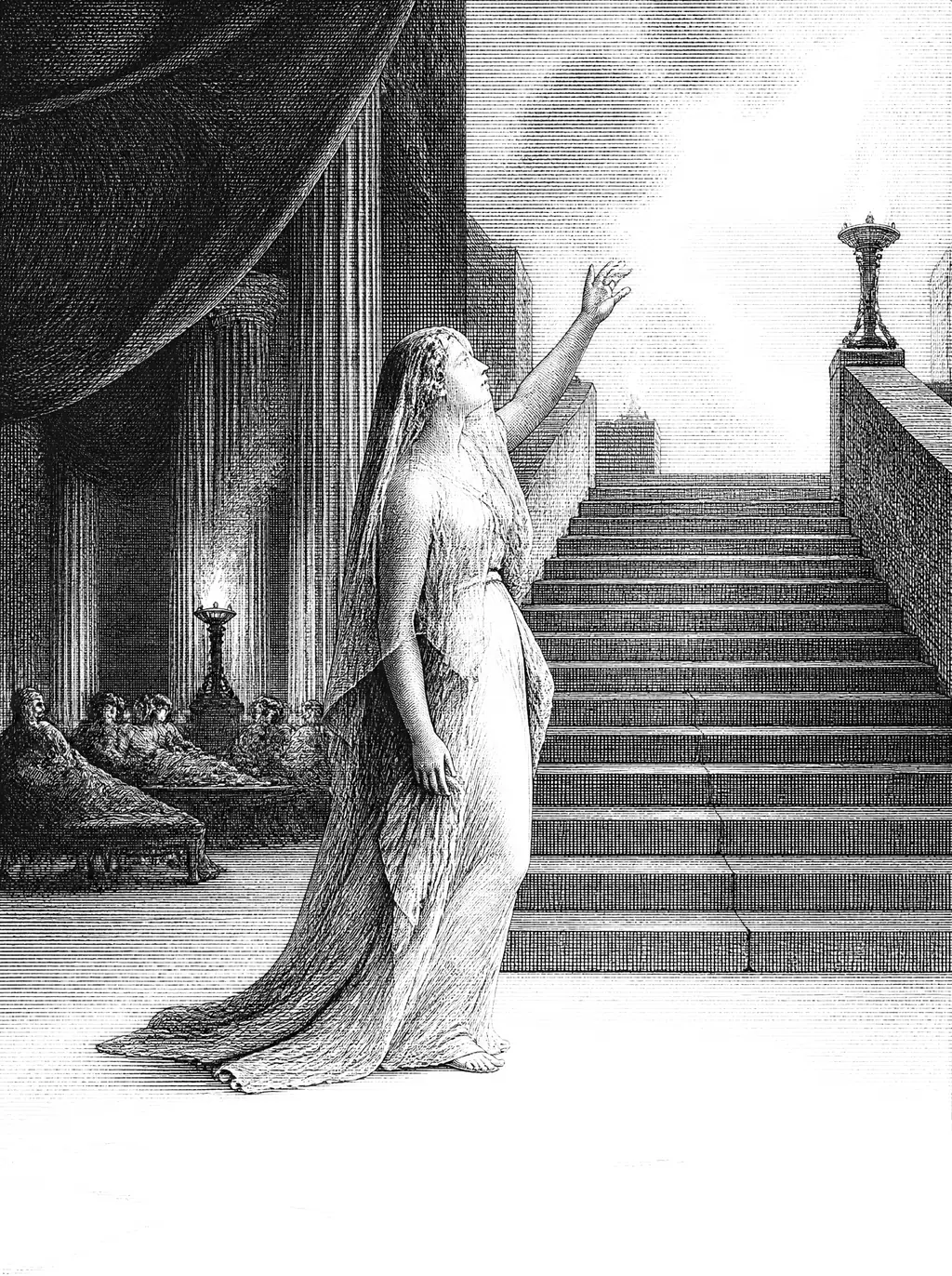
Diotima's Ladder
A ladder that starts in the bedroom
Socrates, asked at a drinking party to praise love, will not speak in his own voice. Instead he reports a lesson given to him years earlier by a priestess from Mantinea called Diotima, who told him he had understood love backwards. Love is not a god and not a possession, she said. It is a lack that reaches, and what it reaches for is not finally a person at all. Diotima then lays out a sequence of steps, from one attractive body to the beauty every beautiful thing has in common. The whole speech is Plato's, delivered by a woman who may never have existed.
The world it came from
The Symposium, written around 385 BC, stages a dinner in Athens where six men take turns praising Eros. A doctor speaks, a comic playwright speaks, a tragedian speaks. Socrates goes last and hands the floor to Diotima, a priestess whom no other ancient source mentions and whom most scholars take to be Plato's invention. She is a woman in a room of men, absent from it, quoted rather than present, and she is the only speaker Socrates never contradicts. Then Alcibiades bursts in drunk to complain that Socrates would not sleep with him. The dialogue puts the ladder and the rejected lover on the same page, and leaves them there.
The idea
Diotima's ladder has rungs, and the climb matters more than any single one of them. You begin by loving one beautiful body. You notice that a second body carries the same quality, so you learn to love beautiful bodies as a class. Then beauty of soul, which outlasts a face; then beautiful practices and laws; then the beauty of knowledge; and finally beauty itself, unmixed, not a face and not a law, but whatever made each earlier rung worth climbing. At the top you are no longer in love with anyone in particular. You are in the presence of the thing you were always after.
How the reasoning runs
The argument turns on what desire is. Nobody wants what they already possess, so love is evidence of a lack, and the lack is not for a person but for something the person supplies. Ask what you love in a face and you can answer that it is beautiful. Ask what beauty is and the face cannot tell you, because the same quality shows up in a law, a proof, a well-lived life. The object of love is therefore more general than any lover realises. Diotima adds a second premise: we want the good to be ours forever, and mortal bodies hold nothing forever. Hence the climb, which trades what perishes for what does not.
Seen in life
You fall for someone at twenty because of the way they laugh. At thirty you notice you were never really after the laugh. You were after the ease behind it, and you have started finding that ease in a colleague's competence, in a piece of music, in a friend's steadiness under bad news. Diotima says this is not infidelity and not cooling off. It is the ladder working as designed. The risk she never softens is the top rung. Someone who has climbed the whole way is in love with a quality, and the person who first showed them that quality has become, somewhere in the ascent, a step.
Why it matters
This gave European thought its lasting picture of love as an education rather than an accident. It also gave us the phrase Platonic love, though Diotima never calls bodily desire bad; she calls it the place you start. The ladder treats beauty as a real feature of the world rather than a private preference, which is why aesthetics kept returning to it for two thousand years. It also puts philosophy inside the story of desire. Wanting to know, on this account, is the same appetite that once pulled you across a crowded room, arriving at last somewhere it can stay.
“from fair forms to fair practices, and from fair practices to fair notions, until from fair notions he arrives at the notion of absolute beauty, and at last knows what the essence of beauty is.”
From the source
Diotima describes the right approach to love as a series of ascending steps, each wider than the last, beginning from the beauties of earth and mounting upward: “from fair forms to fair practices, and from fair practices to fair notions, until from fair notions he arrives at the notion of absolute beauty, and at last knows what the essence of beauty is.” The beauty at the top, she adds, does not come and go, does not appear in one thing while vanishing from another, and is not a face or a body or a piece of speech. It simply is, and everything else is beautiful by borrowing from it. The English is Benjamin Jowett's.
The pushback
Doesn't the ladder end by leaving the beloved behind, so that the better you love, the less you love anyone in particular? Gregory Vlastos put the charge sharply in 1969: Plato's account has no room for loving a person as that person rather than as a carrier of qualities. A second objection is that the rungs do not connect. The beauty of a law and the beauty of a body may share a word without sharing a nature, and Diotima never argues that they do. She simply climbs, and the reader is invited to climb after her.
The reply
Plato's defenders answer that the ladder is not advice about a marriage. It describes what the appetite is finally reaching for, and noticing that does not oblige anyone to stop cherishing the person on the first rung. Alcibiades, who arrives minutes later loving Socrates as an individual and suffering for it, is placed there on purpose; the dialogue shows both loves and does not plainly crown the higher one. On the second objection the reply is thinner. That beauty is one thing across bodies, laws, and proofs is the theory of Forms in miniature, assumed here rather than argued for, and a reader who rejects the Forms loses the ladder with them.
Where it went next
Plotinus rebuilt the ladder as the soul's return to the One. Christian writers turned it into an ascent to God, most visibly in Augustine, and in Dante's Beatrice, who leads the poet upward exactly as Diotima said beauty would. Marsilio Ficino translated the Symposium in 1469 and coined amor platonicus for it, which is where the modern phrase comes from. Later readers pulled the two halves apart: Kant kept beauty and stripped out desire, Freud kept desire and stripped out the ascent. Diotima has had a second life of her own as the first woman in the Western canon handed a full philosophical argument, even if a man wrote her lines.
Where this leads
Concerning the beautiful takes Diotima's top rung and asks what standing there would be like, with Plotinus arguing that the soul recognises beauty because it came from the same source and is remembering its way home. Beauty without wanting anything shows Kant cutting the link Diotima assumed, insisting that a real judgment of beauty carries no wish to possess the thing at all. The allegory of the cave is the same climb told without love: a prisoner turned around, dragged upward against his will, and finally made to look at the sun itself.