Symposium · Epistemology · Pl. 10Plato · c. 428–348 BC
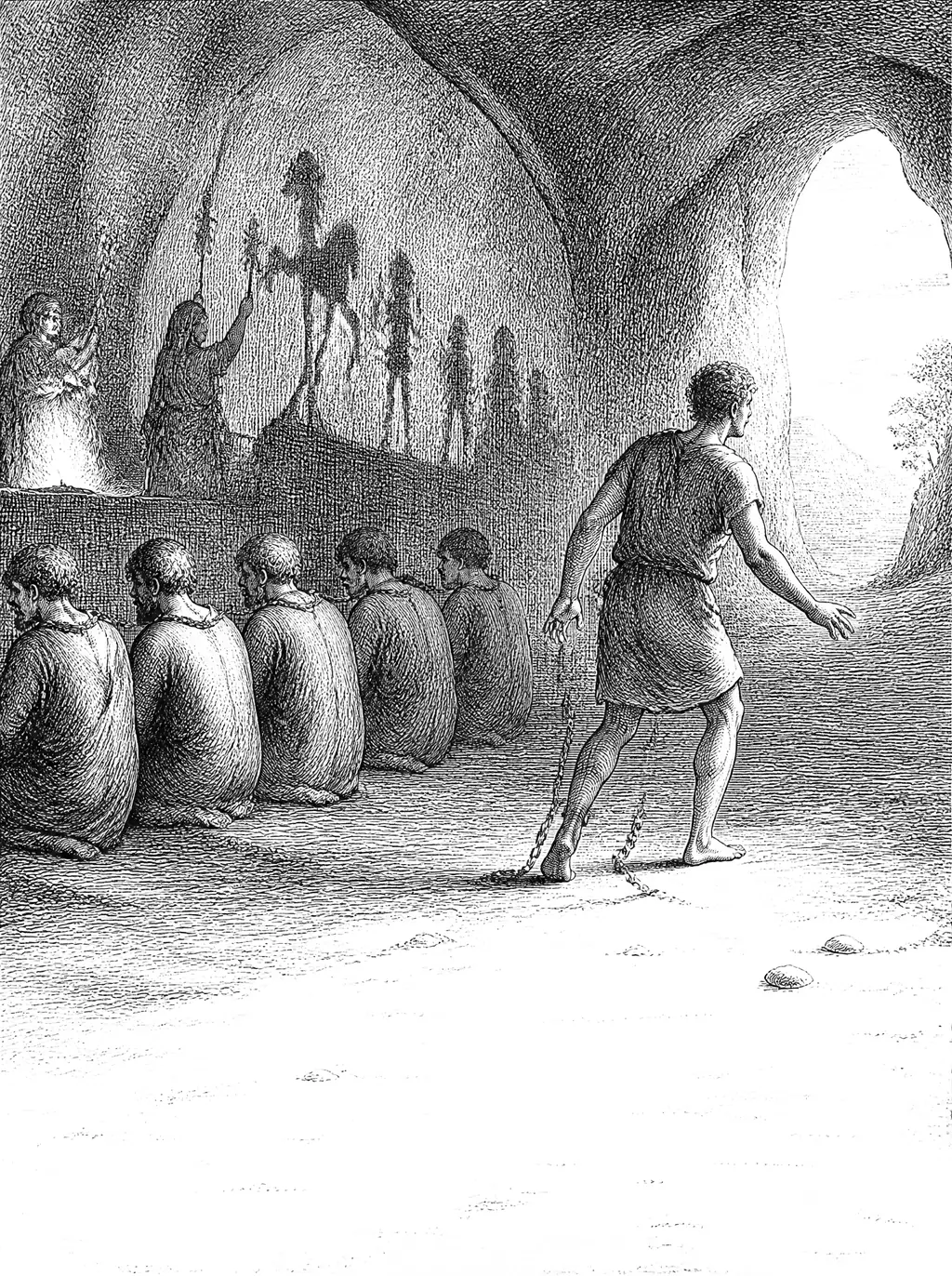
The Allegory of the Cave
Prisoners of the wall
Imagine prisoners chained underground since childhood, facing a blank wall, unable even to turn their heads. Behind them a fire throws shadows of objects onto that wall, and since the shadows are all the prisoners have ever seen, the shadows are, to them, simply reality. They name the shadows, predict their order, and award prizes to whoever guesses best what comes next. Plato's listener, his own brother Glaucon, says these are strange prisoners. Socrates answers that they are like us. The picture is not a warning about some other, more deluded people. It is a diagnosis of the ordinary condition, and the first step out is being told you are in it.
The world it came from
Plato was born into an aristocratic Athenian family during the Peloponnesian War and was about twenty-eight when the city executed his teacher Socrates in 399 BC. Two of his own relatives had sat among the Thirty Tyrants who briefly ruled Athens after its defeat, and the democracy that replaced them killed the wisest man he knew. He founded the Academy around 387 BC and wrote the Republic probably in the 370s. The cave opens Book VII, right after the images of the sun and the divided line, and it answers a political question: why should a city be ruled by philosophers? The freed prisoner who goes back down and is killed for his trouble is Socrates, barely disguised.
The idea
One prisoner is freed and dragged up into the sunlight outside. At first the light blinds him and he wants to go back to the shadows, which were easier. Slowly his eyes adjust, and he sees the real objects, then the sun itself, the source of everything he mistook for the whole world. Each stage of the ascent is a stage of knowledge. The shadows are secondhand opinion, the objects carried past the fire are the things of the visible world, and the sun is the Form of the Good, the source that makes everything else intelligible. Then comes the part people forget: he must go back down. The cave is not a place you escape. It is a place you return to, changed.
How the reasoning runs
Start with the prisoners: they take shadows for things because shadows are all they have. Next, knowledge is not poured into a mind like sight into blind eyes. The eye already sees; it must be turned, and with it the whole soul, from what changes to what stays. Third, every turn hurts. The fire is brighter than the wall, the sun brighter than the fire, and each new thing looks less real than the old. Fourth, whoever reaches the sun sees the source of both truth and being, and understands the shadows for the first time. Fifth, the returner will stumble in the dark and be laughed at. Therefore the city must compel the people who have seen to rule it, since only they rule without wanting to.
Seen in life
You open the feed and the wall lights up. Faces, outrages, a headline cropped to its worst sentence, a stranger's opinion of a stranger. Something behind you chose each shadow, in order, for how long it would hold your head still, and you have never turned around to see the machine that casts them. One day you spend a week with someone the feed has taught you to despise and find a person. You come back and say so, and the replies are the prisoners' replies: he went up and came back with ruined eyes. Plato's point is not that the feed lies. Shadows are real shadows. It is that a life spent naming them is not the same as knowing anything.
Why it matters
Plato is making a claim about knowledge itself, not just about caves. Most of what you call 'seeing the world' is watching shadows cast by causes you never examine directly: secondhand opinions, appearances, and other people's conclusions. Real knowledge means turning around and finding the source those shadows came from. That turning is the whole of education, on his account. It is not information added to a mind but a mind redirected, and it cannot be done for you; it can only be provoked. The allegory also explains why knowledge is unwelcome. Anyone who has really seen something will sound wrong to people who have not, and the temptation to go back to the wall never fully disappears.
“Behold! human beings living in a underground den, which has a mouth open towards the light and reaching all along the den.”
From the source
Socrates opens Book VII of the dialogue with the image itself: “Behold! human beings living in a underground den, which has a mouth open towards the light and reaching all along the den.” — Plato, The Republic, translated by Benjamin Jowett. He fills in the details slowly. The prisoners have been there since childhood, chained by the legs and the neck. Behind them, higher up, a fire burns, and between the fire and the prisoners runs a low wall like the screen of a puppet show, along which people carry statues and figures whose shadows fall on the wall ahead. Glaucon says it is a strange image and strange prisoners. Like ourselves, Socrates replies, and the whole allegory hangs on those two words.
The pushback
A natural objection: who decides which version is the shadow and which is the sunlit truth? Plato's answer, reason trained over years under a philosopher's guidance, ascending from opinion to real understanding, asks for a great deal of trust in whoever is doing the training. The harder objection is political, and Karl Popper made it fiercely after the Second World War. A doctrine that says one class of people has seen the sun and the rest are chained in the dark is a charter for rule without consent. The philosopher-king does not have to argue with the prisoners; he has only to pity them. Every tyrant since has claimed to be the man who came back down.
The reply
Plato's defenders point to what the allegory actually says about the returner. He does not seize the cave. He stumbles, is mocked, and would be killed if the prisoners could reach him, which is what happened to Socrates. The whole argument for philosophers ruling rests on their not wanting to, and Plato treats the desire to rule as a disqualification. That answers the caricature but not the objection. Trust in a trained elite still sits at the center, and Plato gives the prisoners no way to check the sun for themselves except to begin the climb. The honest reply is that the allegory describes what knowledge is like and says less than it should about who gets to say so.
Where it went next
Plotinus and the Neoplatonists made the ascent to the sun a mystical path, and through Augustine it became a Christian one, with the cave as the fallen world. Francis Bacon's idols of the theatre are the shadows renamed. Descartes's deceiving demon is a cave with one prisoner. In the twentieth century Heidegger read the allegory as the moment truth was redefined as correctness of vision, and Iris Murdoch made it the center of her moral philosophy: goodness is the sun, and attention is the climb. The Matrix in 1999 put it on screen, red pill and all, and every argument that we might be living in a simulation is the cave told with better hardware.
Where this leads
The Gettier problem asks a narrower, more modern version of the same question: even when you are right, and you believe it, and you can justify it, do you actually know it, or do you just have a well-dressed shadow? Gettier's Smith is a prisoner who guessed the next shadow correctly for the wrong reason, and the shape of his mistake is Plato's. Existence precedes essence pulls the other way. Sartre denies there is any sun, any fixed source of what things really are, and says the climb out of the cave ends not in a vision but in a choice. Where Plato finds the Good waiting, Sartre finds only the freedom to make one.