Symposium · Aesthetics · Pl. 6Immanuel Kant · 1724–1804
Beauty Without Wanting Anything
A palace you don't want
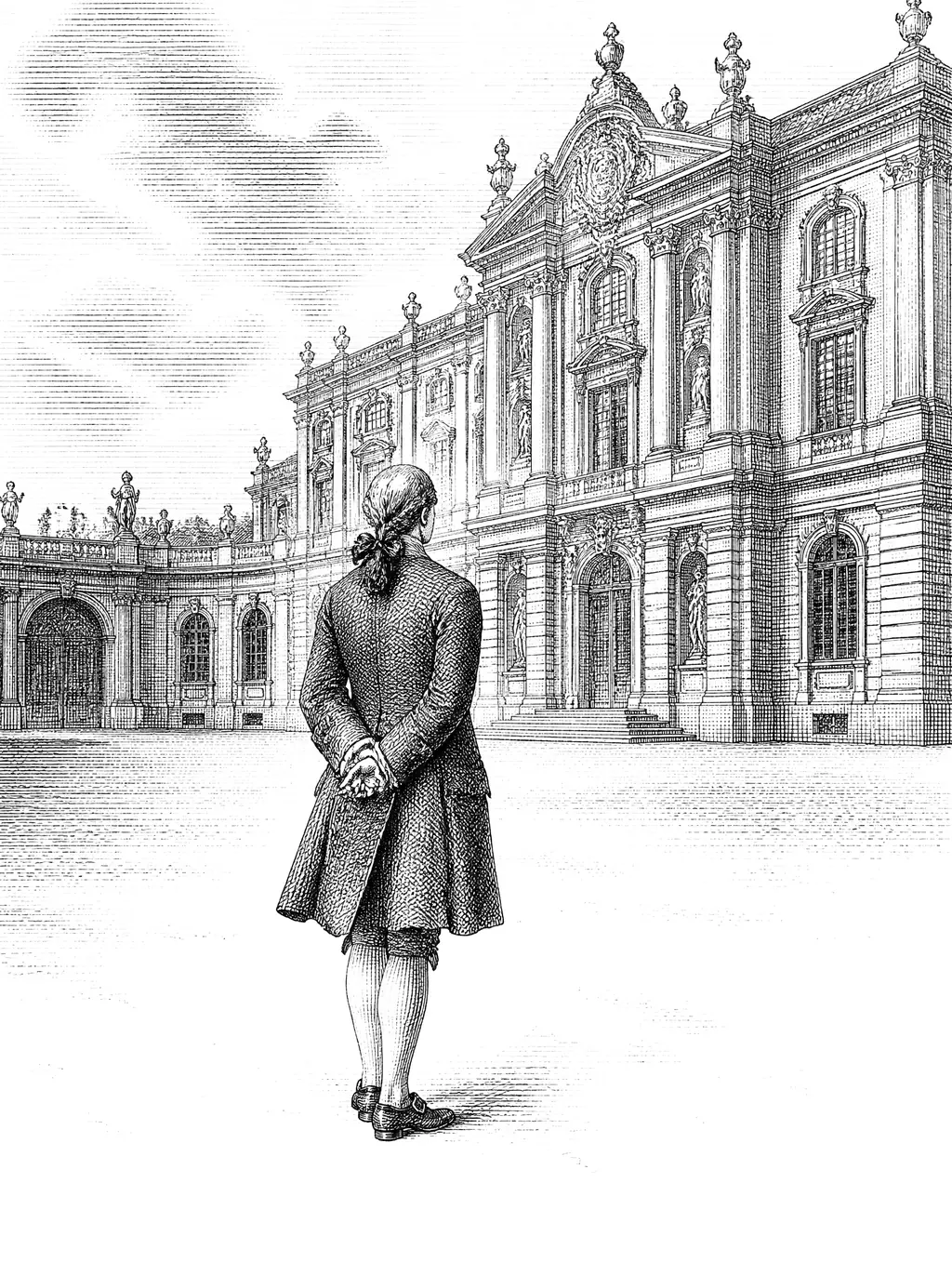
Kant imagines being shown a splendid palace and asked whether it is beautiful. He could answer by talking about wasted labor, or personal taste in architecture, or simple indifference to grand buildings, but none of that, he insists, is really the question. The pure judgment of taste has to set every such interest firmly aside first. He lists the wrong answers with some relish. Rousseau would complain about the sweat of the people spent on vanity. A hermit would say he prefers his hut. A sceptic would add that he would not want the palace if he could have it by wishing. All true, Kant says, and all beside the point. The question was only whether the mere sight of it pleases.
The world it came from
Kant published the Critique of Judgement in 1790, at sixty-six, as the third and last of his critiques. The first had asked what we can know, the second what we ought to do; this one asked how judgments about beauty and purpose fit into a mind already divided between knowledge and morality. Around him, taste was the great eighteenth-century question. Hume had argued in 1757 that taste is sentiment, yet some judges are better than others. Burke had grounded beauty in the body. Baumgarten had coined the word aesthetics in 1735 for a science of sensory knowledge. Kant's problem was to explain how a judgment based on a feeling could nonetheless claim that everyone ought to agree, and disinterest was the first step in that explanation.
The idea
We must not be in the least prejudiced in favour of the existence of the things, but be quite indifferent in this respect, in order to play the judge in things of taste. A judgment about beauty tainted by even a little interest, wanting to own the palace, eat the meal, possess the painting, stops being a pure judgment of taste and becomes something else instead. Kant separates three kinds of liking. The agreeable pleases the senses, and you want more of it. The good pleases reason, and you want it to exist. The beautiful pleases without either want. It is a free liking, taken in the mere representation of the thing, and because it asks nothing of the object, it alone can be shared by everyone.
How the reasoning runs
Kant proceeds by contrast. First, when you enjoy a warm bath, the pleasure depends on the thing's existence and your appetite, so it is private; nobody else shares your hunger. Second, when you approve of an honest act, your pleasure depends on a concept of the good and the wish that such acts exist, so it is a judgment of reason, not of taste. Third, when you call a rose beautiful, you do not want to eat it or improve it; you are pleased simply by contemplating it. Fourth, since that pleasure rests on no private appetite and no concept, nothing in it is peculiar to you. Therefore you are entitled to speak as if everyone should agree, and that entitlement is what the word beautiful claims.
Seen in life
You walk into a gallery and stop at a painting. A voice in your head says: I would hang that in the flat. Another says: that would be worth a fortune. A third says: I could do that. A fourth notices the wall text and adjusts. Kant asks you to switch all four off and see what is left. If there is still something that holds you, a pleasure in the look of the thing that would survive learning it was a fake, unsaleable, and painted by someone you dislike, that is the judgment of taste. The test is easy to state and hard to pass, and the moment you notice how much of your enjoyment was ownership or status, you have understood why he thought it mattered.
Why it matters
This carves out a distinct category of aesthetic experience, separate from practical desire and moral approval, giving philosophy a name for the specific pleasure taken in mere contemplation. It shaped two centuries of art theory built around disinterested looking, the sense that appreciating beauty is not the same activity as wanting to consume it. It also underwrites the strange grammar of taste. When you say a sunset is beautiful you are not reporting that you like it; you are demanding agreement, and you feel that someone who shrugs has missed something. Kant explains why that demand is legitimate without pretending beauty is a fact. The pleasure is yours, but its ground is nothing private, so the claim on others stands.
“We must not be in the least prejudiced in favour of the existence of the things, but be quite indifferent in this respect, in order to play the judge in things of taste.”
From the source
Kant draws the line with a concrete example, imagining someone shown a splendid palace: “We must not be in the least prejudiced in favour of the existence of the things, but be quite indifferent in this respect, in order to play the judge in things of taste.” Wanting the palace, or resenting its cost, is beside the point entirely. The passage is section two of the Critique of Judgement, in J. H. Bernard's translation, under the heading that the satisfaction which determines the judgment of taste is disinterested. Sections three to five then distinguish the beautiful from the agreeable and the good, and section six draws the consequence: a disinterested liking is one you may represent as universal.
The pushback
Can any real viewer actually manage such pure indifference, given how tangled aesthetic pleasure usually is with cultural values, personal history, and plain ordinary desire? Critics have long argued that Kant's disinterested spectator is an idealization no one fully achieves, useful as an analytic distinction but suspect as a description of how people actually experience art. A harder objection comes from Nietzsche and, later, from Pierre Bourdieu. Disinterest is itself an interest: the pose of the person who can afford not to want, and who uses that pose to mark themselves off from those who eat with their eyes. On this view Kant did not discover a pure faculty. He described the manners of a class and called them the structure of the mind.
The reply
Kant's defenders answer the first objection by noting that he never claimed anyone is purely disinterested. The judgment of taste is an ideal against which actual responses are measured; the point is to know what you would have to subtract to reach it, and a hard subtraction is not a meaningless one. The Bourdieu objection is stronger, and the honest reply is only partial. Kant can say that the ability to set interest aside is available to anyone, and that its association with wealth is a fact about who gets the leisure, not about the faculty. But he cannot show that the pleasure that remains is not itself a taste one learns. Whether disinterest is a discovery or a habit remains open, and Kant's text arms both sides.
Where it went next
Disinterest became the spine of modern aesthetics. Schopenhauer turned it into will-less contemplation, a temporary escape from desire. Schiller made it the basis of aesthetic education. In the nineteenth century it fed art for art's sake, and in the twentieth Clive Bell's aesthetic emotion and Greenberg's formalism assume it without argument. Edward Bullough's psychical distance (1912) is disinterest made into a psychological variable. The backlash was equally large: Nietzsche mocked the spectator without a body, Dewey called the doctrine a museum conception of art, and Bourdieu's Distinction (1979) argued from survey data that the disinterested gaze is a class marker. Contemporary aesthetics still divides over whether Kant described a faculty or a fashion, which is a measure of how much of the field he built.
Where this leads
The strongest emotion the mind can feel shows Edmund Burke pulling in the opposite direction, grounding the sublime in danger and terror rather than calm detachment, a reminder that not every eighteenth-century theory of aesthetic pleasure agreed that distance from desire was the whole story worth telling. The categorical imperative is the same mind at work on conduct. There, an act has moral worth only when done from duty and not from inclination; here, a pleasure counts as taste only when free of appetite. In both cases Kant locates value in what is left when private wanting is subtracted, and in both the critics ask whether anything human remains once it is gone.