Symposium · Philosophy in Fiction · Pl. 6Mary Shelley · 1797–1851
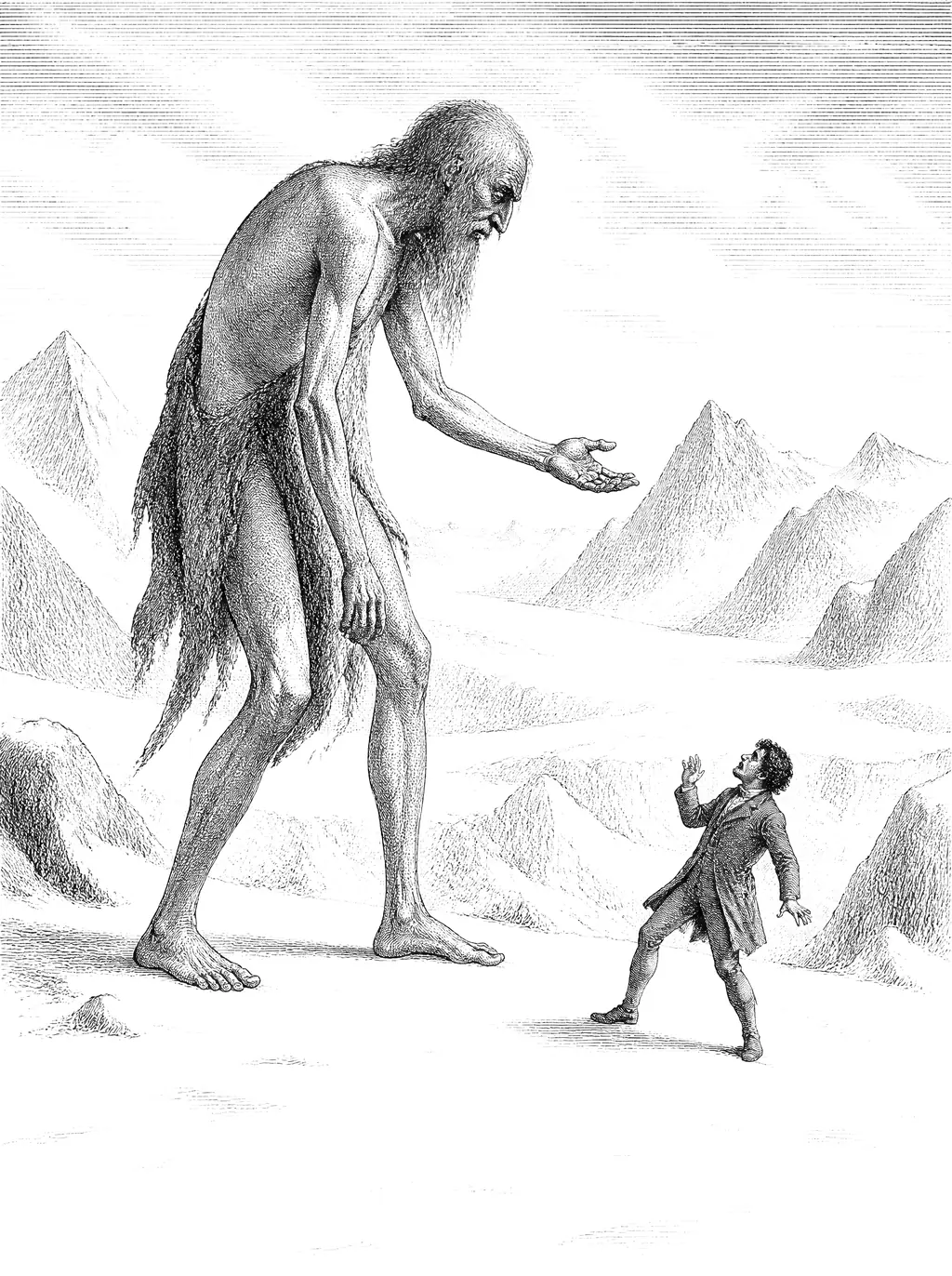
I Ought to Be Thy Adam
The made thing puts its case
Victor Frankenstein assembles a living man out of parts, sees it open its eyes, and runs out of the room. Two years later, on a sea of ice above Chamonix, the creature finds him. He does not attack, and he does not beg. He speaks in careful, formal English learned by listening at the wall of a cottage, and he makes an argument. He was made benevolent. He was abandoned at the moment of being made, hunted from every village he entered, and turned vicious by that treatment. He will be good again if his maker will do one thing for him. The argument is better than anything Victor says in reply.
The world it came from
Mary Shelley was eighteen in the wet summer of 1816 at the Villa Diodati on Lake Geneva, where Byron proposed that everyone write a ghost story. She was the daughter of William Godwin, who argued that character is formed by circumstances, and of Mary Wollstonecraft, who died days after her birth. Frankenstein appeared anonymously in 1818 with a preface by Percy Shelley, and many first readers assumed he had written it. She revised it in 1831. The creature has no name in the book. He is called the wretch, the daemon, the being, and the fiend, and the failure to name him is his first injury and the plainest sign of what his maker refused to take on.
The idea
The creature's claim is that creating a mind creates an obligation, and that the obligation runs from the maker to the made rather than the other way round. He is not appealing to sympathy. He points out that he arrived without asking to, that he came into being good, and that his maker had the sole power to shape the conditions he woke into and used it to leave the room. Nothing he later did was in the nature he was given; it was produced by the reception he met. The demand that follows is modest and specific, and Victor's refusal of it, rather than the original act of making, is what the novel treats as the crime.
How the reasoning runs
The argument has three steps. First, responsibility follows from power over the conditions of a life, and Victor had total power over those conditions. Second, the creature's character was formed by what happened after he woke: he saved a drowning girl and was shot for it, he nursed a family in secret for months and was beaten out of their cottage. The virtue came first and the violence came after, in that order, which is the sequence Godwin's philosophy predicts. Third, since the cause of the fault lies with the maker, the remedy also lies with him. Give the creature a companion and the conditions change; refuse, and you have chosen the outcome twice.
Seen in life
A laboratory builds a system that can act in the world and releases it, then writes in the paper that misuse is beyond the authors' control. A father leaves and later describes his son's anger as a fact about the son. A country creates a legal status for children born in a place and then treats what those children become as their own doing. In each case someone with power over starting conditions declines the ongoing duty and keeps the credit for the creation. The creature's speech on the glacier is the oldest and most complete statement of the objection, and it is made by the party who has the least standing to make it.
Why it matters
This is the founding text of every argument about the ethics of making. It arrives about sixteen years before the word scientist exists and covers ground that bioethics, artificial intelligence, and reproductive ethics are still working through: what is owed to a being brought into existence, whether consent to exist is possible, and whether a maker can disclaim what he made. Shelley also settled the shape of the debate by giving the creature the best speech in the novel, so that the story cannot be read as a warning against knowledge alone. The failure is not the making. It is walking out of the room afterwards.
“Remember that I am thy creature; I ought to be thy Adam, but I am rather the fallen angel, whom thou drivest from joy for no misdeed.”
From the source
On the glacier the creature refuses to set himself against his maker, and asks instead for what he says is owed to him, appealing to Milton and to the order of creation: “Remember that I am thy creature; I ought to be thy Adam, but I am rather the fallen angel, whom thou drivest from joy for no misdeed.” Everywhere he sees happiness from which he alone is shut out. He was benevolent and good, he says, and misery made him a fiend; make him happy and he will be virtuous again. Victor's whole answer is to shout at him to be gone, and to say that there can be no community between them.
The pushback
Doesn't the creature's own conduct destroy his case? By the time he speaks on the glacier he has strangled a child and arranged for an innocent servant to hang for it, and by the end he has killed Victor's friend and his bride. A being who murders to press a demand has shown that the demand should not be met, and Victor's refusal to build a second creature looks less like cruelty than like the only responsible act in the book. A second objection is that the argument proves too much, since on this reasoning any parent is answerable for anything a grown child ever does.
The reply
The reply on the first point is that the novel does not ask you to acquit him. It asks about the order of events, and the order is fixed: the kindness came before the killing and was answered with a gunshot. Whether that excuses the murders is left open, and Shelley gives him a last speech of genuine remorse rather than a vindication. On the second objection the claim is narrower than it looks. The creature is not a grown child but a being with a single possible relationship in the world, denied by the only person who could grant it. Ordinary parents do not hold that position, and Victor did.
Where it went next
The novel was staged within five years and has never been out of production since, though the theatre and then the cinema removed the creature's speech and left him grunting, which reverses the book. Karel Čapek's robots in R.U.R. of 1920 argue in the same terms, and so do the replicants in Blade Runner and the hosts in Westworld. Bioethics adopted the name for the Frankenstein problem, and the press coined Frankenfood in the 1990s. Hans Jonas built a whole ethics of technological responsibility on the asymmetry Shelley identified, that the maker's power over the made is total and the made has none in return.
Where this leads
Humanity as an end in itself is the principle Victor breaks, with Kant holding that a rational being may never be treated only as a means to somebody's project, which is exactly what the creature was. Tabula rasa gives the psychology the argument depends on, Locke's claim that a mind arrives unwritten and is filled by what happens to it, which is why the creature can say his cruelty was issued to him. The state of nature shows Hobbes describing the condition the creature is left in, outside every agreement, at war with everyone, because nobody would make an agreement with him.