Symposium · Political Philosophy · Pl. 3Thomas Hobbes · 1588–1679
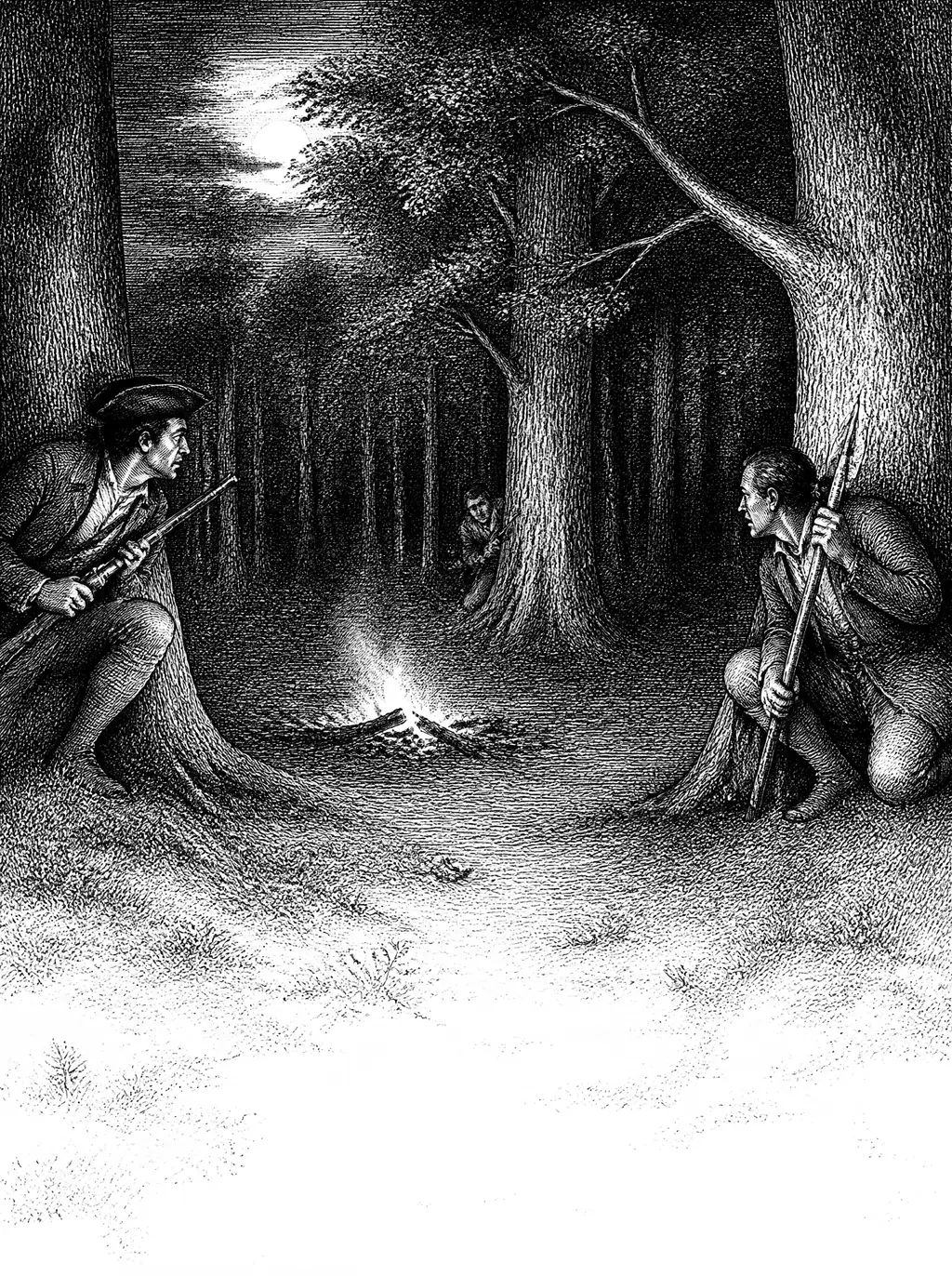
The State of Nature
A thought experiment with no comfort in it
Hobbes asks you to imagine human beings entirely without government: no police, no courts, no shared authority to appeal to when a dispute turns violent. He does not picture this as freedom. Roughly equal in strength and cunning, with everyone free to take whatever they can defend, he sees only a permanent, exhausting contest with nothing above it to keep the peace. He did not have to imagine very hard. He wrote the description while his own country was fighting a civil war, and he had already fled it. The state of nature is a thought experiment, but the fear in it was measured against an England where the king's head had just come off.
The world it came from
Hobbes was born in 1588, the year the Spanish Armada threatened England, and later wrote that his mother had given birth to twins, himself and fear. He spent his working life as tutor and secretary to the Cavendish family. In 1640, as Parliament and Charles I moved toward war, he fled to Paris, where he stayed eleven years and for a time taught mathematics to the exiled Prince of Wales. Leviathan was published in London in 1651, two years after Charles I was executed, and Hobbes returned to England the same year and submitted to the new republic. He was answering both sides at once: the parliamentarians who had fought the king, and the royalists who claimed the king ruled by God's grant.
The idea
Without a common power to keep everyone in awe, people live in a condition of war, every man against every man. In such a state there is no industry, no agriculture, no navigation, no arts, no society, only continual fear and danger of violent death, and the life of man is solitary, poor, nasty, brutish, and short. Hobbes is careful about what war means. It is not constant fighting but a known readiness to fight, the way foul weather is not a single shower but a tendency lasting many days. In that condition nothing is unjust, because there is no law, and nothing is anyone's, because there is no one to guarantee it.
How the reasoning runs
Start with equality. People differ in strength and wit, but not by enough: the weakest can kill the strongest by cunning or by combining with others. Equal ability produces equal hope, so when two people want the same thing that both cannot have, they become enemies. Three causes of quarrel follow: competition for gain, distrust for safety, and glory for reputation. Without a common power, each person's safest move is to strike first, and everyone knows that everyone else is reasoning the same way. Hence war. Reason offers a way out: seek peace, and give up your right to everything if others do the same. But a covenant without a sword is only words. Therefore a sovereign with enough power to enforce the bargain is the price of peace.
Seen in life
A storm takes out the power in your town for a week, and with it the streetlights, the phone network, and, on the third night, most of the police presence. You have water and a generator. By day, neighbors share food. By night, you find yourself doing things you would not have predicted: sleeping in shifts, chaining the generator to the porch, keeping a bat by the door. Nobody has attacked you. You are not a violent person. But you know that the man three streets over has children and no water, and you know he knows where your generator is. Hobbes says that this calculation, run by everyone at once, is the state of nature. Its cause is not wickedness but the absence of a referee.
Why it matters
This is the argument that makes government something you should want, not merely tolerate: a genuine escape from a condition that would otherwise be far worse. Every complaint about authority, on this view, has to reckon with what the honest alternative actually looks like, since the absence of government is not liberty, but constant, unmanaged danger. Hobbes also changed the question. Before him, political theory asked who deserved to rule and what made a ruler good. He asked instead what problem rulers solve, and answered that they make it safe to keep promises. Every later contract theory, whatever it concludes, starts from his question rather than the older one.
“In such condition, there is no place for Industry... no Society; and which is worst of all, continuall feare, and danger of violent death; And the life of man, solitary, poore, nasty, brutish, and short.”
From the source
Hobbes describes the state of nature in one relentless sentence: “In such condition, there is no place for Industry... no Society; and which is worst of all, continuall feare, and danger of violent death; And the life of man, solitary, poore, nasty, brutish, and short.” The full sentence also strikes out Culture of the Earth, Navigation, commodious Building, Arts, and Letters. The passage is in Chapter XIII of Leviathan, on the natural condition of mankind. Hobbes anticipates the reader who doubts such a condition ever existed. Look at yourself, he says: you lock your doors when you sleep, lock your chests even inside your own house, and ride armed when you travel. Every lock is an accusation against your fellow subjects, made while the law still protects you.
The pushback
Was Hobbes describing an actual historical condition, or inventing a worst-case scenario to justify accepting almost any authority as better than none? Critics, including Rousseau, argued his state of nature already smuggled in competitive, acquisitive human traits from civilized life, rather than describing people as they would actually be before society shaped them. Locke pressed a different point. Hobbes's cure looks worse than the disease. To escape the harm that many weak people might do to each other, he hands unlimited power to one strong person and removes every check on him. That is not leaving the state of nature, Locke argued, but staying in it with one of the parties armed to the teeth.
The reply
Hobbes has an answer to Rousseau. The state of nature is not a claim about prehistory but about what happens whenever authority fails, and he points to civil war and to the way sovereign states treat each other as evidence that it happens. On that reading his acquisitive human beings are the only ones we have ever met. To Locke he replies that a sovereign with limited power is a sovereign who can be defied, and a sovereign who can be defied brings the war back. The reply is honest and still incomplete. Hobbes underestimated how much cooperation people build without a sovereign, and he had no answer to the ruler who is himself the danger, except to say that the alternative is worse.
Where it went next
Locke and Rousseau each wrote their own state of nature to answer his, and the contract tradition that runs through them to Rawls begins with the question Hobbes asked. Oxford burned Leviathan in 1683. Realists in international relations still describe the world of states as a Hobbesian anarchy, each armed because no power stands above them. Game theorists read the prisoner's dilemma as his argument in miniature: two rational players who cannot enforce a promise defect, and both lose. Elinor Ostrom's studies of fisheries and irrigation systems, which earned a Nobel in 2009, are the strongest empirical answer to him, documenting communities that keep the peace over shared resources with no Leviathan at all. The word Hobbesian now means what he feared.
Where this leads
The consent of the governed picks up exactly where this grim picture leaves off, asking what people escaping this condition are rightly entitled to demand from the authority they agree to accept in exchange for leaving it behind for good. Locke's answer is more than Hobbes would allow: a government that can be dismissed when it fails. Thinking matter is the other Hobbes, the one who insisted that everything, including the mind, is body in motion. The two projects are one project. If people are matter driven by appetite and aversion, then fear of death is the strongest motion in them, and a state built on that fear is built on the firmest thing there is.