Symposium · Epistemology · Pl. 12John Locke · 1632–1704
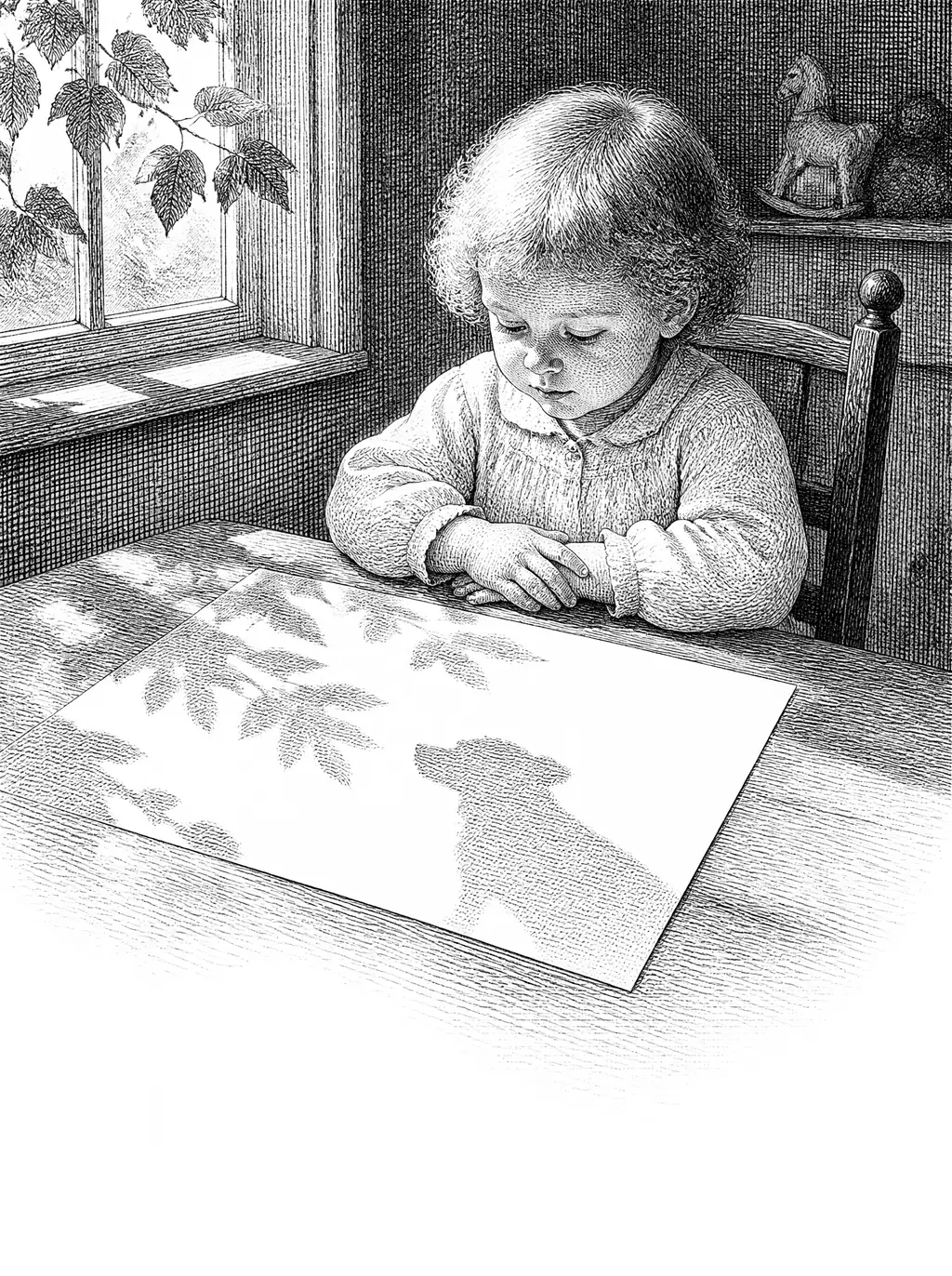
Tabula Rasa
Nothing stamped in advance
Many philosophers before Locke assumed certain ideas, God, morality, basic logic, were simply built into the human mind from birth, native furniture no one had to earn. Locke examined this assumption carefully and rejected it. He wanted to know where a mind's ideas actually come from, and refused to accept an easy answer that stopped the inquiry before it started. The stakes were not only academic. A principle stamped on every mind by nature is a principle nobody may question, and Locke had lived through a civil war fought partly over which principles those were. Clear the page, and every belief has to show where it came from.
The world it came from
Locke was born in 1632 and grew up through the English Civil War. He trained as a physician at Oxford, became secretary and doctor to the Earl of Shaftesbury, and fled to Holland in 1683 when Shaftesbury's opposition to the crown turned dangerous. He came back in 1689 with the Glorious Revolution and published the Essay Concerning Human Understanding the same year, having worked on it for nearly two decades. By his own account it began when a conversation among friends in his rooms ran into the ground, and he decided the first job was to find out what the understanding could handle. His targets were Descartes's innate ideas, the Cambridge Platonists, and every authority that called its doctrine self-evident.
The idea
Picture the mind at birth as white paper, void of all characters, without any ideas at all. Everything that later fills it, every concept, memory, and belief, arrives afterward, through the two channels of experience: sensation, what your senses report from the world, and reflection, what you notice happening inside your own mind. Nothing comes pre-written. The Latin tag tabula rasa, the scraped tablet, is older than Locke and goes back through the medieval schools to Aristotle's wax; Locke's own image is paper. His point is not that the mind is passive. It receives simple ideas and then combines, compares, and abstracts them into complex ones. What it cannot do is start with content it never received.
How the reasoning runs
First, if any idea were innate, it would be found in every mind, since nature does not stamp selectively. Second, take the strongest candidates, such as whatever is, is. Children and people with severe mental impairment show no sign of them, so they are not in every mind. Third, the defender says the principles are there implicitly, waiting to be noticed. Locke replies that this empties the word: any truth a mind could ever come to know would then count as innate, which proves nothing. Fourth, so no idea is innate. Fifth, but minds plainly have ideas. The only source left is experience, through sensation and reflection. Sixth, everything complex, from number to God, can be traced by analysis back to those simple inputs.
Seen in life
Your niece is eighteen months old and has just acquired the word dog. She points at the neighbor's spaniel: dog. Then the cat: dog. Then a photograph of a horse: dog. Each correction from the adults around her narrows the idea a little, until one afternoon she looks at the cat, pauses, and says nothing. Watch what happened. Nobody installed dog. She received a run of sensations, matched them, drew a boundary, and redrew it when the world pushed back. Now watch yourself. Somewhere you learned what doubt is, not from a definition, but by noticing yourself doing it. That is Locke's second channel, reflection, writing on the page in your own hand.
Why it matters
If Locke is right, no belief gets a free pass just for feeling innate or self-evident; every single one has to be traced back to some actual experience that put it there. This makes knowledge answerable to evidence rather than inherited certainty, and it puts enormous weight on upbringing and circumstance, since the blank page absorbs whatever experience happens to write on it. That second consequence is political. If minds are written by experience, then education can rewrite a society, and no class or creed holds truths by birthright. Locke's friends took the hint, and so did his enemies. The same picture that liberates the learner also makes the learner terrifyingly available to whoever controls the pen.
“Let us then suppose the mind to be, as we say, white paper, void of all characters, without any ideas.”
From the source
Locke sets out the whole picture in one sentence: “Let us then suppose the mind to be, as we say, white paper, void of all characters, without any ideas.” Everything else in his philosophy of knowledge builds outward from that single image. The sentence opens the second book of the Essay, after a first book spent demolishing innate principles one by one. He asks at once how the paper comes to be furnished, and answers in one word: experience. Our observation, employed either about external sensible objects or about the internal operations of our minds, supplies the understanding with all the materials of thinking. Those, he says, are the two fountains of knowledge, and there are no others.
The pushback
Critics, including Locke's contemporary Leibniz, argued some structure has to be built into the mind already, if only the capacity to organize experience into concepts at all; a truly blank page could not process sensations into ideas on its own. Locke's answer was that the mind's faculties, its capacity to receive and combine, can be innate without any particular idea being innate. Leibniz pressed further with a rival image. The mind is not blank paper but a block of marble already veined, so that some figures come out more easily than others. Two centuries later the objection hardened into data: children acquire grammar far faster than the sentences they hear could teach it, which suggests something was there before the first word.
The reply
Locke's defenders draw the line where he drew it: between ideas and faculties. A mind can arrive with powers, to perceive, remember, compare, abstract, and still arrive with no content. Leibniz's veined marble concedes exactly this, since a vein is a tendency, not a statue. The modern evidence about language is harder to absorb. If the capacity for grammar is that specific, the distinction between a faculty and an idea starts to blur, and a Lockean has to say either that grammar is not an idea or that the page was never quite blank. Most now say the latter, and keep the rest. What survives untouched is the demand that any claim to innate truth show its evidence rather than its pedigree.
Where it went next
Berkeley and Hume took the empiricist premise and pushed it until matter and the self dissolved. In France, Condillac imagined a statue gaining senses one at a time, and Helvétius concluded that education could make anyone anything. Rousseau's Emile is a blank page raised by design. The behaviorists of the twentieth century inherited the picture almost intact: John B. Watson boasted he could train any healthy infant into any profession. Then Noam Chomsky's work on grammar in the 1960s revived nativism, and by 2002 Steven Pinker could title a book The Blank Slate and mean it as an accusation. The tabula rasa is now the position everyone in cognitive science defines themselves against, which is one kind of immortality.
Where this leads
The problem of induction picks up exactly where tabula rasa leaves off: once you grant that experience is where every idea comes from, the next question is how much any past experience can actually justify a belief about what has not happened yet. Hume was Locke's most faithful reader and his most dangerous one. Not born a woman runs the same thought through a different channel. If nothing is stamped in advance, then what a society calls a woman's nature is a page that upbringing wrote, and Beauvoir's sentence is Locke's white paper applied to a life. Both ideas make the same demand: show the experience that put the belief there, or stop calling it natural.