Symposium · Stoicism · Pl. 7Epictetus · c. 55–135 AD
What Makes a Tyrant Formidable
The child and the guards
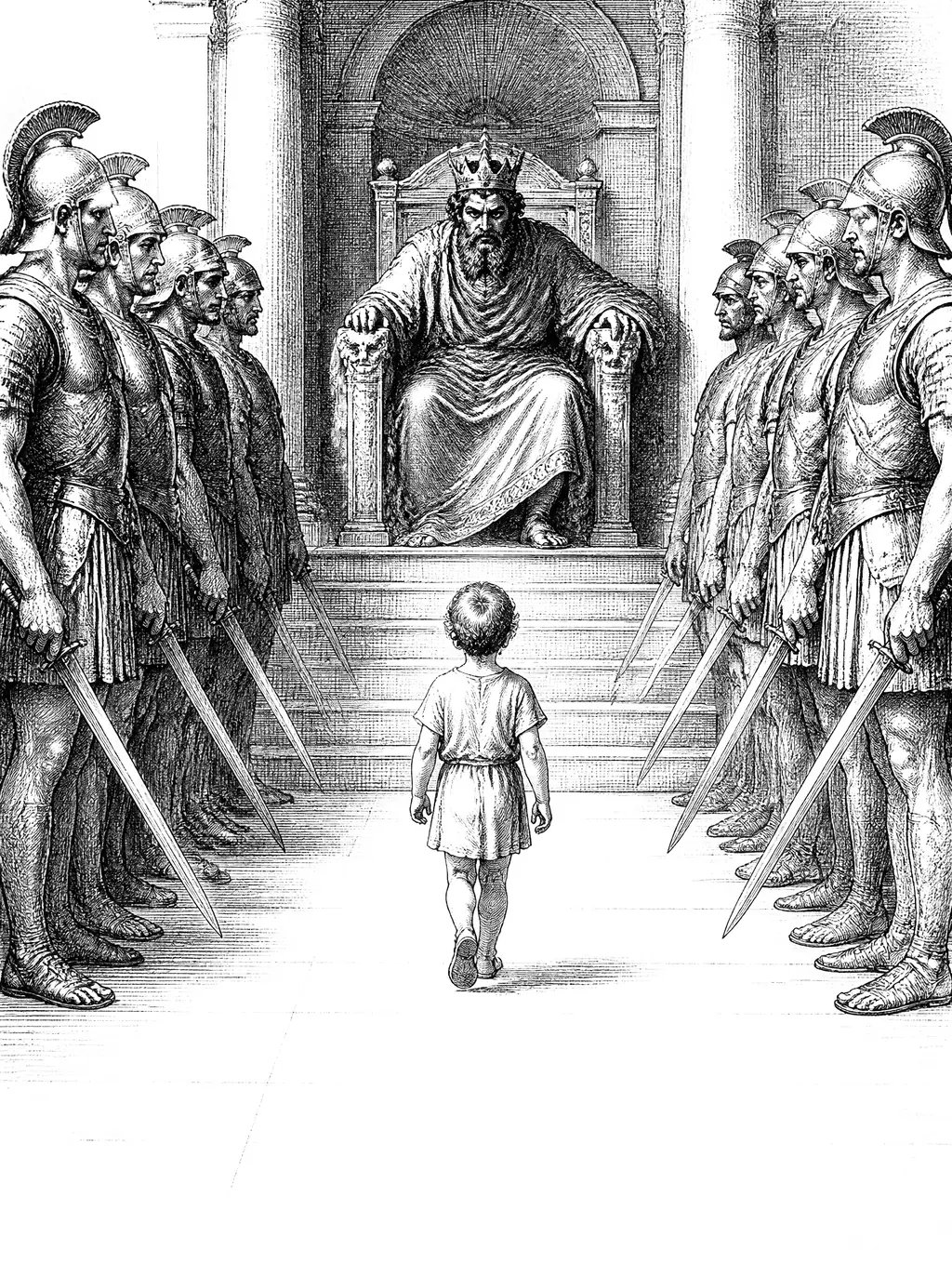
Epictetus asks his students to picture a small child brought before a tyrant surrounded by armed guards. The child feels no fear at all, not from courage, but from simple ignorance of what swords can do. Epictetus's question is sharper than it looks: what would it take for a grown, informed adult to walk in that calmly, on purpose? The lecture the question comes from is titled On freedom from fear, and Epictetus was speaking to students who might one day stand in exactly that room, in front of exactly that man.
The world it came from
Epictetus lectured on this at Nicopolis in the years around 100 AD, to students whose fathers had lived through Nero and Domitian. Both emperors had killed senators for their opinions. Epictetus's own teacher, Musonius Rufus, had been exiled twice. The Stoic opposition in the senate, men like Thrasea Paetus, forced to open his veins in 66 AD, and Helvidius Priscus, executed under Vespasian, had shown what the philosophy cost when a ruler wanted obedience. Epictetus names Helvidius in the Discourses as a model. So the tyrant in the lecture is not a thought experiment. It is the Roman emperor, and the question is what a student should already have settled in himself before he ever stands in front of one.
The idea
A tyrant's power depends entirely on your caring about the things he can take: your body, your property, your life. Stop caring about those in the way that makes them controllable, and the guards and swords lose their leverage over you, not because the danger vanished, but because the one thing they could never seize, your own opinions, is the only thing you were ever holding onto. The tyrant is formidable exactly in proportion to what you are unwilling to lose. Cut that list to what he cannot reach, and the room changes, though the swords do not.
How the reasoning runs
Take the guards apart. What is a sword? A piece of iron. Why does it frighten you? Because it can cut the body. Why does that frighten you? Because you have judged that the body's safety is a good that must be kept. So the sword's power over you runs entirely through one judgment, and the judgment is yours. Now, the child feels no fear because the judgment has not formed; the fool feels fear because it has formed wrongly; the philosopher feels none because he has examined it and moved the good elsewhere, to his own choices, where no iron reaches. Same swords, three responses. The difference is not in the guards. It is in what each person has decided must not be lost.
Seen in life
You are the one person in the meeting who knows the numbers in the deck are wrong. Saying so will embarrass the director who built it, and the director controls your review. You stay quiet, and the quiet feels like prudence. Epictetus would call the director a small tyrant and the review a small sword, and ask what you have already agreed to trade for it. Not your life; your honesty. Now decide in advance, not in the room. Write down what you will not do for a rating. The next time the numbers are wrong, the fear will still be there, but the decision will already be made, and the room will have lost most of its power over you.
Why it matters
Most fear is not fear of pain itself but fear of losing something you have quietly agreed matters more than your own integrity: comfort, safety, a good name. Epictetus is not asking you to stop valuing your life. He is asking you to notice exactly what you are trading away in a moment of coercion, and to decide in advance what you refuse to trade. Coercion works by finding what you value more than your judgment and holding it. Know that in advance, and you know exactly where the lever is, exactly who can reach it, and exactly what it would take to remove it from their hands.
“My opinions alone are mine, and they cannot be taken from me, and I am satisfied while I have them, wherever I may be and whatever I am doing.”
From the source
In the Discourse on freedom from fear, Epictetus states the position plainly: “My opinions alone are mine, and they cannot be taken from me, and I am satisfied while I have them, wherever I may be and whatever I am doing.” The lecture opens with the child before the tyrant and asks whether reason can produce on purpose what ignorance produces by accident. It can, Epictetus says, once you have understood that death and prison are among the things not up to you, and that what is not up to you cannot be a real evil. He adds the case of people who face death from mere habit, and asks whether reason should not manage what habit has managed.
The pushback
This can sound like it demands a kind of fearlessness only a handful of people, willing to die for a principle, could actually reach. Epictetus was writing partly for exactly that audience, students who might face real political danger, but the smaller version still applies day to day: most of what unsettles you is a much smaller tyrant than the one in the example. There is a colder objection. A person who has stopped caring about body, property, and life in the way that makes them controllable has also stopped caring about them in the way that makes them worth protecting for others. Fearlessness bought this way can look like indifference wearing a brave face.
The reply
The tradition answers the elitism charge by scale. Epictetus does not ask you to be Helvidius on day one; he asks you to notice the small tyrants, and to stop trading your judgment away for small stakes, so that if the large one ever comes the habit is already there. The indifference charge gets a partial answer. Stoics did value body and life, as preferred indifferents worth protecting, in yourself and in others. What they refused was to let the fear of losing them override a right judgment. But the lecture is written from inside the fearless person, and says less about the people that person is responsible for. Epictetus's students, who went on to govern, had to fill that in themselves.
Where it went next
Boethius wrote The Consolation of Philosophy in a prison cell around 524 AD, awaiting execution, and its argument that no tyrant can take what is truly yours is Epictetus rethought for a Christian. James Stockdale, the highest-ranking American naval officer held in North Vietnam, said Epictetus was the philosophy he lived by through seven years of captivity and torture, and he wrote about it for the rest of his life. Tom Wolfe put the same Discourses into a bestselling novel, A Man in Full, in 1998. Modern dissidents rarely cite Epictetus by name, but the move he taught, deciding in advance what cannot be taken, is the one their memoirs keep describing.
Where this leads
The discipline of desire supplies the mechanism behind this fearlessness: it is the same redirection of wanting, away from what others control and toward what you alone control, applied here to its most extreme and most public test, a tyrant with real guards. The dichotomy of control is the line the child drew by accident and the philosopher draws on purpose: what the guards can take on one side, what they cannot on the other. The child will grow up and learn to fear the swords. The philosopher has grown up, learned it, and then learned the one thing the child never needed to know.