Symposium · Logic & Paradoxes · Pl. 4Eubulides of Miletus · 4th century BC
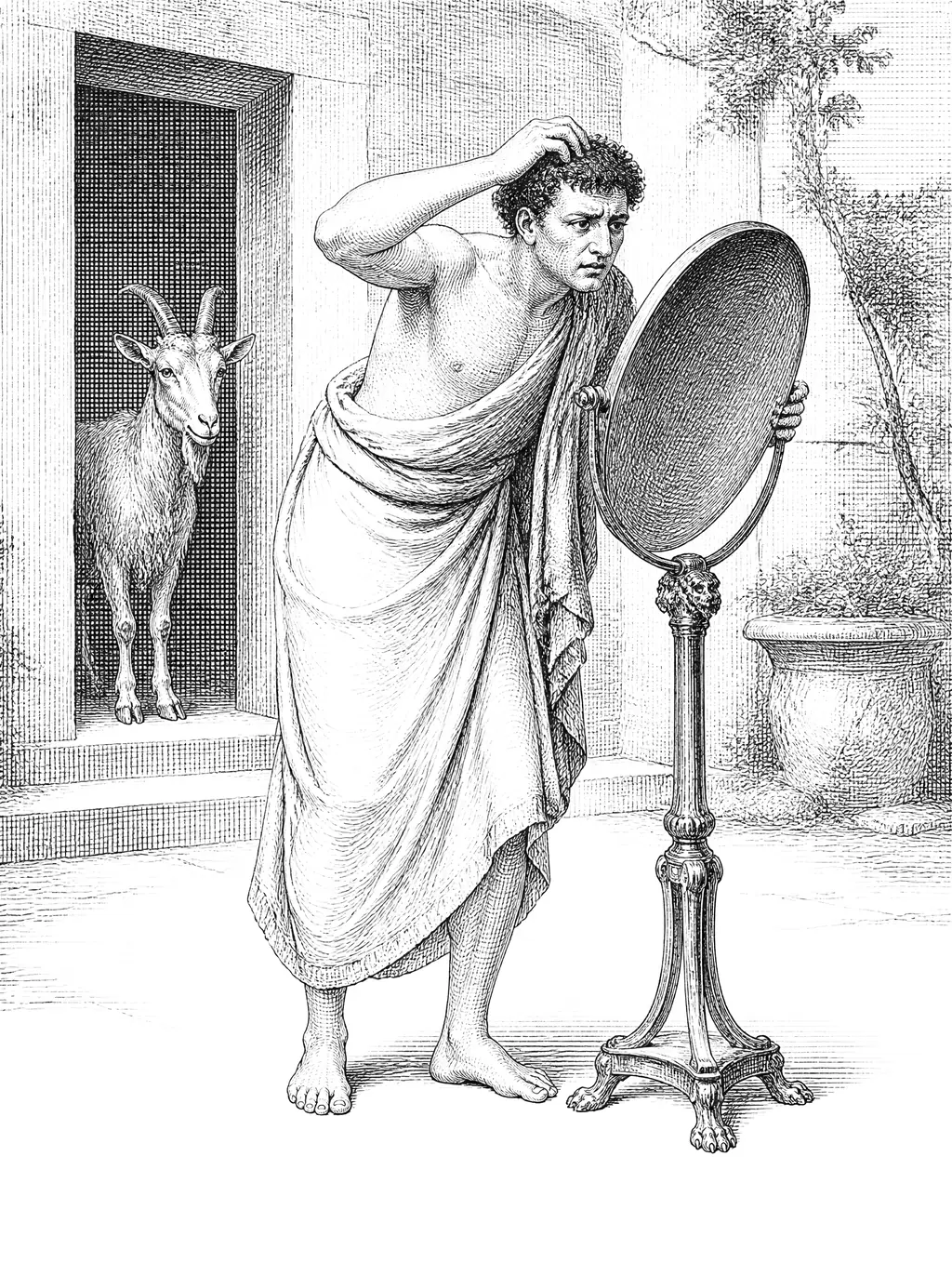
The Horned One
A trap built from a true premise
Eubulides liked puzzles that started from something obviously true and walked, one small legitimate-looking step at a time, straight into something obviously false. The horned one starts from a rule almost impossible to deny on its face: if you still possess something, you cannot have lost it. From there the argument reaches somewhere no one actually wants to stand. The puzzle is short enough to say in one breath, and the conclusion is absurd enough that no one is fooled. That is exactly why it is useful. You know something has gone wrong, and the only work left is to say what.
The world it came from
Eubulides taught at Megara in the fourth century BC and spent his career sparring with Aristotle, whose new logic claimed to sort valid arguments from invalid ones. Greek dialectic was played as a game with rules: the questioner asks, the answerer must say yes or no, and a concession once made cannot be taken back. The Horned One is built for that game. Do you have what you have not lost? Yes, obviously. Have you lost horns? No. Then you have horns, and the answerer has been walked into a corner by his own two answers. Diogenes Laertius lists it with the Liar and the Heap. Seneca, centuries later, sneered at such puzzles as a waste of a serious man's time, which shows they were still being taught.
The idea
You have what you have not lost. You have not lost horns; therefore you have horns. The trick lives in the first premise, which quietly slides between two different senses of having: having something you once possessed and would notice losing, and never having possessed the thing at all, which is a completely different situation the rule was never really built to cover. Say it in two sentences and the slide shows. Whatever you had and have not lost, you still have. And: you never lost horns, because you never had any. The word lost is doing a different job in each.
How the reasoning runs
Premise one: whatever you have not lost, you have. Premise two: you have not lost horns. Conclusion: you have horns. The form is valid. If both premises are true, the conclusion follows, so the fault must be in a premise. Look at premise one. It is true only if it means: whatever you once had and have not lost, you still have. That version quietly presupposes possession. Now look at premise two. It is true only in the plain sense: no event of losing horns ever happened to you, because you never had any. Feed the plain sense of the second into the presupposing sense of the first and the argument breaks apart. The word lost has been used in two ways, and the conclusion needs both at once.
Seen in life
You are asked to count customers who still hold a subscription. Someone proposes a shortcut: a customer holds the product if there is no cancellation record for them. You run the query and the number is far too big. It includes everyone who never subscribed at all, because they have no cancellation record either. Not cancelled has been read as still holding, and the two are not the same for anyone who never started. The same slip turns up in a survey question, have you stopped exceeding your budget, and in a warranty clause that covers any part you have not replaced. Each one takes a premise that presupposes a history and applies it to someone who has none.
Why it matters
This is an early, playful lesson in how a single ambiguous word, doing double duty across two different meanings, can smuggle a false conclusion past an argument that otherwise looks airtight at every individual step. Spotting the paradox is easy. Naming precisely which word is doing the smuggling, and why, takes real logical care. The habit it teaches is to ask, of every innocent-looking word, whether it means the same thing in the premise as in the conclusion. Most arguments that fail in public fail this way, not by an obvious false step but by a word that changes its job halfway through.
“You have what you have not lost. You have not lost horns, therefore you have horns.”
From the source
Diogenes Laertius records the puzzle in full, right alongside the sorites and several of Eubulides's other favorite dialectical traps against unwary opponents: “The horned one:—You have what you have not lost. You have not lost horns, therefore you have horns.” Diogenes sets it beside the Liar, the Veiled One, and the Heap as part of a single kit of dialectical traps. Yonge's translation keeps the compression of the original: two premises, a conclusion, and no comment. The absence of commentary is the point. The listener is expected to feel the wrongness and then to explain it, and Eubulides is not going to help. Aristotle, in the Sophistical Refutations, had already catalogued arguments that turn on ambiguous words and on questions that hide a second question inside.
The pushback
Isn't this obviously just wordplay, too silly to teach anything serious about logic? Eubulides would likely agree it is playful, but the underlying lesson is not: many far more consequential arguments smuggle exactly this kind of ambiguity past their audience, wearing the same innocent-looking premise the horned one wears openly, as a party trick. There is also a defense of the puzzle as more than a trick: it shows that a premise can be true under one reading and useful under another, and that the slide between them is invisible unless you are looking for it.
The reply
The standard diagnosis is equivocation, sometimes called the fallacy of the loaded premise. Premise one presupposes prior possession, premise two denies it, and an argument cannot help itself to both. Aristotle had already filed such moves in the Sophistical Refutations, and later writers treat the Horned One as the model for the loaded question, the kind that cannot be answered yes or no without conceding something false. In the twentieth century Strawson gave the machinery a name: presupposition. A sentence like you have not lost your horns presupposes that you had horns, and when the presupposition fails the sentence does not simply come out true or false. Unlike its siblings the Liar and the Heap, this puzzle is regarded as solved. It survives as a diagnostic tool.
Where it went next
The direct descendants are the loaded question and the trick clause. Lawyers learn to spot a question like when did you stop, which presupposes that you started, and to refuse the yes-or-no it demands. Medieval logicians collected such sophismata by the hundred and used them as classroom exercises. In database work the problem returns in a precise form: a query that treats not recorded as lost, or absent as false, counts people who were never in the system. Three-valued logic in SQL, with its unknown value, exists partly to stop this. Presupposition became a field of its own in linguistics after Strawson, and every analysis of it can be tested on Eubulides's two short premises.
Where this leads
The heap paradox shows the very same clever logician working the opposite kind of trap, this time built not from a hidden ambiguity in one single word, but from an entire long chain of individually harmless, seemingly identical small steps. The Liar is the third member of the set, and the most stubborn. The Horned One can be dissolved by naming an ambiguity; the Liar cannot, because there is no ambiguous word in it, only a sentence about itself. Reading the three together shows the range of one logician's mischief, from a party trick to a problem still open.