Symposium · Logic & Paradoxes · Pl. 5Eubulides of Miletus · 4th century BC
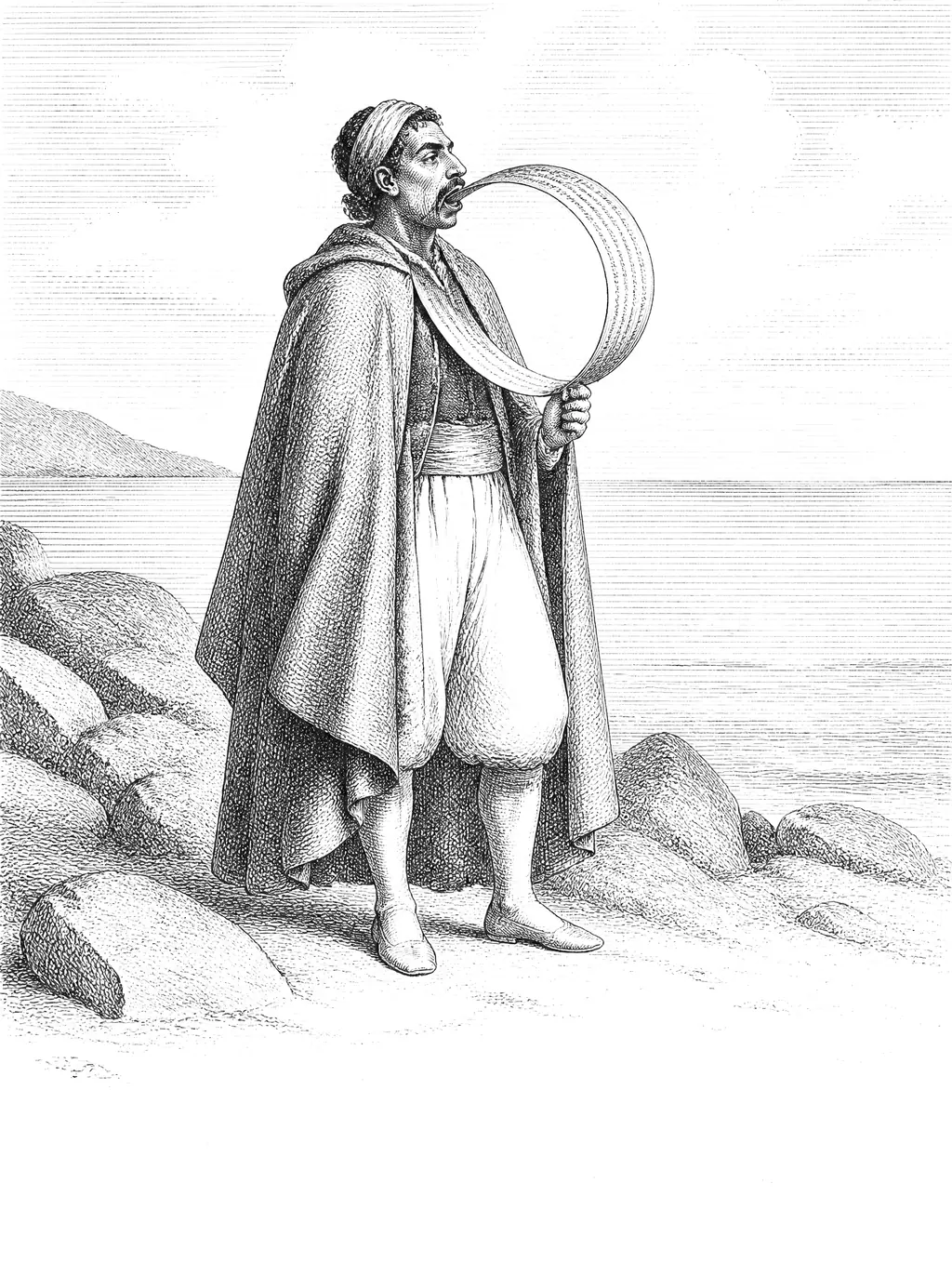
The Liar Paradox
A sentence that cannot settle
The New Testament preserves an old Cretan saying: a prophet of their own declared that Cretans are always liars. Ancient logicians noticed the trap hiding inside it, sharpened centuries earlier by Eubulides of Miletus into a cleaner form: a man says, plainly, that he is lying. Decide whether he is telling the truth, and the sentence refuses to let you land anywhere. Call it true and it makes itself false. Call it false and it makes itself true. Two and a half thousand years of logicians have tried to find the mistake, and the best of them have concluded that the mistake is in something we all believed.
The world it came from
Eubulides ran the Megarian school in the fourth century BC, a generation after Socrates, and made his name as a critic of Aristotle. Diogenes Laertius credits him with a set of puzzles, the Liar, the Heap, the Horned One among them, built to test the new logic Aristotle was writing. Aristotle had assumed that every declarative sentence is either true or false. The Liar is the sentence that will not be either. The Stoics took it seriously: Chrysippus wrote several books on it, and one story says the poet Philitas of Cos wore himself out over it and died. The Cretan version, older still, is credited to Epimenides of Crete, and reached the New Testament through the letter to Titus.
The idea
If the statement I am lying right now is true, then the speaker really is lying, which makes the statement false. If the statement is false, then the speaker is not lying, which makes it true. The sentence flips between true and false with no stable resting point, a self-reference that breaks the ordinary assumption that every statement is simply one or the other. Notice what the sentence needs: a way to refer to itself, and a notion of truth that applies to it. Take away either and the trap does not close. That is why the puzzle is about language itself, not about any particular speaker's honesty.
How the reasoning runs
Write the sentence down: L says that L is false. Premise one: every sentence is true or false, with no third option. Premise two: a sentence is true exactly when what it says is the case. Now test. Suppose L is true. Then what it says is the case, so L is false. Suppose L is false. Then what it says is not the case, so L is not false, and by premise one it is true. Each supposition delivers its opposite, so L is true if and only if L is false, which no sentence can be. The contradiction does not come from a hidden trick. It comes from three plain things together: self-reference, the truth rule, and the assumption of two values. One of them has to give.
Seen in life
Open a spreadsheet and type into cell A1 the formula that returns the opposite of A1. The program refuses. It reports a circular reference and leaves the cell blank, because there is no value it can settle on: if A1 were true it would have to be false, and the reverse. That refusal is the Liar handled by engineering. The software does not decide the value; it declines to let the cell exist. Now notice that ordinary language has no such guard. A compliance form that says every statement on this form is unverified, a reviewer who writes that this review is not to be trusted, a witness who says he never tells the truth: each of them types the formula, and nothing stops them.
Why it matters
This is not a cute wordplay trick; it exposes a genuine structural problem at the heart of language and logic, wherever a system becomes powerful enough to refer to its own statements. Centuries later, versions of this same self-reference would sit at the core of Gödel's work on the limits of mathematics and Tarski's own theory of truth. The practical stakes are these: any language rich enough to talk about its own sentences can build a Liar, and that includes the languages we use to program computers, prove theorems, and write law. Whatever rule you adopt to block it has a cost, and the cost has to be paid somewhere.
“One of themselves, even a prophet of their own, said, The Cretians are alway liars, evil beasts, slow bellies.”
From the source
The New Testament preserves the ancient version of the puzzle: “One of themselves, even a prophet of their own, said, The Cretians are alway liars, evil beasts, slow bellies.” Diogenes Laertius separately credits Eubulides of Miletus with sharpening this into a formal dialectical puzzle, “the Lying one.” The Cretan saying, taken alone, is not quite a paradox. If the prophet lies, some other Cretan may still sometimes tell the truth, and the sentence comes out false without contradiction. It becomes a true paradox only when tightened to a single sentence about itself, which is the work Eubulides did. Diogenes lists it first among his puzzles, and later Stoics treated the Lying one as a standing problem rather than a joke.
The pushback
Isn't this just a curiosity of self-referential grammar, with no real bearing on ordinary true and false statements that never talk about themselves? Modern logic disagrees: formal systems expressive enough to refer to their own sentences, including the arithmetic underlying computers, cannot simply legislate the paradox away without real cost to what the system can prove. A harder objection comes from the other side. Perhaps the Liar is not a sentence at all, just a string of words that fails to say anything, the way a definition that refers to itself fails to define. Then there is nothing to be true or false. The trouble is saying why, since it looks grammatical and its parts all mean something.
The reply
There is no agreed solution, only families. Tarski's answer in the 1930s is a hierarchy: a language may not contain its own truth predicate, so true-in-L belongs to a richer language above L, and the Liar cannot be written at any level. Kripke, in 1975, let a language keep its truth predicate but allowed gaps: the Liar is neither true nor false because its truth never gets grounded in anything outside itself. Graham Priest takes the hardest line, that the Liar is both true and false and logic must be rebuilt so a contradiction does not spread. Each answer meets a revenge version, such as this sentence is not true, which rebuilds the trap out of the answer's own vocabulary.
Where it went next
Medieval logicians filled treatises on insolubilia with variants, Bradwardine and Buridan among them. The modern turn came with Gödel in 1931, who built a sentence of arithmetic that says of itself that it is unprovable, and used it to show that any consistent system rich enough for arithmetic leaves truths it cannot prove. Tarski, a few years later, proved that arithmetic truth cannot be defined inside arithmetic. Turing's halting problem uses the same self-referential move to show that no program can decide, for every program, whether it stops. The Liar, sharpened into a proof technique, turned out to mark the limits of mathematics and computing.
Where this leads
The sentence 'snow is white' is true if, and only if, snow is white supplies Tarski's own careful answer to exactly this problem, building a theory of truth designed specifically to keep a language from being able to talk about its own truth in the way that breaks it. The heap paradox is the Liar's sibling from the same workshop. It attacks the same assumption from a different side: not self-reference, but vagueness, showing that the demand for a sharp true or false at every step can break on a pile of sand as easily as on a sentence about itself.