Symposium · Existentialism · Pl. 11Søren Kierkegaard · 1813–1855
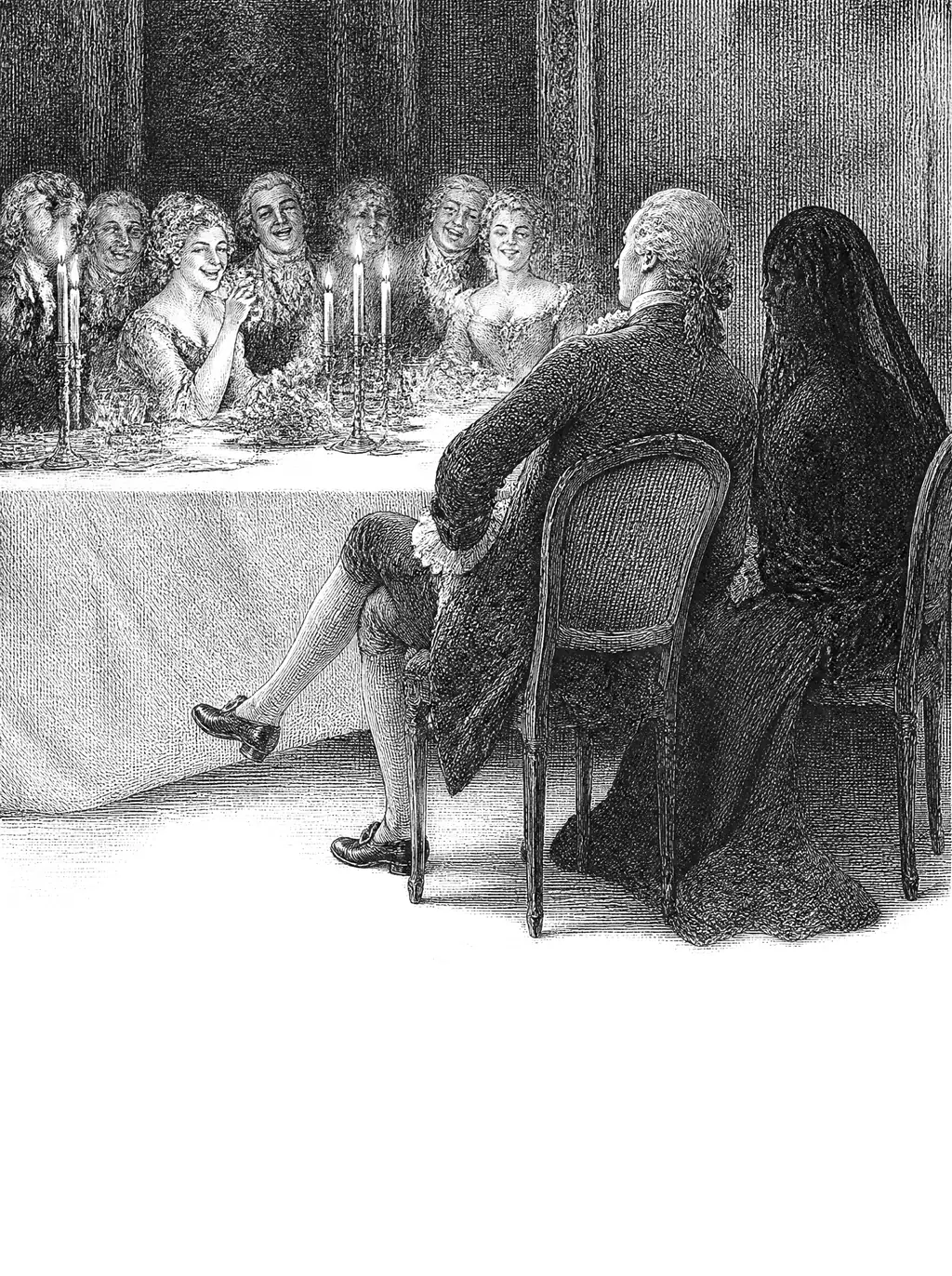
My Melancholy, My Sweetheart
An intimate friend
Most people who suffer from a heavy, recurring sadness try to talk themselves out of naming it clearly, calling it a bad mood or a rough week. Kierkegaard, writing under a pseudonym in Either/Or, did the opposite. He gave his melancholy a place at the table, a name, a history, and something close to affection, without pretending it did not hurt. He was twenty-nine when Either/Or appeared, and had already broken off the engagement that would shadow the rest of his life. The melancholy was not new. It was, on his own account, the family inheritance.
The world it came from
Either/Or was published in Copenhagen in February 1843 under the name Victor Eremita, a supposed editor who claims to have found the papers of two men in a secondhand writing desk. The first man, called A, is an aesthete who lives for moods, and the Diapsalmata are his scattered aphorisms. Kierkegaard had ended his engagement to Regine Olsen sixteen months earlier, an act he never fully explained and never stopped writing about. His father, a wealthy hosier, had raised him in a house of guilt and religious dread, convinced that God would punish the family for a curse he had uttered as a starving boy. Kierkegaard's word for the condition was Tungsind, heavy-mindedness, and he used it of himself in his journals for the rest of his life.
The idea
Melancholy, in this account, is not simply an enemy to be defeated. It is a companion that shows up in the middle of pleasure and work alike, calling you aside even while you remain present in the room. Naming it honestly, instead of masking it with forced busyness or borrowed cheer, is itself a kind of fidelity to what you actually feel. There is a further move hidden in the passage. A calls his melancholy the most faithful sweetheart he has had, which is a joke at his own expense: he has just lost the real one, and knows the substitute is a symptom.
How the reasoning runs
Start from a plain fact of experience: a certain sadness arrives uninvited, in the middle of pleasure and work alike, and does not leave when told to. Most people respond by refusing it a name, on the theory that naming it makes it stronger. A tests that theory and finds the opposite. What is unnamed rules from hiding; what is named can be addressed, argued with, and, in his phrase, loved back. Second step: fidelity. The melancholy has never left him, and everything else has. That constancy is a fact worth honoring, however grim. Third: the honesty itself is a small act of freedom, because it is his own report on his own state, rather than the cheerful account others would prefer to hear.
Seen in life
It is a good evening. Friends, a long table, someone telling a story you have heard before and still enjoy. Then, between one laugh and the next, it arrives: a pull to one side, a sense of being called out of the room while your body stays in it. You know this visitor. Your usual move is to order another drink and talk louder. Kierkegaard's A does something else. He turns toward the visitor and says, in effect, there you are. He does not leave the table, and he does not pretend the seat beside him is empty. Try it once. The sadness does not shrink, but it stops being a secret you are keeping from yourself.
Why it matters
A culture that treats sadness only as a malfunction to be fixed can leave people feeling doubly bad: sad, and then ashamed of being sad. Kierkegaard's blunt honesty about his own melancholy offers a different posture, neither wallowing in it nor faking its absence, just acknowledging a real and recurring part of an inner life without dressing it up as something else. It also refuses the cure that costs more than the disease: the forced cheer that makes a sad person a liar as well. Naming the thing keeps you honest, which for Kierkegaard was always the first requirement of any inner life worth having.
“My melancholy is the most faithful sweetheart I have had—no wonder that I return the love!”
From the source
In the Diapsalmata from Either/Or, Kierkegaard writes: “In addition to my numerous other acquaintances I have still one more intimate friend—my melancholy. In the midst of pleasure, in the midst of work, he beckons to me, calls me aside... My melancholy is the most faithful sweetheart I have had—no wonder that I return the love!” The English is from Lee Hollander's 1923 Selections, which the free edition reproduces. The voice belongs to A, a fictional aesthete, not to Kierkegaard in his own name; but the journals show him saying the same of himself, and the pseudonym was a thin one to anyone in Copenhagen who knew him.
The pushback
Doesn't romanticizing sadness as a sweetheart risk making it comfortable, even attractive, instead of something to work through and past? Kierkegaard's own life argues against easy comfort here: the melancholy he describes coexisted with real productivity and real suffering, not a pose. Naming a feeling honestly is not the same as choosing to stay inside it forever. There is also a clinical worry. What Kierkegaard calls a sweetheart, a doctor might call an untreated depressive illness, and courting it rather than treating it is a choice he could not have known he was making.
The reply
Kierkegaard would answer the first objection with the structure of his own book. Either/Or gives A the first half and then hands the second to Judge William, who tells the aesthete that a life lived in moods is not yet a life, and that the way out is a choice. The melancholy passage is a diagnosis, not a prescription. The clinical objection has no reply from 1843, and it is right that the vocabulary of illness did not exist for him. What can be said is narrower: naming a sadness honestly and seeking help for it are not rivals, and the first is often the condition of the second. Kierkegaard supplies the first. He could not supply the other, and did not claim to.
Where it went next
Kierkegaard's willingness to treat a mood as a datum of philosophy reached Heidegger, whose Being and Time in 1927 made anxiety and boredom into ways the world is disclosed rather than noise to be filtered out. The existential psychotherapists of the mid twentieth century, Rollo May and Irvin Yalom among them, took the further step and made the naming of dread part of the treatment. Camus's absurd hero and Sartre's nausea are both descendants of A's honest report. In Denmark, Kierkegaard became the melancholy Dane of national legend, which he would have found both accurate and beside the point. The line about the faithful sweetheart is now among the most quoted in his work, usually without the joke.
Where this leads
The leap of faith shows the other side of Kierkegaard's inner life: the same man who sat with his melancholy also insisted that a decisive leap past reason's comfort was possible, which suggests the sadness never had the final word. The two ideas share a structure. In both, a person refuses the comfortable account of his own state and stays with the true one, whether that state is sadness or the terror of Abraham. Honesty about the inner life is the thread that ties Kierkegaard's darkest pages to his most hopeful.