Symposium · Existentialism · Pl. 10Søren Kierkegaard · 1813–1855
The Leap of Faith
A father and a knife
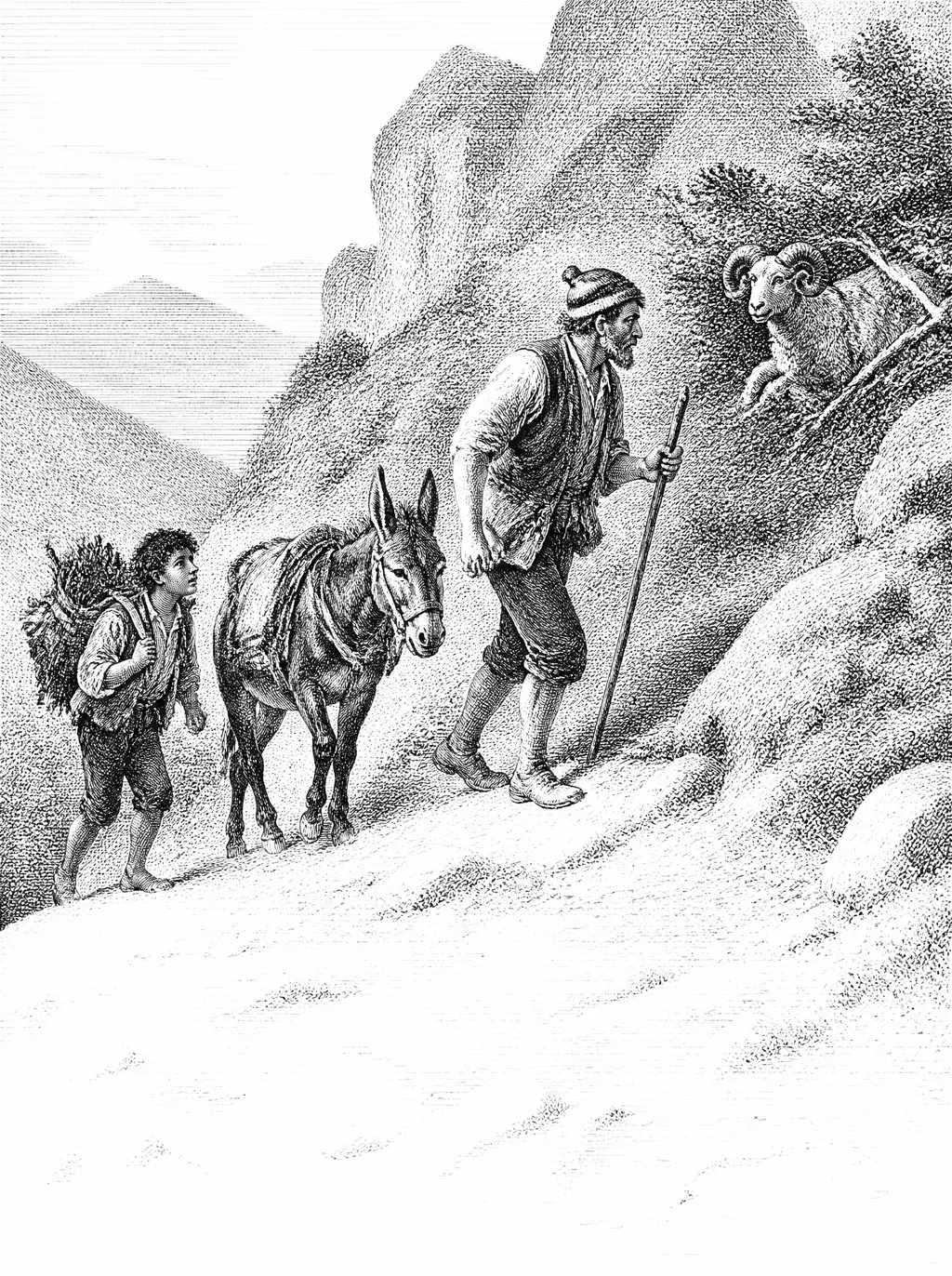
God tells Abraham to sacrifice his son Isaac, and Abraham saddles his donkey the next morning and rides toward the mountain without protest. Kierkegaard spent an entire book refusing to soften this story into something comfortable. He wanted readers to feel the full horror of it, because the horror is exactly what makes Abraham's faith worth understanding at all. He published the book under a pseudonym, Johannes de Silentio, John of Silence, a narrator who says again and again that he cannot understand Abraham and cannot do what Abraham did.
The world it came from
Fear and Trembling appeared in Copenhagen in October 1843, the same day as Repetition, two years after Kierkegaard had broken his engagement to Regine Olsen without telling her why. Readers then and since have seen Regine in Isaac: something loved, given up on a conviction that could not be explained, and yet, he hoped, somehow to be given back. The philosophical enemy was Hegel, whose system dominated the Danish church and university, and whose followers spoke of going further than faith into rational understanding. Kierkegaard's narrator replies that in his day nobody stops at faith; everyone goes further, and he wonders whether anyone has actually arrived. The story of Genesis 22 was chosen because no system could digest it.
The idea
Faith, for Kierkegaard, is not calm trust that everything will work out reasonably. It is a leap made past the point where reason can follow, holding onto God's promise while simultaneously being willing to do the very thing that would destroy it. Abraham believed he would keep Isaac and raised the knife anyway. Both halves are the leap, held at once. Kierkegaard's own term is the double movement. First the knight of infinite resignation gives up everything finite; then the knight of faith, by virtue of the absurd, expects to receive it back in this life, not the next.
How the reasoning runs
Set out the alternatives honestly. Abraham could refuse and remain ethical; the ethical is universal, and it says a father does not kill his son. He could obey in despair, giving up Isaac in his heart; that is resignation, and it is coherent. What he actually does is neither. He obeys, and he goes on believing he will keep Isaac, not in heaven but here. Reason has no category for holding both. So either Abraham is a murderer, or there is a movement of the self that suspends the ethical for a higher purpose and cannot be justified to any third party. Kierkegaard calls the second option faith and refuses to make it comfortable. The absurd is not a flaw in the leap; it is the leap's material.
Seen in life
You leave a secure post for work nobody has asked you to do. Every spreadsheet says no, and every friend, kindly, agrees with the spreadsheets. You cannot argue them out of it, because the argument is not what you are acting on. What you are acting on is a conviction that this is yours to do and that, past the point where the evidence gives out, it will not turn out to have been a mistake. That is not Abraham; nobody's life is on the knife. But it has the shape Kierkegaard cared about: a commitment that only becomes real once you can no longer show anyone why it is reasonable. If you wait for the proof, you will wait forever, and that waiting is the refusal.
Why it matters
Most people want faith to be reasonable, backed by evidence and argument, so that believing feels safe. Kierkegaard denies that this is possible for the kind of faith that matters most. Some commitments, to a person, a calling, a conviction, only become real once you have gone further than the evidence justifies, and that gap is the leap itself, not a flaw in it. The leap also explains why such commitments cannot be shared. Abraham cannot explain himself to Sarah, to Isaac, or to us. Whatever is chosen this way is chosen alone, and its loneliness is part of its price.
“The movement of faith must ever be made by virtue of the absurd, but, note well, in such wise that one does not lose the things of this world but wholly and entirely regains them.”
From the source
In Fear and Trembling, Kierkegaard writes of Abraham's ordeal: “The movement of faith must ever be made by virtue of the absurd, but, note well, in such wise that one does not lose the things of this world but wholly and entirely regains them.” The narrator sets the sentence against the alternative he understands and can do himself. He can renounce; he can give up the thing of this world and hold it only in eternity. What he cannot do is Abraham's further move, which regains Isaac in time, in the flesh, by a faith that expects the impossible. The English is Lee Hollander's 1923 rendering. Kierkegaard rarely uses the phrase leap of faith; the leap is his, but the label was attached later.
The pushback
Doesn't praising a man for nearly murdering his son on a private conviction of God's voice give cover to every fanatic who claims the same? Kierkegaard does not deny the danger; he calls Abraham's situation a terrifying paradox precisely because it cannot be justified to anyone else. He offers no formula for telling true faith from delusion, only the honest admission that none exists. Kant had already made the point in 1798: a voice commanding you to kill your child is, by that fact, not God's, and Abraham should have answered that he could not be sure. The moral law, for Kant, outranks any revelation.
The reply
Kierkegaard's reply to Kant is that Kant has described the ethical perfectly and then assumed it is the highest court. If it is, Abraham is a murderer, and Kierkegaard says so plainly: that is what the book means by fear and trembling. The reply to the fanatic is weaker, and the narrator knows it. He offers only marks, not tests: the knight of faith does not want followers, does not preach, expects to be misunderstood, and would not lift the knife against anyone but what he most loves. A zealot who kills strangers for God fails every one of these. But a mark is not a proof, and Kierkegaard's honesty here is his whole answer: no proof exists, and pretending one does is the deeper fraud.
Where it went next
Kierkegaard's leap was taken up by Karl Barth in the 1920s, whose theology made the gap between God and reason the whole point, and by Wittgenstein, who read Kierkegaard with admiration and held that faith could not be a matter of evidence. Camus called the leap philosophical suicide in 1942, and the accusation defined the split between religious and secular existentialism. Sartre secularized the shape, keeping the commitment without a rulebook and dropping God. The teleological suspension of the ethical, Kierkegaard's phrase for what Abraham does, became the standard name for the problem of whether religious duty can override morality, and it has been argued on both sides ever since. Regine Olsen outlived him by nearly fifty years and kept his letters.
Where this leads
Existence precedes essence secularizes the same shape of choice: a commitment made without a rulebook to justify it in advance, backed by nothing but the fact that you made it and now, absurdly, have to go on living inside it every day. Against the crowd is the other half. A leap is by nature a thing one person does; a crowd cannot leap, only shuffle. Kierkegaard's attack on the mass and his praise of Abraham are the same conviction, that the serious decisions of a life are made alone.