Symposium · Existentialism · Pl. 13Albert Camus · 1913–1960
One Must Imagine Sisyphus Happy
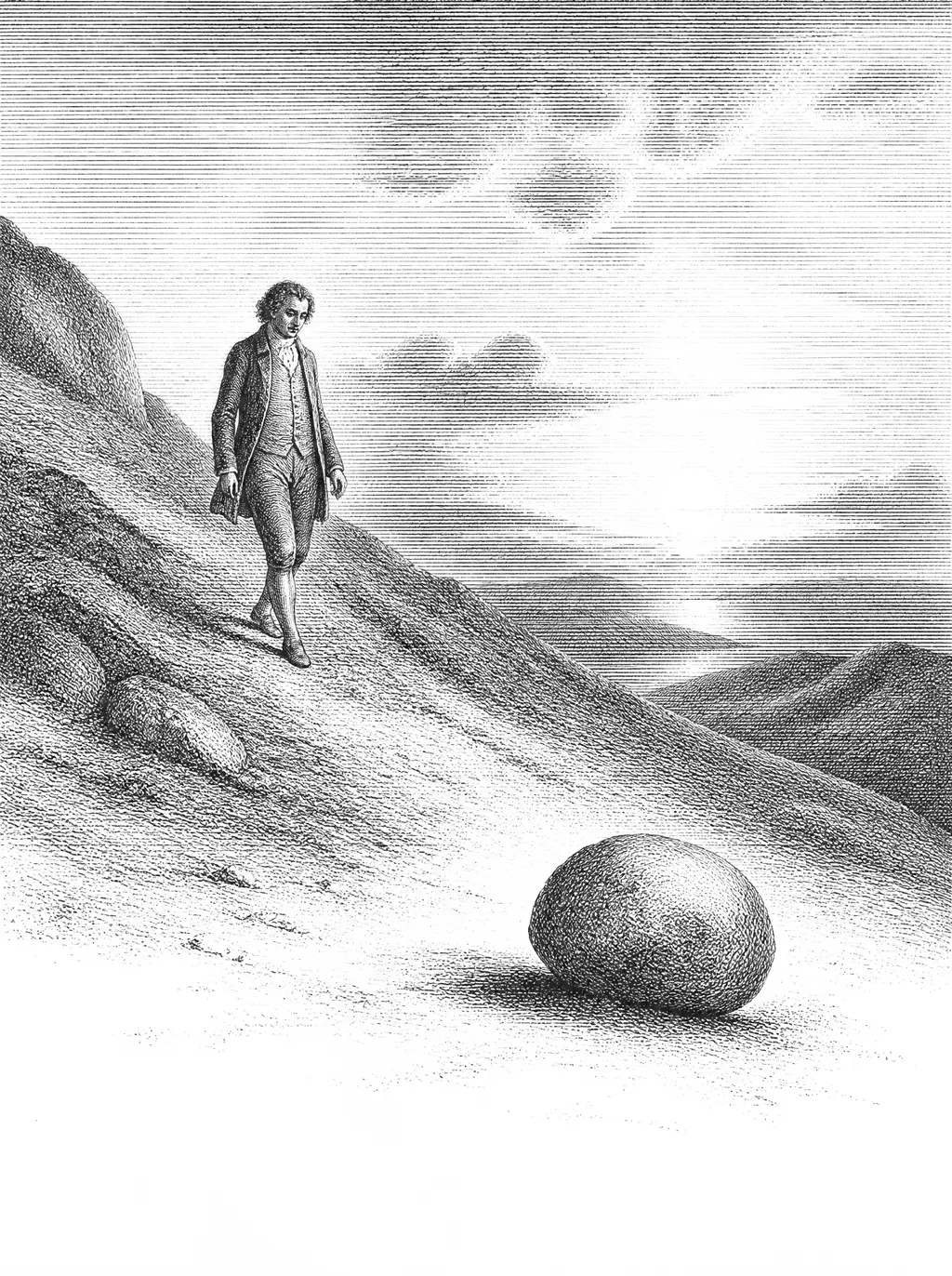
The boulder rolls back down
Sisyphus tricked death itself, and the gods answered with a punishment engineered to be as pointless as possible: push a massive rock to the top of a mountain, watch it roll all the way back down, and start again, forever. No task in mythology looks more like a definition of futility. Camus chose it deliberately as the emblem for the whole absurd human condition. The essay that carries the name is short, and the myth itself takes up only its last few pages. Everything before it is the argument that makes the closing image bearable.
The world it came from
Camus wrote The Myth of Sisyphus between 1940 and 1941, in Paris, Lyon, and Oran, while France fell and he moved between newspaper jobs that kept closing. He was twenty-seven, tubercular, and had just finished The Stranger; the two books came out in 1942 as a pair. The Sisyphus chapter is a coda. Camus takes the myth from the Greek sources, where Sisyphus is the founder of Corinth, a man who twice cheated death, once by chaining Death himself and once by talking his way out of the underworld. The gods' punishment was designed for a mind that had outwitted them. Camus wanted a hero of the absurd who was neither a saint nor a suicide, and the cleverest of mortals was exactly the man.
The idea
The crushing part of the myth is not the labor. It is the moment of consciousness, the walk back down the mountain, when Sisyphus knows exactly what is coming and has to choose how to meet it anyway. Camus locates the possibility of happiness right there, in that lucid walk, not in ever finishing the task, since the task by design can never be finished. Happiness and the absurd, Camus says, are two sons of the same earth. Sisyphus is happy not despite knowing his fate but because he knows it, and the knowledge is his, not the gods'. They can own the rock. They cannot own the walk.
How the reasoning runs
Begin where the essay's earlier chapters end: the absurd is permanent, suicide and faith are both evasions, and the only honest stance is a revolt that keeps the contradiction open. Now ask what such a revolt looks like when nothing can be changed at all. Sisyphus cannot escape the rock. What he can do is refuse the gods the one thing they wanted, which is his despair. The walk down is the hour of consciousness: he sees the whole of his fate and it does not crush him, because a fate seen whole belongs to the one who sees it. There is no higher destiny, so there is no higher judge. The rock is his thing. The struggle toward the heights is enough to fill a heart.
Seen in life
You clear the inbox on Friday, and on Monday it is full. You clean the kitchen after dinner, and by breakfast it needs cleaning. You finish the quarter's report, and the next quarter starts. None of it will ever be done, and you know that on the walk back to your desk with the coffee. Camus's move is to look hard at that walk. You can spend it counting what the rock took from you, or you can spend it as the one moment when the whole shape of the thing is yours to see. The rock does not care which. That, he says, is precisely the point: nobody is watching, so the verdict on the day is entirely yours.
Why it matters
Most lives contain their own version of the boulder: work that repeats without a final finish line, effort the world will not visibly reward, days that resemble the day before. Camus's Sisyphus offers a way to hold that repetition without despair, by locating meaning in the full, conscious ownership of the struggle itself, rather than in an ending that was never coming. The claim is not that repetition is secretly meaningful. It is that meaning was never going to arrive from the top of the hill, so waiting for it there was the real waste, and the walk down was the real life.
“One must imagine Sisyphus happy.”
From the source
Camus closes the essay with its most famous line, right after describing Sisyphus's slow, conscious walk back down the mountain toward his waiting rock: “One must imagine Sisyphus happy.” The struggle itself, he writes just before it, is enough to fill a human heart. The passage before the last line is where the argument is made. Camus calls the walk down the hour of consciousness, and says that Sisyphus is superior to his fate because he is stronger than his rock. There is no fate, he writes, that cannot be surmounted by scorn. This universe without a master seems to Sisyphus neither sterile nor futile, and each atom of the stone is a world to him.
The pushback
Isn't this just a philosopher's way of glamorizing pointless suffering, telling people stuck in dead-end labor to feel fine about it? Camus is not recommending passive acceptance of injustice; elsewhere he insists on revolt against whatever can actually be changed. Sisyphus specifically cannot change his punishment, which is what makes his case a limit test, not a template for every hardship. Thomas Nagel's objection presses harder. Camus makes Sisyphus a hero by an act of will, and the heroism looks like a pose. If the rock genuinely does not matter, why the scorn and the drama? A lighter response, irony, would suit the case better.
The reply
Camus would accept Nagel's first point and reject the conclusion. Yes, Sisyphus's happiness is an act of will; there is no other kind available in a masterless universe, and calling it a pose assumes there was something more natural to stand on. But the charge of theatre lands. Camus's prose loves defiance, and a reader may reasonably prefer a Sisyphus who shrugs to one who scorns. The honest concession is this: the essay proves that despair is not compulsory, and it does not prove that happiness is available. Between those two lies a range of attitudes, from Nagel's irony to Camus's revolt, and Camus chose the one that suited a young man in an occupied country in 1942.
Where it went next
The last line escaped the essay almost at once and became a slogan, quoted on posters, in pop songs, and by people who never read the argument before it. Beckett's Waiting for Godot, a decade later, staged the same repetition with the defiance removed. Thomas Nagel's 1971 essay The Absurd answered Camus directly, and the exchange remains the standard classroom pairing. Camus himself moved on: The Rebel, in 1951, argued that revolt implies solidarity, and that Sisyphus alone on his hill was only half the story. He won the Nobel Prize in 1957. The image has lasted longer than the philosophy around it, which may be what Camus, who trusted images over systems, would have expected.
Where this leads
The absurd supplies the diagnosis this myth is answering: once you accept that the universe offers no explanation for the boulder, the only question left is exactly the one Sisyphus settles by walking back down toward it anyway, every single time. Read the two as a single motion. The absurd is the stone at the top, about to roll; Sisyphus is what a person does on the way down. Neither idea is complete without the other, and Camus wrote them as chapters of one short book, the diagnosis first and the picture of a cure last.