Symposium · Political Philosophy · Pl. 10John Stuart Mill · 1806–1873
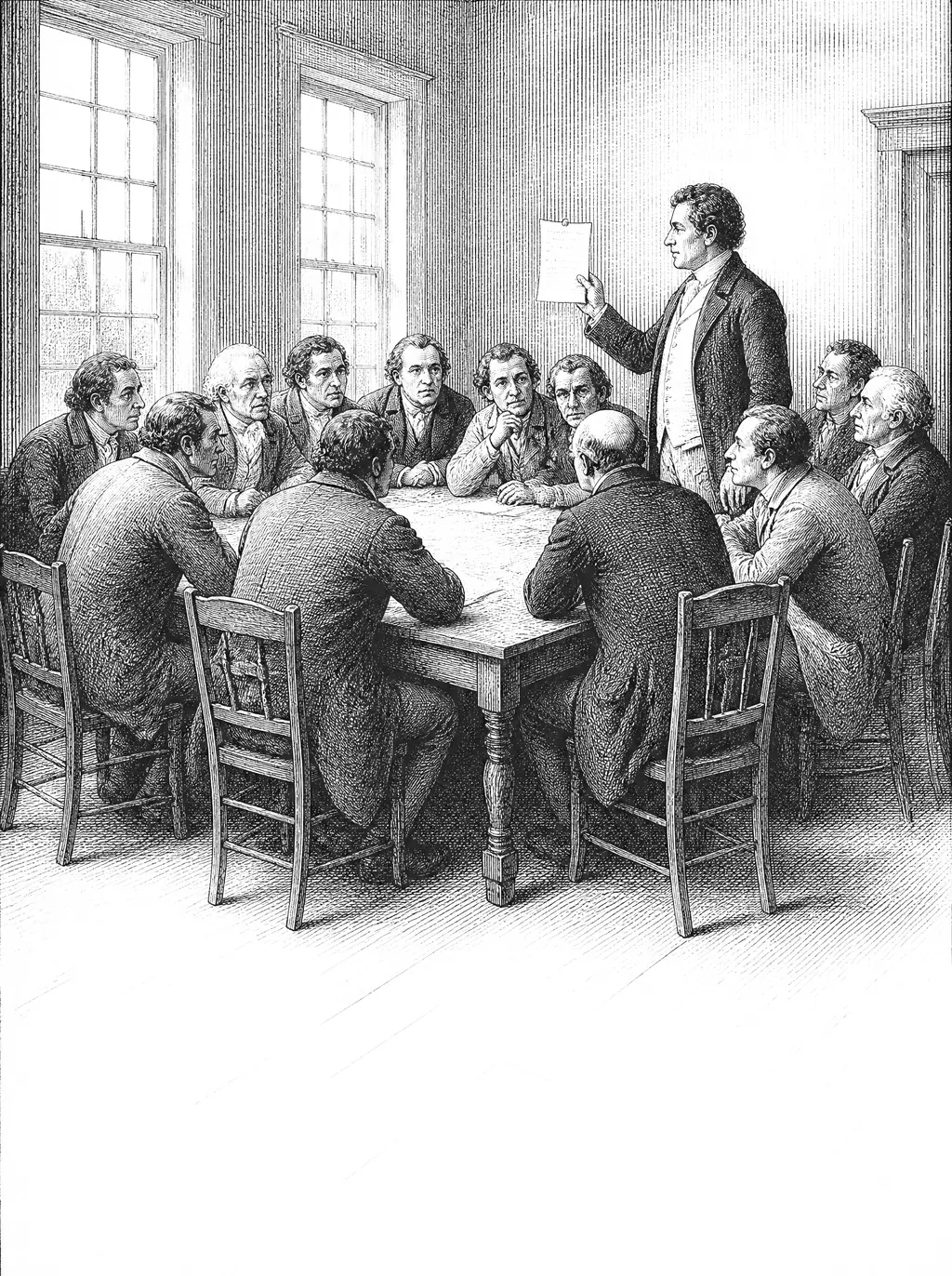
The Ideally Best Government
Two questions, not one
Judging a government's goodness, Mill argues, actually splits into two separate questions people tend to run together: how well does it manage the practical business of society right now, and what effect does it have on the character and capacities of the citizens living under it over time, improving or degrading their judgment and initiative. The second question is the one his predecessors mostly skipped. A benevolent despot might run the trains, the courts, and the treasury faultlessly, and Mill grants it. What such a ruler cannot do is make anyone but himself a capable adult. A people governed perfectly by someone else, he thought, is a people that has been kept from growing up.
The world it came from
Mill published Considerations on Representative Government in 1861, two years after On Liberty and while Britain was arguing about extending the vote beyond the propertied minority who held it. He had spent thirty-five years as an administrator of the East India Company, governing a subcontinent from a desk in London, and had read Tocqueville on the tyranny of the majority in America. He feared both an ignorant mass electorate and a class of rulers accountable to no one. In 1865 he was elected to Parliament for Westminster, and in 1867, during the debate on the Second Reform Act, he moved an amendment to give women the vote. It lost by 196 to 73. He knew the odds when he moved it.
The idea
The ideally best form of government is not one which is practicable in all states of civilization, but the one which, where it is practicable and eligible, produces the greatest amount of beneficial consequences. A completely popular, representative government is the only polity that can make out any claim to this character, being pre-eminent in both the management of affairs and the cultivation of citizens. Representative means the whole people, or a numerous portion of them, exercising ultimate control through deputies they periodically elect. Mill is not asking the people to govern directly. He is asking that nobody be governed without a share in choosing, and dismissing, those who do.
How the reasoning runs
Start with the test: a government is good in proportion to how well it promotes the virtue and intelligence of the people and how well it uses the virtue and intelligence that exist. Next, two arguments for popular rule. First, each person is the only reliable guardian of his own interests, since a class excluded from power has its interests overlooked, not from malice but from inattention. So everyone must have a share, or someone's interests are unprotected. Second, an active character beats a passive one, and people become active by having something to do. Participation in public affairs, even as a juror or a voter, is a school. Therefore the government that gives everyone a share both protects everyone's interests and educates everyone, and no other form does both.
Seen in life
You serve on a jury for the first time. On the first morning you assume the judge will tell you what to think. By the third day you are arguing with eleven strangers about what a witness meant, weighing a document you would once have skimmed, and holding out against a majority because you are not yet convinced. You go home tired and different. Mill's point is that the jury did not only produce a verdict. It produced a citizen. A system that decided cases by expert panel might produce better verdicts, and Mill would concede that. It would also send you home unchanged. He thought a country was governed well only when it kept sending people home changed.
Why it matters
This gives representative government a justification beyond mere fairness or majority rule: participation itself, Mill argues, actively develops the intelligence, judgment, and public spirit of ordinary citizens, in a way passive subjection to even a well-run despotism never could. A government's education of its people becomes as important as its day-to-day management of them. That standard cuts both ways, which is why Mill is still worth arguing with. It condemns the efficient autocracy that keeps its people comfortable and childlike. It also condemns a democracy in which people vote once every few years and otherwise let others decide, since that, by Mill's test, is barely self-government at all.
“A completely popular government is the only polity which can make out any claim to this character. It is pre-eminent in both the departments between which the excellence of a political Constitution is divided.”
From the source
After weighing management and cultivation as the two tests of a government's worth, Mill states his conclusion directly: “A completely popular government is the only polity which can make out any claim to this character. It is pre-eminent in both the departments between which the excellence of a political Constitution is divided.” The passage is from Chapter III, titled That the Ideally Best Form of Government Is Representative Government. Mill has just set up the good despot as the strongest rival and dismissed him: what such a ruler produces is a passive people, and a passive people is a people whose faculties are left to decay. The chapters that follow add the conditions, and the qualifications for which Mill is now criticized.
The pushback
Mill himself immediately qualifies the claim: representative government is not practicable or eligible everywhere, requiring a population with certain capacities already in place to make good use of it. Critics have pushed further, asking who decides which populations qualify, and whether that qualification test has too often served as an excuse to withhold self-government altogether. The charge is not abstract in Mill's case. He wrote that despotism is a legitimate mode of government for peoples he called barbarians, and he spent his career administering one. A second objection targets the mechanism. Mill proposed giving extra votes to the educated. That protects against the ignorant majority he feared, at the price of the equality his own first argument demanded.
The reply
Mill's defenders make two points. His developmental test is the strongest argument against colonial rule ever written by a colonial administrator, since it says that a people governed by others cannot grow into self-government, only out of it; the argument condemns the exception Mill made for India. And his plural voting was always paired with a demand that everyone get at least one vote and that schooling be universal, so the inequality was meant to shrink to nothing over time. Both replies are honest and neither is complete. Mill never explained how a people denied participation would ever become fit for it, and plural voting has been rejected by every democracy that considered it. The test he set survives. Some of his answers to it do not.
Where it went next
Mill's 1867 amendment is counted as the start of the parliamentary campaign for women's suffrage in Britain, and his Subjection of Women in 1869 became its text. The proportional voting scheme he championed, Thomas Hare's single transferable vote, is used today in Ireland, Malta, and the Australian Senate. Carole Pateman's Participation and Democratic Theory in 1970 rebuilt the developmental argument for a new generation, and the whole field of deliberative democracy takes Mill's claim that participation educates as its starting point. Amartya Sen's argument that democracies do not suffer famines, because rulers who must face voters must feed them, is Mill's first argument with data. His exceptions for empire are now the standard case study in how a liberal argues himself into illiberal conclusions.
Where this leads
The general will approaches this same underlying question from an earlier, considerably more skeptical angle still, asking whether popular participation reliably tracks a genuine common good, or only ever the louder, better-organized private interests quietly hiding underneath it all along. Mill read Rousseau's worry and answered with machinery: proportional representation so minorities are heard, an educated electorate so error is checked, and open debate so that factions must argue in public. The harm principle is the other half of Mill's politics. Representative government says who may rule; the harm principle says how far any rule, however popular, may reach into a single life.