Symposium · Ethics · Pl. 8John Stuart Mill · 1806–1873
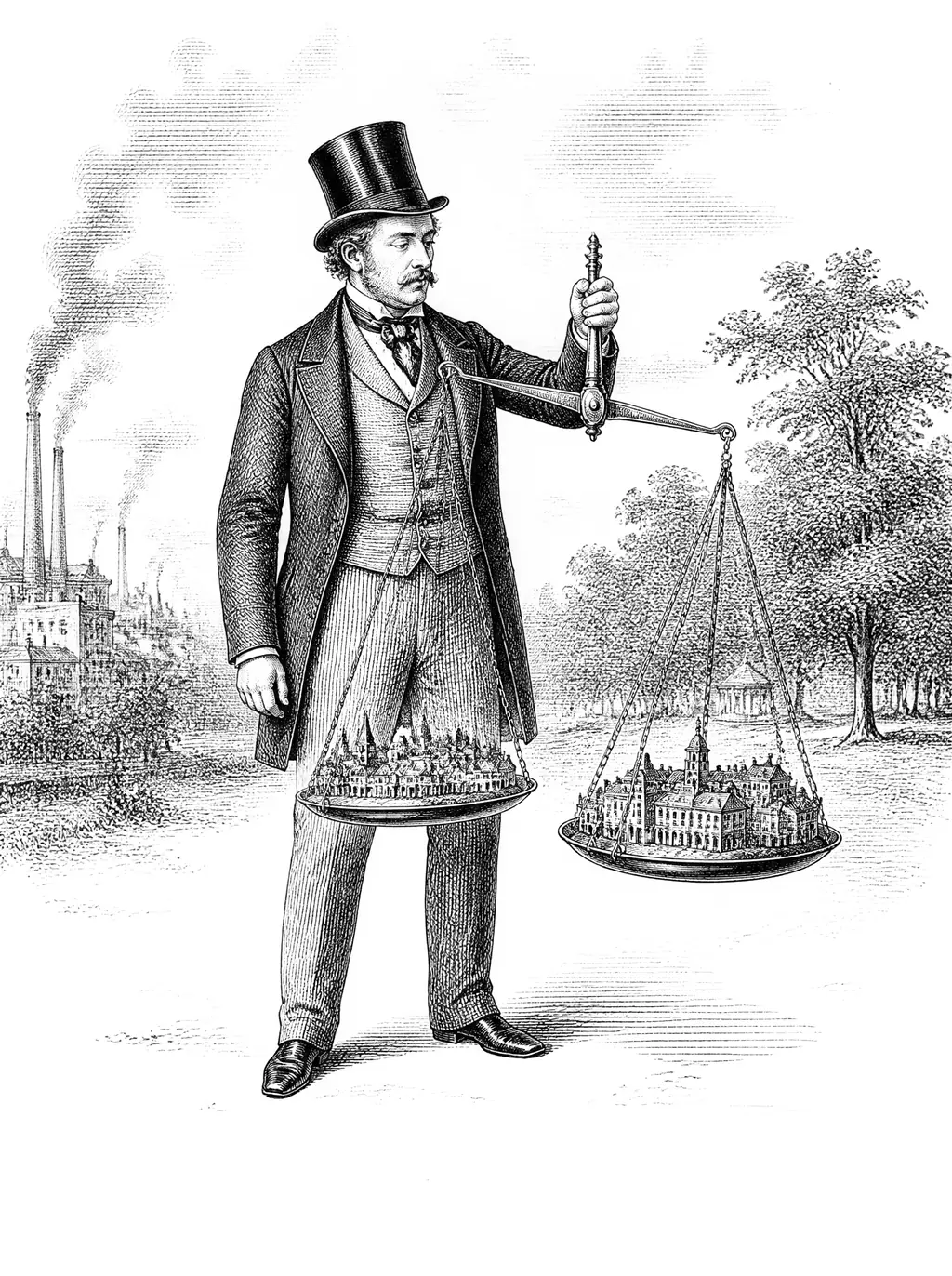
The Greatest Happiness Principle
One test for everything
Instead of a long list of separate rules for lying, stealing, promise-breaking, and every other category of wrongdoing, Mill proposed one master test underneath all of them. Whatever the situation, the same question applies: which available action produces the greatest balance of happiness over suffering, counting everyone affected, not just the person doing the choosing. The rules do not vanish. Do not lie, keep promises, and pay debts remain, but as summaries of what the test has found over centuries of human experience, not as commands from somewhere else. When two rules collide, the test is what you fall back on, because it is what the rules were always for.
The world it came from
Mill was raised by his father, James Mill, and by Bentham to be the perfect utilitarian, reading Greek at three and Plato at eight. At twenty he broke down. He realized, he wrote later, that if every reform he wanted were granted tomorrow he would feel no joy, and that a life aimed only at happiness could not produce it. Wordsworth's poetry and Harriet Taylor pulled him out. Utilitarianism appeared in Fraser's Magazine in 1861 and as a book in 1863, when Mill was fifty-seven and the doctrine was under attack as a philosophy fit for pigs and shopkeepers. He wrote it to defend the principle he had inherited and, without quite saying so, to repair the parts of it that had nearly destroyed him.
The idea
Actions are right in proportion as they tend to promote happiness, and wrong as they tend to produce the reverse of happiness, where happiness means pleasure and the absence of pain. This is not a license for selfish pleasure-seeking: the standard weighs everyone's happiness impartially, which means a truly right action often costs the person choosing it a great deal. Mill added one change to Bentham that alters everything. Pleasures differ in quality, not only quantity. The pleasures of the intellect, of feeling, and of the moral sense are higher than those of the body, and the test of which is higher is the preference of people who have experienced both. It is better, he wrote, to be Socrates dissatisfied than a fool satisfied.
How the reasoning runs
Mill's argument for the principle comes in chapter four and he calls it not a proof but the only kind of evidence available. First: the only proof that a thing is visible is that people see it; the only proof that something is desirable is that people desire it. Second: each person desires their own happiness, so each person's happiness is a good to that person. Third: the general happiness is therefore a good to the aggregate of persons. Fourth: nothing else is desired except as a part of happiness or a means to it; virtue, money, and fame are wanted because they have become parts of what happiness means to the person who wants them. So happiness is the only thing desirable as an end, and the principle stands.
Seen in life
You are the only person who knows your friend's business partner has been lying about the accounts. Telling him breaks a promise you made to the partner's wife, who told you in confidence. Keeping it lets the fraud run another year. Two rules you respect point in opposite directions and neither one outranks the other by fiat. Mill says this is what the principle is for. Count. The wife's trust, the friend's savings, the employees who will lose their jobs if the firm collapses, the precedent you set for yourself as someone whose word can be bought by a sad story. Do the count honestly and one answer is worse for more people. That is the wrong one, however it feels.
Why it matters
This gives ethics something rule-based systems often lack: a single, outcome-focused yardstick that can, in principle, settle hard cases by calculation rather than by appeal to tradition or intuition alone. It also forces uncomfortable honesty about trade-offs, since two competing rules, both normally respected, can be weighed directly against each other by their actual consequences. And it refuses to let anyone's happiness count for less. Mill's principle was an engine of reform because a slave's misery, a woman's confinement, and a pauper's hunger all went into the sum at full weight, whatever custom said. Every argument that the suffering of some group does not matter had, on this test, to show that it did not exist.
“Actions are right in proportion as they tend to promote happiness, wrong as they tend to produce the reverse of happiness.”
From the source
Mill states the principle at the heart of his essay: “Actions are right in proportion as they tend to promote happiness, wrong as they tend to produce the reverse of happiness.” Happiness, he specifies, means pleasure and the absence of pain, unhappiness the reverse. This is the opening of chapter two, What Utilitarianism Is, and Mill spends the rest of the chapter answering the charges he had heard. The doctrine is not a theory of swine, because human beings have faculties higher than the animal appetites. It does not demand that you act always from the motive of general benevolence, since the motive has nothing to do with the morality of the action. And the happiness that counts is not the agent's own, but that of all concerned.
The pushback
Critics point out the obvious danger: a calculation of total happiness could, in principle, justify sacrificing one innocent person if it produced enough benefit for everyone else, a worry the trolley problem later dramatizes directly. Mill's defenders reply that rules protecting individuals, built up over long experience, usually maximize happiness better than case-by-case calculation ever could. A second objection, from Bernard Williams in 1973, is about integrity. If what matters is only the sum, then your own projects, commitments, and refusals are merely inputs, and you must abandon any of them the moment the arithmetic says so. A theory that treats a person's deepest commitments as one more variable, Williams argued, has lost sight of what a person is.
The reply
Mill answers the sacrifice objection in his fifth chapter. Justice, he says, is the name for the class of rules whose observance matters most to human welfare, and security is the one interest no one can do without. A principle that breaks those rules for a local gain destroys the confidence on which all future happiness depends, so a competent utilitarian will almost never break them. Later writers made that answer formal: rule utilitarianism, in Brandt and Hooker, evaluates codes rather than acts. Williams's integrity objection has no such tidy reply. Mill's notion of higher pleasures gives your projects some weight, but not the veto Williams wanted. The tradition's honest position is that a person's own commitments count, and that they do not count for everything.
Where it went next
Henry Sidgwick's Methods of Ethics in 1874 rebuilt the theory with a rigor Mill lacked and found at its heart a conflict between self-interest and the general good that he could not resolve. G. E. Moore attacked the chapter four proof in 1903 as the naturalistic fallacy, and the argument about whether Mill committed it is still running. R. M. Hare split moral thinking into two levels, intuitive rules and critical calculation, to answer the sacrifice cases. Welfare economics is the principle in equations. Peter Singer applied it to animals and to famine, and the effective altruism movement of the 2010s applied it to charity with spreadsheets. Bentham's calculus never got built, but Mill's version became the default ethics of public policy in the English-speaking world.
Where this leads
The trolley problem stress-tests this exact principle against a case where the arithmetic and the gut both pull hard in opposite directions, asking whether maximizing total welfare can really justify using one person as a mere means to reach it. The harm principle is what Mill built on top of this foundation for politics: a society that leaves adults alone in their private choices produces more happiness in the long run than one that polices them, so liberty is what the sum recommends. Two sovereign masters is the older, blunter statement Mill inherited from Bentham. Read the three together and you can watch a doctrine being softened by its heir, who kept the arithmetic and quietly changed what was being counted.