Symposium · Philosophy in Fiction · Pl. 13Samuel Johnson · 1709–1784
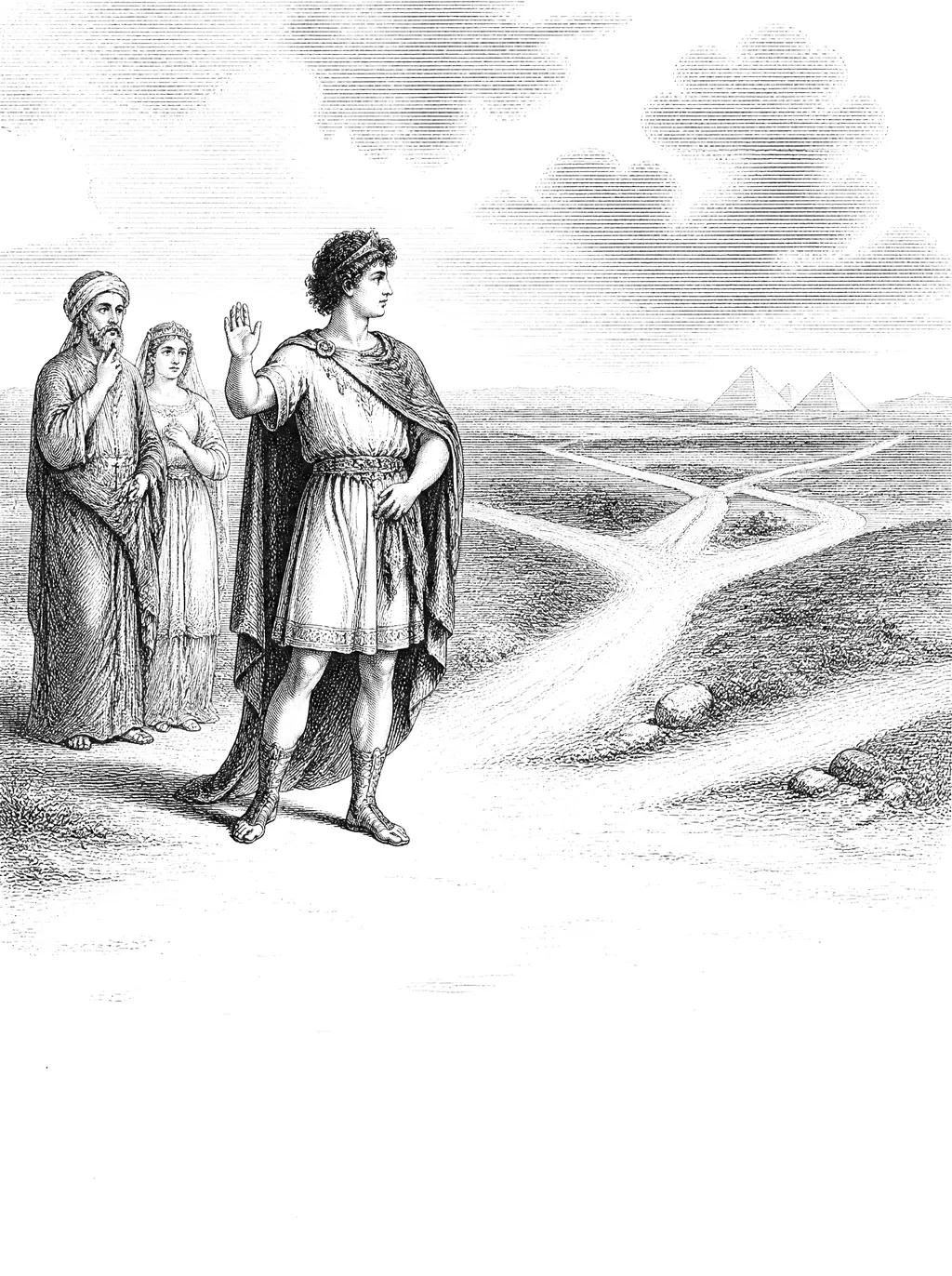
The Choice of Life
The survey that never ends
Rasselas, fourth son of the emperor of Abyssinia, is raised in a valley where every appetite is met before it is felt, and is bored past bearing. He escapes with his sister Nekayah and the poet Imlac, intending to inspect every condition of human life and then select his own. They sample the court, the countryside, the university, the hermitage, marriage, and celibacy. Each turns out to contain a defect the outside view had hidden. The search is conducted honestly and at length, and by the end of the book the prince has still chosen nothing.
The world it came from
The character is Prince Rasselas; the work is The History of Rasselas, Prince of Abissinia, which Samuel Johnson wrote in the evenings of a single week in January 1759 to pay for his mother's funeral. He was forty-nine, had finished the Dictionary four years earlier, and had lived most of his adult life short of money and afraid of madness. The book borrows an Oriental-tale form that was fashionable after Voltaire's Zadig and Candide, which appeared the same year. Behind the plot lies the older question the Stoics and Epicureans had each answered confidently: which manner of living produces happiness.
The idea
Johnson attacks a hidden assumption in that older question, the assumption that life is a set of options laid out for inspection, and that a rational person surveys them and selects. Once you take the survey seriously it eats the years it was supposed to inform. Every condition looks tolerable from outside and reveals its particular misery from inside, so the comparison can never be completed by an observer. Imlac's correction is not that one of the options is best after all. It is that the surveying posture is itself a way of not living, and that the choice was never available in the form the prince imagined.
How the reasoning runs
The book argues by exhaustion rather than by proof. Take any condition of life: it appears happy from outside, because its griefs are private. Enter it and the griefs appear. Therefore no external survey can rank conditions, and an internal one requires living each of them, which no life is long enough to do. Meanwhile time is passing, and the surveyor has been spending it on inspection rather than on any condition at all. Add Johnson's darker premise, that human life is a state in which much is to be endured and little enjoyed, and the conclusion follows: the choice of life is not a decision problem, and treating it as one guarantees the worst outcome.
Seen in life
A graduate spends four years testing careers by proxy: coffees with people in each field, a spreadsheet of trade-offs, three internships, a year of research into which city, and a rule that nothing gets committed to until the comparison is complete. Every entry on the list is defensible. The four years are not on the list. Johnson's point is not that the graduate should have picked the first option, which would be its own foolishness. It is that the spreadsheet quietly assumes the clock is stopped while it is being filled in, and that this assumption is the single largest error in it.
Why it matters
Modern life multiplies options and then supplies tools for comparing them, which makes the surveying posture easier to hold and harder to notice. Johnson wrote before any of that and named the structure exactly. His book is also unusual in refusing the consolation it has earned. It does not conclude that a simple life is best, or that happiness is within, or any of the endings its form invites. The final chapter is called the conclusion in which nothing is concluded, and Johnson means it as a description of the human case rather than as a joke about his own plot.
“while you are making the choice of life you neglect to live”
From the source
In chapter thirty, Rasselas tells Imlac that the dismal history of private life has almost discouraged him from further search. Imlac answers: “It seems to me,” said Imlac, “that while you are making the choice of life you neglect to live.” He then turns the prince outward, toward the Egyptian monuments and the works of the dead, on the ground that to know anything we must know its effects. Late in the book, standing in the catacombs, Rasselas says that the wise and powerful lying before them were perhaps snatched away while they were busy, like him, in the choice of life. Nekayah replies that she now hopes to think only on the choice of eternity.
The pushback
The first complaint is that Johnson has proved too much. If comparing conditions is futile, then deliberation about how to live is futile, and the book leaves nothing between paralysis and arbitrary commitment. That is unhelpful advice for a person who really does have to decide between two jobs. The second complaint is about the ending. Johnson dissolves the problem by pointing at eternity in the last chapters, which reads to a secular reader as changing the subject rather than answering it, and which sits oddly with a book that has been so unsparing about every earthly comfort.
The reply
On the first charge, Imlac's advice is narrower than the objection assumes. He does not say stop deliberating; he says stop deliberating instead of living, and his cure is to go and look at Egypt while thinking. Deliberation embedded in an actual life is a different activity from deliberation as a substitute for one. On the second charge, Johnson would not concede much. He was a believer for whom the shortness of the present state was a fact rather than a comfort, and he had already written that human life is everywhere a condition in which much is endured and little enjoyed. The turn to eternity is his premise, not his escape.
Where it went next
Rasselas stayed in print continuously and was translated across Europe, read alongside Candide as the sober English answer to Voltaire's French one; the two books appeared within months and neither author knew of the other. Jane Austen and George Eliot both knew it well, and Charlotte Brontë put it into Jane Eyre as the book Helen Burns is reading. Its phrase, the choice of life, became a standard heading in nineteenth-century moral writing. Modern psychology rediscovered the mechanism under other names, in work on the paralysis produced by too many options and on how badly people predict what will suit them.
Where this leads
Seneca's essay on the shortness of life is the same diagnosis eighteen centuries earlier, and reading it beside Rasselas shows how little the argument needed to change: both say that the time spent preparing to live is the life. Aristotle's eudaimonia is the target Johnson is undermining, since it assumes a best kind of life exists and can be identified. And William James on whether life is worth living picks the question up once the survey has failed, asking not which condition to choose but what to do when no answer is going to arrive.