Symposium · Stoicism · Pl. 14Seneca · c. 4 BC – 65 AD
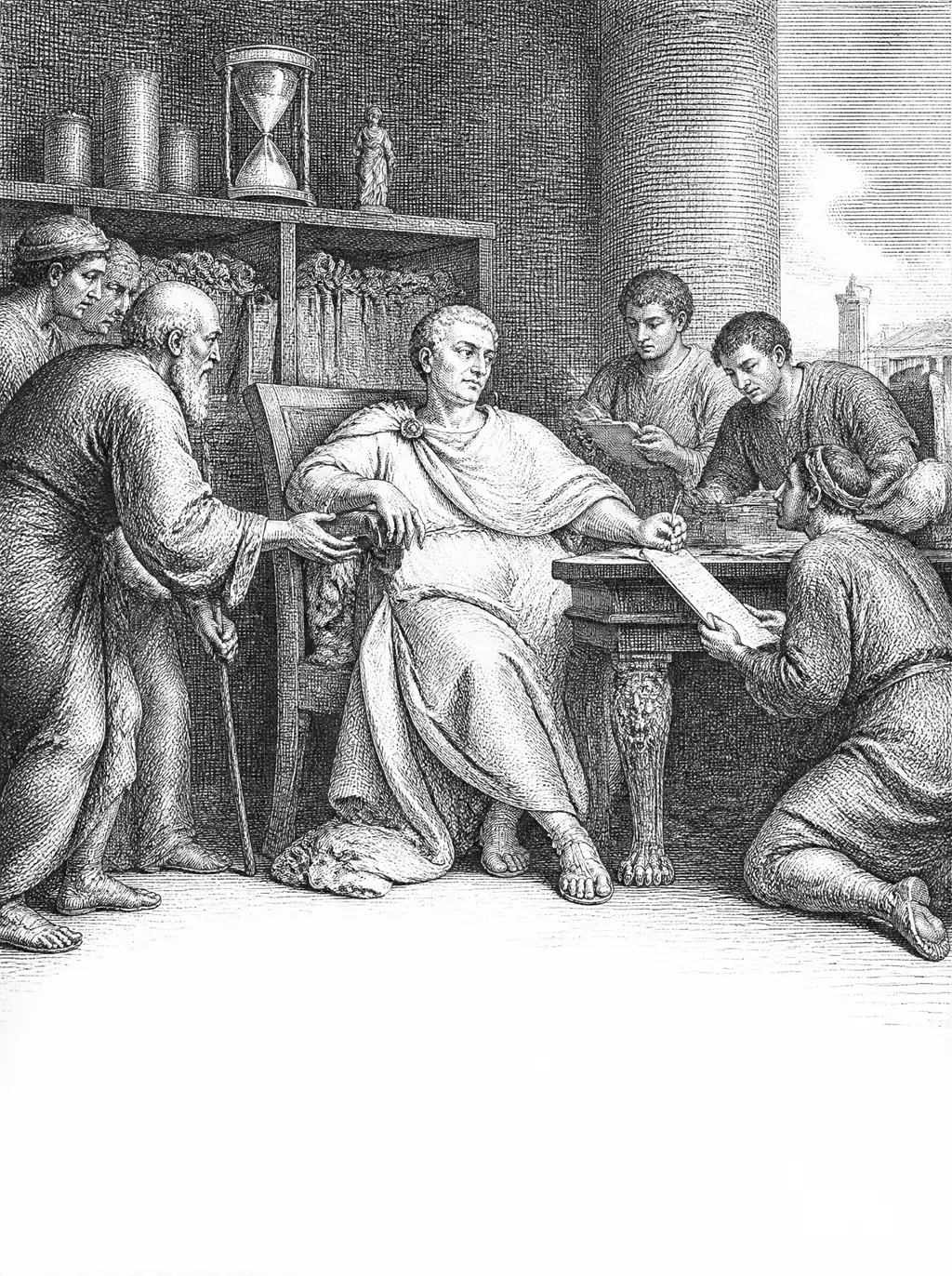
On the Shortness of Life
A common complaint
Seneca opens his essay by naming a grievance nearly everyone shares: nature gave us too little time, and it runs out just as we are learning how to use it. He does not dismiss the feeling. He turns it around, and argues the shortage people feel is almost never the actual length of their days. He wrote it for a man who had spent his career counting Rome's grain, and had never once, Seneca suspected, sat down to count his own days with the same care.
The world it came from
Seneca addressed On the Shortness of Life to Paulinus, the official in charge of Rome's grain supply and probably his wife's father, around 49 AD. Seneca had just returned from eight years of exile on Corsica, banished by Claudius in 41 on an adultery charge, and was about to become tutor to the young Nero. He was, in other words, a man who had lost eight years to someone else's decision and was about to hand the rest to a court. Rome's elite lived by the morning call: hours spent waiting in a patron's hall, days spent in other people's lawsuits and dinners. Seneca had a word for such people, the occupati, the busy, and the essay is his case that their busyness was the theft.
The idea
You are not given a short life. You make it short, by handing enormous stretches of it to things that were never worth the trade: idle ambition, other people's business, distractions chosen because they were easy rather than because they mattered. The days themselves were long enough for anything important. What ran out was your attention to them. Seneca's test for a wasted hour is simple. Was it spent on something you chose, for a reason you could state, or on something that merely presented itself? Most people, he thinks, could not say where last week went, and that is the whole diagnosis.
How the reasoning runs
Seneca argues from arithmetic and then from ownership. The arithmetic: a life is long enough for great things if the whole of it were used for them, and nobody disputes this when the accounting is done honestly; the problem is that the accounting is never done. The ownership: time is the one possession people give away without noticing, because it is invisible and because they assume the supply is large. They would fight for a coin and hand over an afternoon. So the shortage people feel is real, but its cause is mislocated: not a stingy nature, but a spendthrift owner. From this follows the remedy. Take back the hours from other people's business, and spend them on the only work that is properly yours: learning how to live.
Seen in life
Look at your calendar for last week. Count the hours that were yours: chosen, for a reason you could state now. Then count the others. The standing meeting nobody remembers scheduling. The two hours reading arguments between strangers. The favour for a colleague that grew into a project. The evening that vanished into a screen you did not decide to open. Seneca does not tell you those were sins. He tells you to notice that you would have fought for the same hours if someone had tried to take them by force, and that you gave them away for nothing because no one asked. Now look at the coming week. Some of those hours are not yet spent.
Why it matters
This moves the entire problem from something done to you, an unfair universe stingy with your years, to something you are actively doing to yourself, one wasted afternoon at a time. That reframe is less comforting and more useful: a stingy universe cannot be fixed, but a habit of spending your days on the wrong things can. It also relocates the emergency. If time were short by nature, the right response would be resignation, and a graceful one at that. If time is short by habit, the right response is available this afternoon, and there is no grace in putting it off until the next one.
“We do not have a very short time assigned to us, but we lose a great deal of it: life is long enough to carry out the most important projects.”
From the source
Seneca states his whole thesis early in the essay: “We do not have a very short time assigned to us, but we lose a great deal of it: life is long enough to carry out the most important projects.” — On the Shortness of Life. He then walks through the thieves. The man enslaved to his patron's morning audience. The man enslaved to his wine. The man who counts the days to a retirement he will not live to see, and the man so busy arranging his life that he never gets around to living it. Paulinus, he says at the end, has kept Rome's accounts long enough. It is time he kept his own.
The pushback
This can sound like it blames people for circumstances they never chose: exhausting jobs, family obligations, sheer bad luck eating up their hours. Seneca's target is narrower than that. He is writing chiefly to the comfortable, whose time is eaten less by necessity than by their own restless ambition, and the essay says so directly. There is a second objection Seneca does not see coming. His remedy is philosophy: withdraw and study. For a modern reader that looks like one more way to spend a life, not the only one, and a rather comfortable one for a man who could afford to withdraw.
The reply
Seneca's defense against the blame charge is in the text: his named targets are the ambitious, the idle rich, and the officials who cannot stop, and he does not count necessity among the thieves. The remedy objection has a partial answer. Seneca's philosophy was not scholarship; it was the practice of living well, and the essay counts as leisure only the study of how to live, not any pleasant idleness. So a modern reader can substitute their own version of that study without breaking the argument. What the reader cannot do is escape the demand behind it, that some of your hours be spent on the question of what your hours are for. On that Seneca concedes nothing.
Where it went next
The essay became one of the most reprinted things Seneca wrote, and every age has found its own thieves in it. Montaigne took the argument into the Essays in the 1580s and made time-accounting a private habit. Thoreau went to Walden in 1845 to stop paying the same debts to other people's business. The twentieth century's time-management industry is Seneca inverted: the same arithmetic, spent on fitting more in. The attention critics of the last forty years, from Neil Postman in 1985 to Oliver Burkeman's Four Thousand Weeks in 2021, have turned the argument back the right way round. Burkeman's title is the essay's thesis as a number. Seneca's question is how many of the weeks you spent.
Where this leads
Memento mori gives this idea its daily discipline: remembering you could depart this life at any moment is exactly the tool Seneca recommends for noticing, in real time, which of today's hours were actually worth spending, before they too run out unspent. Measure things by their use applies the same audit to objects instead of hours. The question of what a thing was actually for, asked of your possessions, is the question of what an hour was for, asked of your day, and Seneca wrote both essays for the same kind of reader: someone rich enough to waste and honest enough to notice.