Symposium · Ethics · Pl. 4Aristotle · 384–322 BC
Eudaimonia
Not a mood, a way of living
Ask most people what they want most, and eventually the answer bottoms out at happiness, the one thing chosen for its own sake and never as a means to something else. Aristotle agreed happiness was the ultimate goal, but he meant something stranger and sturdier than a pleasant feeling: eudaimonia, closer to human flourishing, a whole life well lived and well used. The Greek word is built from eu, well, and daimon, a guiding spirit, and older Greeks had used it for the luck of the gods' favorites. Aristotle kept the word and took the luck out of it, or most of it. The good life, on his account, is something you do, not something that happens to you.
The world it came from
Aristotle worked out this account in Athens in the 330s BC, lecturing at the Lyceum to young men who would go on to run estates and cities. The question of the best life was not academic there. The old aristocratic answer was honor and glory, the answer of the Homeric heroes. The Sophists had offered pleasure and power. Plato, Aristotle's teacher for twenty years, had answered with knowledge of the Good, a single form beyond the world. Aristotle had spent the years since Plato's death studying animals, and he brought that habit to ethics: look at what the thing is, find what it is for, and judge it by how well it does that. The Nicomachean Ethics is the result, and its first book is about happiness.
The idea
Every craft and skill has a proper function, and doing that function well is what excellence means for it. Aristotle asked what the proper function of a human being is, and answered: activity of the rational soul in accordance with virtue. Eudaimonia is that activity, sustained over a complete life, not a peak feeling but a pattern of living and acting excellently. The stress on a complete life is deliberate. One swallow, he says, does not make a spring, and one good day does not make a person happy. He also admits that a flourishing life needs some external goods: friends, health, enough money, decent birth. A person who is very ugly, or alone, or who has lost his children, is hindered, however good he is.
How the reasoning runs
Start with the observation that every action aims at some good, and that some goods are wanted for the sake of others. Second, if there is a good wanted for its own sake and never for anything else, that is the highest good, and everyone calls it happiness. Third, ask what happiness consists in, and answer by function. A flute player's good lies in playing well, a carpenter's in building well. Fourth, a human being has a function too, and it is not nutrition or perception, which plants and animals share, but life according to reason. Fifth, the good of a thing with a function is to perform it excellently. Therefore the human good is the excellent exercise of reason, in action, across a whole life.
Seen in life
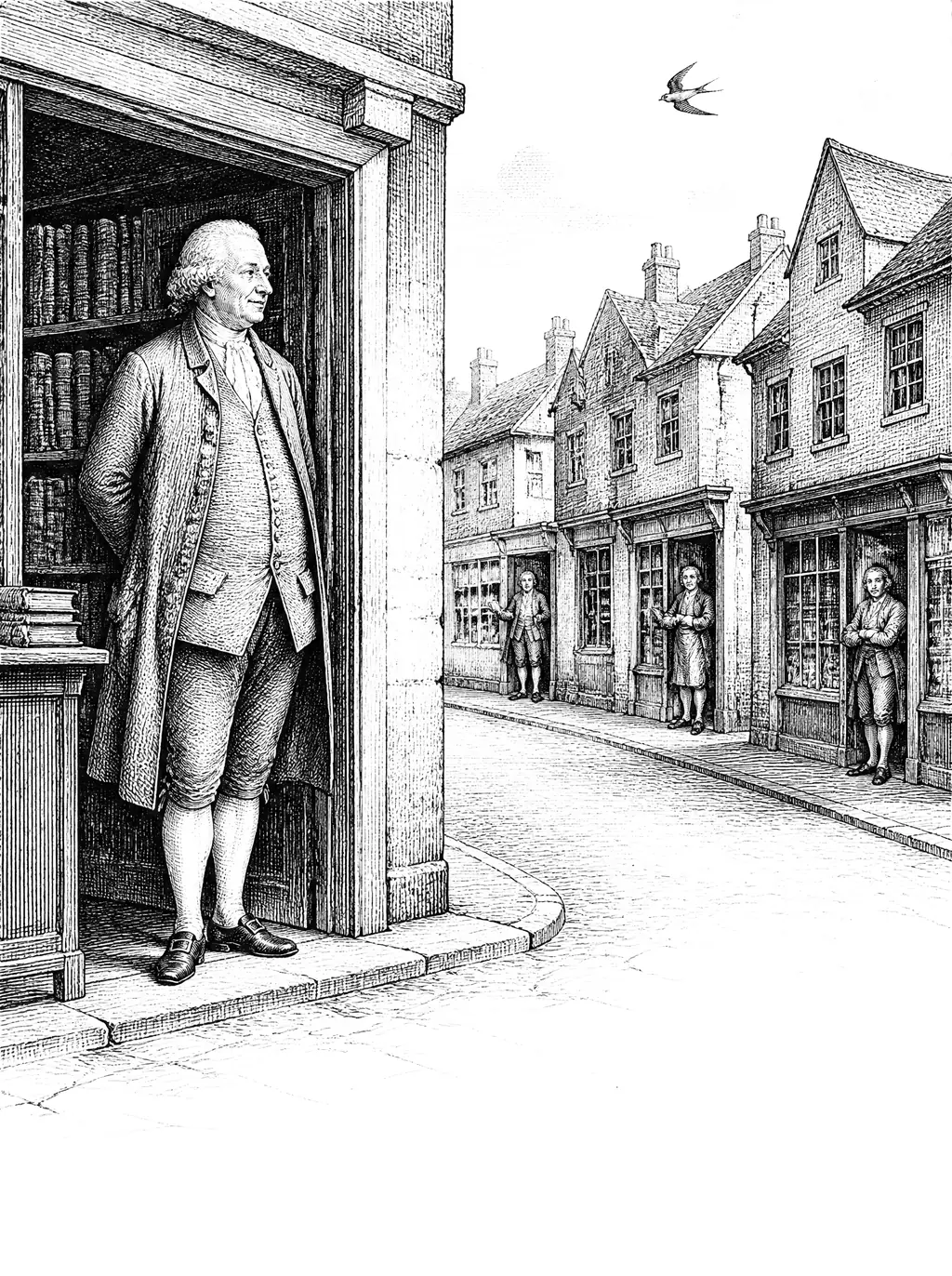
Two people retire in the same month. One has spent thirty years keeping a small bookshop alive, arguing with customers, mentoring three assistants who now run shops of their own, and reading everything. The other won a lottery at thirty-two and has been comfortable ever since, with good weather, good wine, and nothing in particular to do. Ask which of them has been happier and the second may well report more pleasant afternoons. Aristotle's question is different: which of them has lived well? The bookseller has exercised judgment, courage, generosity, and intelligence every working day for three decades. That activity is the happiness, on Aristotle's account, whether or not it felt like happiness at four o'clock on a Tuesday.
Why it matters
This reframes the pursuit of happiness away from moment-to-moment pleasure, which comes and goes regardless of how you are actually living, and toward the ongoing exercise of your own capacities at their best. A single lucky, pleasant day tells you little about whether a life is eudaimon; a whole life shaped by wisdom and virtue tells you everything. It also makes happiness something you can work on. A feeling can be chased and missed. An activity can be practiced. If the good life is the exercise of your best capacities, then the question each morning is not how to feel better but what to do well, and that is a question with an answer, most days, within reach.
“It is a working of the soul in the way of excellence or virtue of a certain kind.”
From the source
Aristotle gives the definition directly in the Nicomachean Ethics: “It is a working of the soul in the way of excellence or virtue of a certain kind.” Chance and circumstance play a part, he admits, but the core of the good life is this sustained activity, not luck alone. The passage is the conclusion of the function argument in Book I, chapter seven. Aristotle adds at once that if there are several excellences, happiness is activity in accordance with the best and most complete of them, and that it must be in a complete life. He then tests the definition against what people already say about happiness, that it involves virtue, pleasure, and prosperity, and finds that his account explains why each of them seemed right.
The pushback
A natural objection: doesn't this make happiness sound suspiciously like hard work and virtue, when most people simply want to feel good and be free of suffering? Aristotle's answer is that he is describing the deepest, most stable kind of good life available to a human being, not denying that pleasure matters; on his view, the virtuous life turns out to be the most pleasant one anyway. A harder objection attacks the function argument itself. A knife has a function because someone made it for cutting. Nobody made human beings for anything, so the step from what humans distinctively do to what they ought to do is a leap. And even granting the leap, why should the distinctive activity be reason rather than, say, cruelty?
The reply
Aristotle's defenders answer that the function argument does not need a maker. A living thing has a nature, a characteristic way of going on, and that nature sets a standard for it the way a healthy oak sets a standard for oaks; a philosopher can say a wolf is doing badly without believing anyone designed wolves. Reason is chosen not because it is unique but because it is what organizes everything else a human does, so that a human life goes well or badly as reason goes well or badly. That answers the cruelty point: cruelty is a failure of the organizing capacity, not a rival exercise of it. What the reply does not settle is whether nature can generate an ought at all.
Where it went next
The Stoics kept the word and dropped the external goods, insisting that virtue alone was enough for eudaimonia; Epicurus kept the word and reduced the activity to calm. Aquinas translated it as beatitudo and made its full form the vision of God. The concept went quiet under Kant and Mill and came back in 1958, when Elizabeth Anscombe told moral philosophers to stop talking about obligation and start talking about flourishing. Philippa Foot's Natural Goodness and Rosalind Hursthouse's On Virtue Ethics rebuilt the case. Martha Nussbaum and Amartya Sen made the capabilities approach to development explicitly Aristotelian. In psychology, Carol Ryff's and Richard Ryan's work on eudaimonic well-being now measures what Aristotle described, and finds that it predicts health better than pleasant feeling does.
Where this leads
Pleasure is the absence of pain offers a rival answer to the very same question from Epicurus, locating the good life not in virtuous activity but in a calm, untroubled state, a genuinely different picture of what flourishing actually requires from you. The golden mean is the daily mechanism that eudaimonia depends on: the virtues whose exercise makes up the good life are each a target between two ways of missing, and hitting them is the activity Aristotle means. Read the two Aristotle beats together and the theory closes into a loop. The mean tells you what excellent action looks like in a single case, and eudaimonia tells you why a lifetime of such cases is the only happiness worth the name.