Symposium · Logic & Paradoxes · Pl. 9Carl Hempel · 1905–1997
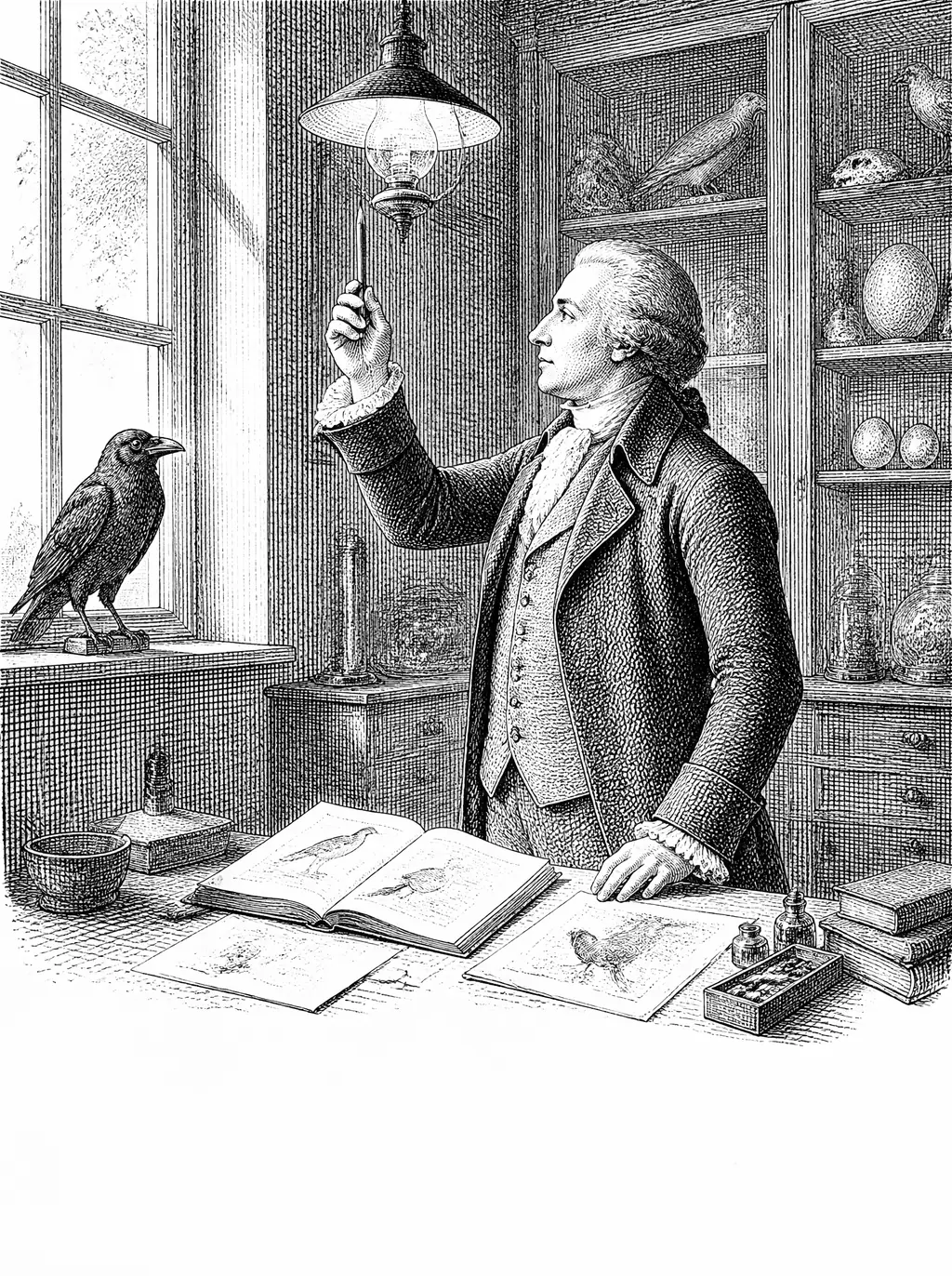
The Raven Paradox
A logically identical twin
All ravens are black seems to be confirmed the ordinary way: go out, find a black raven, and your confidence in the claim rises a little. Hempel noticed that this statement is logically equivalent to a stranger-sounding one, all non-black things are non-ravens, which should be confirmed the exact same way, by finding any non-black thing that also happens not to be a raven. Both readings are correct as logic. Something in the ordinary notion of evidence must therefore be wrong, and Hempel set out to say what.
The world it came from
Carl Hempel grew up near Berlin and belonged to the Berlin Circle around Hans Reichenbach, the Vienna Circle's northern ally. He left Germany in 1934, worked in Brussels, and reached the United States in 1937. The logical empiricists wanted a theory of confirmation as exact as deductive logic: a rule saying which observations support which hypotheses, and by how much. Jean Nicod had proposed in 1924 that a universal claim is confirmed by its instances. Hempel tested that rule against the demand that logically equivalent hypotheses be confirmed by the same evidence, and the ravens came out. He stated the paradox in a French paper in 1937 and in full in Studies in the Logic of Confirmation in Mind in 1945, while teaching at Queens College in New York.
The idea
A red pencil is a non-black, non-raven object. By the ordinary logic of confirmation, it should count as evidence for all non-black things are non-ravens, and since that statement is logically equivalent to all ravens are black, the red pencil becomes evidence for the claim about ravens too, without anyone ever needing to look at an actual bird. The pencil is not a special case. Every non-black non-raven, a white shoe, a green leaf, a blue car, becomes evidence about ravens by the same route.
How the reasoning runs
Premise one, Nicod's criterion: a hypothesis of the form all F are G is confirmed by an object that is both F and G. Premise two, the equivalence condition: whatever confirms a hypothesis confirms every hypothesis logically equivalent to it. Premise three: all ravens are black is equivalent to all non-black things are non-ravens, since each fails exactly when a non-black raven exists. Now a red pencil is non-black and a non-raven. By premise one it confirms the second hypothesis. By premises two and three it confirms the first. Nobody accepts that, so a premise must go. Drop Nicod and you lose the obvious idea of a confirming instance. Drop equivalence and confirmation depends on wording. Hempel kept both and dropped the intuition.
Seen in life
You are checking that every invoice above ten thousand carries a director's signature. There are two ways in. Pull the large invoices and look for signatures, or pull the unsigned invoices and look at their amounts. The second search is the raven paradox in a filing cabinet: each unsigned invoice that turns out to be small is a non-signed non-large item, and it counts, a little, toward the rule. The reason the second search feels legitimate here, when the pencil felt absurd, is the numbers. Unsigned invoices are a few dozen; non-black things are the universe. When the complement class is small, checking it is a sound audit. When it is everything, each item in it carries almost nothing.
Why it matters
This exposes real tension inside an intuitively appealing theory of how evidence works: logically equivalent statements ought to be confirmed by the same evidence, and yet almost no one's actual sense of what counts as evidence treats a red pencil as remotely relevant to a claim about ravens. Something in the ordinary picture of confirmation is quietly broken. For a school that hoped to make scientific method a branch of logic, that was serious. If the formal rules of confirmation and the practice of scientists disagreed on so plain a case, one of them had to be revised.
“The impression of a paradoxical situation is not objectively founded.”
From the source
Hempel, confronting the strangeness of his own result, offered a deflationary diagnosis rather than a retreat: “The impression of a paradoxical situation is not objectively founded.” He argued the sense of paradox is itself a kind of psychological illusion, not a genuine flaw in the underlying logic of confirmation. The full paper sets out the equivalence condition and Nicod's criterion, derives the paradox, and then argues that the feeling comes from background knowledge the formal case has stripped away. In a world with no other information, Hempel says, learning that some object is a non-black non-raven would be relevant to the hypothesis. We find it irrelevant only because we already know there are vastly more non-black things than ravens.
The pushback
Isn't calling the paradox a mere psychological illusion a way of dodging the problem rather than solving it, since the red pencil still feels like it should be worthless as raven-evidence no matter how the logic is explained? Later philosophers proposed more technical fixes, but no single solution has won general agreement, and the paradox remains genuinely contested. A second objection comes from I. J. Good, who described a world in which observing a black raven would lower the probability that all ravens are black, because in that world black ravens go with a large population containing some non-black ones. Instances do not always confirm.
The reply
The most widely accepted answer is Bayesian, sketched by Janina Hosiasson-Lindenbaum as early as 1940 and developed by Good and others. The pencil does confirm the hypothesis, but by an amount proportional to how surprised you should be to find it, and since almost everything is a non-black non-raven the increase is negligible, while a black raven, drawn from a small class, raises the probability appreciably. That keeps both premises and explains the intuition rather than dismissing it. A second line, from Quine, says that non-raven is not a natural kind and the rule of instances applies only to predicates that carve the world at its joints. Popper rejected the whole project: evidence never confirms, it only fails to refute. The paradox still opens textbooks on confirmation.
Where it went next
Nelson Goodman's grue puzzle of 1955 came from the same workshop and showed that confirmation depends on which predicates you allow. Bayesian confirmation theory, systematized by Howson and Urbach in 1989, made the small-class answer standard. Popper's falsificationism was in part a refusal of the whole confirmation programme the ravens embarrassed. The practical echo is in auditing and machine learning, where you must decide whether to sample the target class or its complement, and where a negative example is worth more the rarer it is. Conan Doyle had the point before Hempel: the dog that did nothing in the night-time is evidence, because a barking dog was the expected thing and a silent one is rare.
Where this leads
The problem of induction supplies the deeper background worry this whole paradox is really circling around, Hume's own older challenge about whether any pattern of past evidence can ever fully justify a general claim about the whole world at all. Falsifiability is the other neighbour. Popper's rule that a good theory forbids something is the raven paradox turned inside out: instead of asking which observations support the claim, ask which one would kill it, and go looking for that.