Symposium · Epistemology · Pl. 5Karl Popper · 1902–1994
Falsifiability
A different question entirely
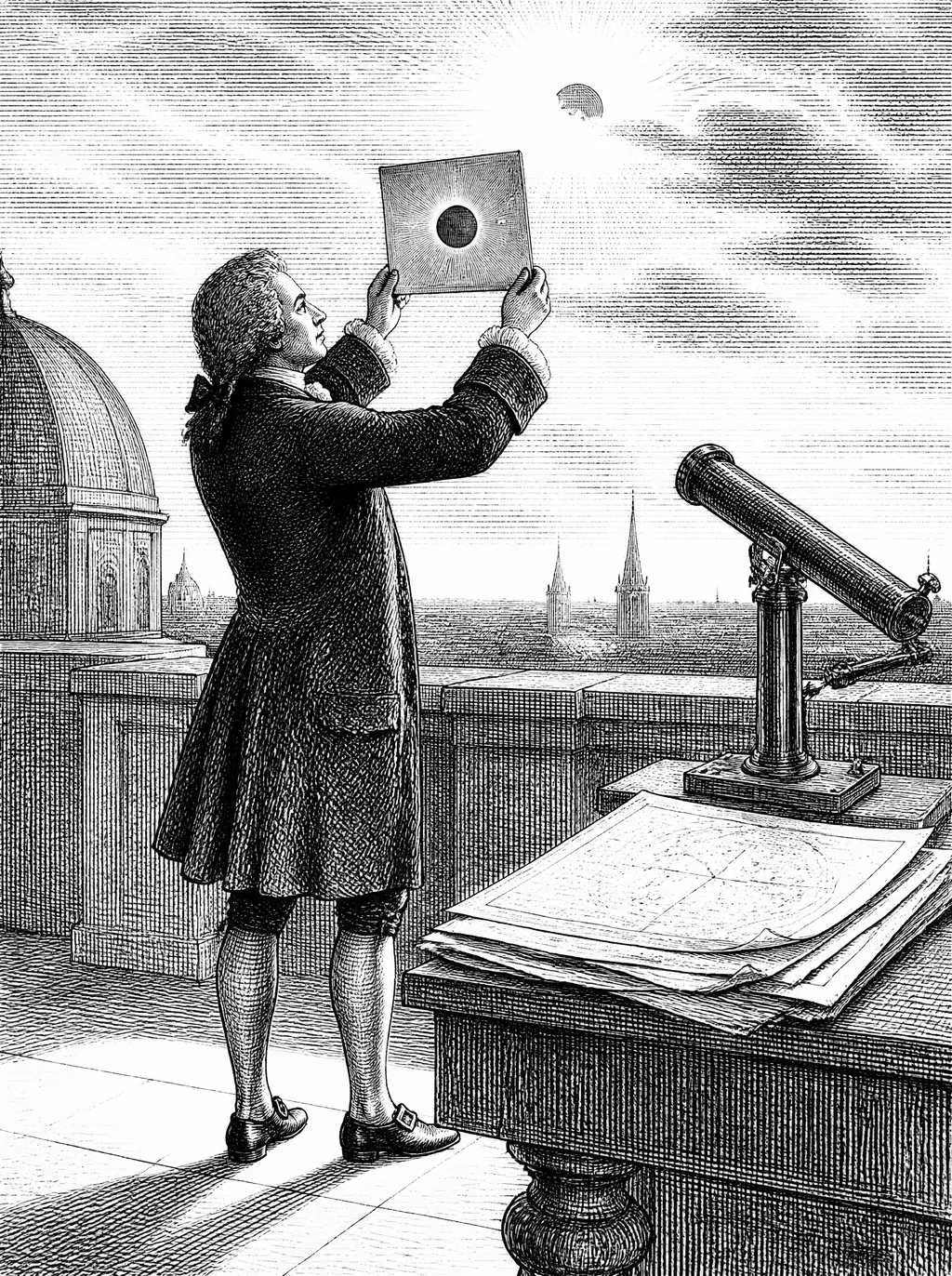
Popper noticed something odd about theories like astrology or certain strands of Freudian psychology: they seemed able to explain literally any outcome after the fact, which made them feel powerful but should have made them suspicious. A theory flexible enough to fit every possible observation, he realized, was not obviously telling you anything, since nothing could ever count as evidence against it. The contrast that struck him was Einstein. In 1919 relativity predicted that starlight passing the sun would bend by a specific amount, and an expedition went to measure it during an eclipse. Had the number come out wrong, the theory was dead. Freud's followers, Popper noticed, never risked anything like that.
The world it came from
Popper was a Viennese teenager in 1919, briefly a Marxist, working in Alfred Adler's clinics for children and watching Adler explain every case with the same theory, whatever the case. Then came the eclipse result and the contrast stayed with him for life. He wrote Logik der Forschung in 1934 on the edge of the Vienna Circle, whose members wanted to separate science from metaphysics by the test of verification: a statement means something only if observation could confirm it. Popper thought that got the logic backwards and called himself their official opposition. He left Austria in 1937 for a post in New Zealand, wrote The Open Society during the war, and joined the London School of Economics in 1946.
The idea
What separates genuine science from imitation is not that scientific claims can be proven true, since Hume already showed that no finite set of observations can prove a general claim with certainty. What separates them is that scientific claims can, in principle, be proven false. A theory earns scientific status by specifying exactly what observation would refute it, and then surviving repeated attempts to find that observation. The measure of a theory's content is what it forbids. A claim that rules out nothing tells you nothing, however profound it sounds. A claim that rules out a great deal is bold, informative, and easy to kill, which is exactly why it is worth having. Science, on this view, is organized risk.
How the reasoning runs
Start with a logical asymmetry. No number of white swans proves that all swans are white, but one black swan disproves it. A universal statement cannot be verified by any finite set of observations, yet a single observation can falsify it. Second, so if science cannot proceed by proof, as Hume showed, it can still proceed by disproof. Third, a theory is scientific when it forbids something, when some possible observation would contradict it. Fourth, the more a theory forbids, the more it says, and the more ways it could fail. Fifth, science therefore works by conjecture and refutation: propose boldly, test hard, discard what fails. A theory that survives is not confirmed, only corroborated, and stays on probation forever.
Seen in life
Your team is sure the users are leaving because onboarding is confusing. Ask the Popper question: what result would show that this is wrong? If the answer is nothing, if a rise in churn proves onboarding is bad and a fall proves the fix is working and a flat line proves it needs more time, then you do not have a theory. You have a slogan. So make it forbid something. If onboarding is the cause, then users who complete it should stay at a measurably higher rate than those who do not. Now the claim can lose. Run the comparison. If it loses, you have learned more in a week than the slogan taught you in a year.
Why it matters
This gives science a demarcation line that does not depend on impossible proof: a hypothesis counts as scientific not because it has been confirmed, but because it has stuck its neck out, made a risky, falsifiable prediction, and not yet been knocked down. Unfalsifiable claims, however confident-sounding, simply fall outside the game science is actually playing. The rule also travels well outside science. Any belief you hold, about a person, a plan, a politics, can be asked what would change your mind. If the honest answer is nothing, Popper says you are not holding a belief about the world. You are holding a belief about yourself, and the world has been excused from the conversation.
“Science is not a system of certain, or well established, statements.”
From the source
Popper puts the underlying humility at the very center of his whole account of scientific method, in a line that quietly overturns centuries of assumptions about what science delivers: “Science is not a system of certain, or well established, statements.” Its strength comes from testability, not proof. The passage continues with an image he liked enough to keep for the rest of his career. Science does not rest on bedrock, he says. Its bold structure rises above a swamp, on piles driven down from above, and we stop driving them not when we reach solid ground but when we judge them firm enough to carry the building for now. If the piles give way, we drive them deeper. Nothing is ever settled.
The pushback
Critics, including Kuhn, pointed out that working scientists rarely abandon a well-established theory over a single stubborn anomaly; they patch it, set the anomaly aside, and keep working, which makes strict falsification a much messier guide to actual scientific practice than Popper's clean criterion suggests. A deeper objection is logical, and it is older than Popper: Pierre Duhem stated it in 1906. No hypothesis is ever tested alone. A prediction depends on the theory plus a crowd of auxiliary assumptions about instruments, conditions, and background facts. When the prediction fails, logic tells you only that something in the crowd is wrong, not which. In 1846 Uranus misbehaved, and instead of refuting Newton the anomaly revealed Neptune.
The reply
Popper accepted much of this and drew a line where he could. Yes, you can always save a theory by adjusting an assumption; the question is whether the rescue is honest. A rescue that predicts something new and testable, as Neptune did, is good science. A rescue invented only to absorb the failure, adding nothing that could itself be checked, is what he called a conventionalist stratagem, and adopting it is a decision to stop doing science. So falsifiability becomes a rule of conduct as much as a property of theories. That is a real answer, and a partial one. It leaves the judgment of which rescues are honest to the scientist's taste, and Popper's clean logical line has quietly become a matter of character.
Where it went next
Imre Lakatos, Popper's student and colleague at LSE, built a methodology of research programmes to say when a rescue is progressive and when it is degenerating, and the 1965 debate with Kuhn's side fixed the terms of philosophy of science for a generation. Working scientists loved Popper more than philosophers did: the Nobel laureates Peter Medawar and John Eccles called him the greatest philosopher of science who ever lived. In 1993 the United States Supreme Court, in Daubert, listed testability as a mark of admissible scientific evidence. George Soros, another student, named his foundations after The Open Society. And the black swan, Popper's example, became Nassim Taleb's name for the event no model predicted.
Where this leads
The paradigm shift complicates Popper's clean picture directly, showing how working scientists routinely protect a favored paradigm from falsification for long stretches before a shift finally happens, rather than discarding a theory the moment a single contrary observation actually turns up somewhere. Kuhn and Popper argued this in person in 1965 and neither moved. The problem of induction is where Popper started. He agreed with Hume that no observation justifies a generalization and took the argument as a gift: if induction cannot support science, then science must never have been resting on it. Hume found a gap and lived with it by custom. Popper found the same gap and built a method that steps around it.