Symposium · Epistemology · Pl. 11David Hume · 1711–1776
The Problem of Induction
A habit mistaken for proof
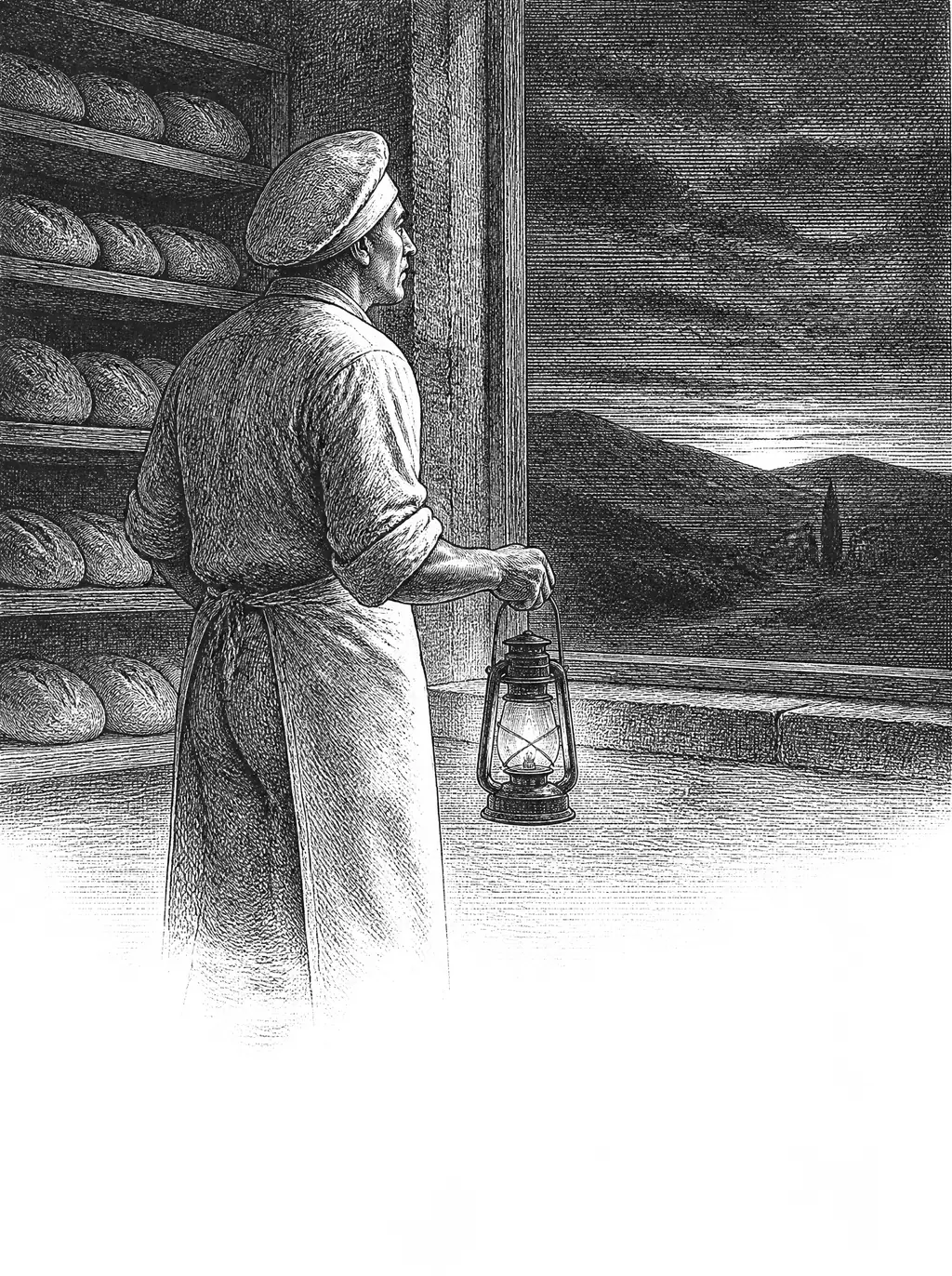
You expect bread to nourish you tomorrow because it nourished you yesterday, the same way you expect the sun to rise because it always has. Hume pressed on this ordinary confidence until it cracked. Every single one of those expectations rests on an assumption, that the future will resemble the past, which he showed cannot itself be proven by appealing to the past. He was not a crank looking for a loophole. He admired Newton, ate bread, and expected the sun. He simply asked a question nobody had pressed hard enough, and then declined to pretend the answer was better than it was.
The world it came from
Hume wrote A Treatise of Human Nature in his mid-twenties, much of it at La Flèche in France, where Descartes had gone to school a century before. It appeared in 1739 and, in his own words, fell dead-born from the press. He rewrote the argument in plainer form for the Enquiry Concerning Human Understanding in 1748. The setting was Newton's triumph. Physics had found laws that held everywhere, and philosophers wanted to know what made such laws certain. Hume proposed a science of man on Newton's own experimental method, and the first thing the method turned up was that the certainty everyone assumed for causal laws could not be found. He spent the rest of his life being called a skeptic for reporting it.
The idea
Reasoning from past experience to a conclusion about the future always smuggles in one unproven assumption: that nature's patterns will keep holding. You cannot justify that assumption by pointing to more past experience, since doing so already assumes the very thing in question, that the past reliably predicts the future. The reasoning circles back on itself rather than closing the gap. Nor can you prove it by pure reason, since a future that breaks the pattern is perfectly conceivable and involves no contradiction. What actually carries you from yesterday's bread to tomorrow's is custom, a habit of the mind so strong you never notice it working. Hume's word for this is not an insult. It is a diagnosis.
How the reasoning runs
First, split every claim into two kinds: relations of ideas, like arithmetic, which reason can prove, and matters of fact, which it cannot. Second, every belief about a matter of fact you have not observed rests on cause and effect. Third, you know causes only from experience; no amount of staring at bread tells you it will nourish. Fourth, experience licenses a prediction only if the future resembles the past. Fifth, that principle is not a relation of ideas, because its denial is conceivable. Sixth, it cannot be proved from experience, because every such proof assumes it. Therefore no argument justifies induction. What remains is custom: repeated conjunction produces expectation the way a bell produces a flinch.
Seen in life
You build a model to predict which customers will leave. You train it on ten years of data, and it backtests beautifully. Every quarter it would have called, it did call. You put it in production and it fails within a year, because a competitor launched, a pandemic hit, or the customers simply changed. Ask what the backtest actually proved. It proved that the past resembled the past. The step to next quarter was never in the data; it was an assumption you added, that the world would keep behaving. Hume is not telling you to throw the model out. He is telling you to know what it rests on, so that the surprise, when it comes, is the world's and not yours.
Why it matters
Nearly all practical knowledge, science included, runs on induction: generalizing from observed cases to unobserved ones. If Hume is right that this move has no rational proof behind it, then the entire edifice of expected regularities, gravity, cause and effect, tomorrow resembling today, rests on custom and habit rather than demonstrated certainty, however useful that custom turns out to be. The right response is not paralysis. It is a change in tone. Every forecast, every law, every promise that the past is a guide carries a silent clause, and Hume's service is to make you read it. The people who forget the clause are the ones who are astonished when the world does something new.
“All inferences from experience suppose, as their foundation, that the future will resemble the past, and that similar powers will be conjoined with similar sensible qualities.”
From the source
Hume states the gap directly in his Enquiry, after walking through exactly how we generalize from bread to bread: “All inferences from experience suppose, as their foundation, that the future will resemble the past, and that similar powers will be conjoined with similar sensible qualities.” He goes on to ask what would follow if nature changed its course. Then, he says, all experience becomes useless and can give rise to no inference. So the resemblance of past and future cannot be proved by any argument from experience, since every such argument is founded on the supposition of that resemblance. The passage is short, patient, and unanswered. Hume himself calls the conclusion a sceptical doubt and, in the next section, offers a sceptical solution: custom.
The pushback
Doesn't this prove too much, since no one, including Hume himself, actually stops trusting that the sun will rise tomorrow? Hume agreed entirely; he was not recommending anyone abandon induction, only pointing out that our confidence in it is a psychological habit rather than a rationally demonstrated certainty, a distinction he thought philosophy owed itself to admit honestly. A sharper objection came from P. F. Strawson in the twentieth century. Asking whether induction is rational, he argued, is like asking whether the law is legal. Reasoning from evidence is part of what rational means; demand a further proof and you have misunderstood the word. On that view Hume found not a gap but a confusion.
The reply
Hume's own reply to the first objection is the sceptical solution. Nature has not left belief to reason, which would be too slow and too fallible; it has given us custom, an instinct as reliable as the one that teaches a bird to build a nest. We can trust it while knowing it is not proof. To Strawson, a Humean answers that defining rationality to include induction changes the label, not the situation. You still cannot show that the practice will work, only that you call it reasonable, and a person who wanted to know whether tomorrow will resemble today has been handed a dictionary. Most philosophers agree the reply is partial. The problem has been dissolved, reframed, and lived with; it has not been solved.
Where it went next
Kant said Hume woke him from his dogmatic slumber, and the Critique of Pure Reason is partly an attempt to show that causality is a form the mind imposes, not a habit it acquires. Bertrand Russell gave the problem its most quoted image: the chicken fed every morning of its life until the morning its neck is wrung. Karl Popper accepted Hume's conclusion and rebuilt science without induction, on conjecture and refutation. Nelson Goodman's grue paradox of 1955 showed the problem is worse than Hume thought, since the same evidence supports contradictory predictions depending on how you describe it. Bayesians turned the question into one about updating probabilities, and Nassim Taleb sold a million copies of Russell's chicken by renaming it a turkey.
Where this leads
Falsifiability is one later attempt to answer Hume's challenge directly, proposing that science should not claim to prove its generalizations true at all, only to keep testing them against the one thing that actually can defeat a claim: a contrary observation. Popper took Hume's verdict and refused the consolation of custom. Tabula rasa is the premise Hume inherited. Locke had said every idea comes from experience; Hume asked what experience can license and found that it licenses nothing beyond itself. The two ideas are one argument in two generations: first empty the mind of inborn certainty, then discover that the experience meant to refill it cannot reach one hour into the future.