Symposium · Eastern Philosophy · Pl. 13Buddha · c. 563 – c. 483 BC
The Root of Thirst
A stump that will not stay down
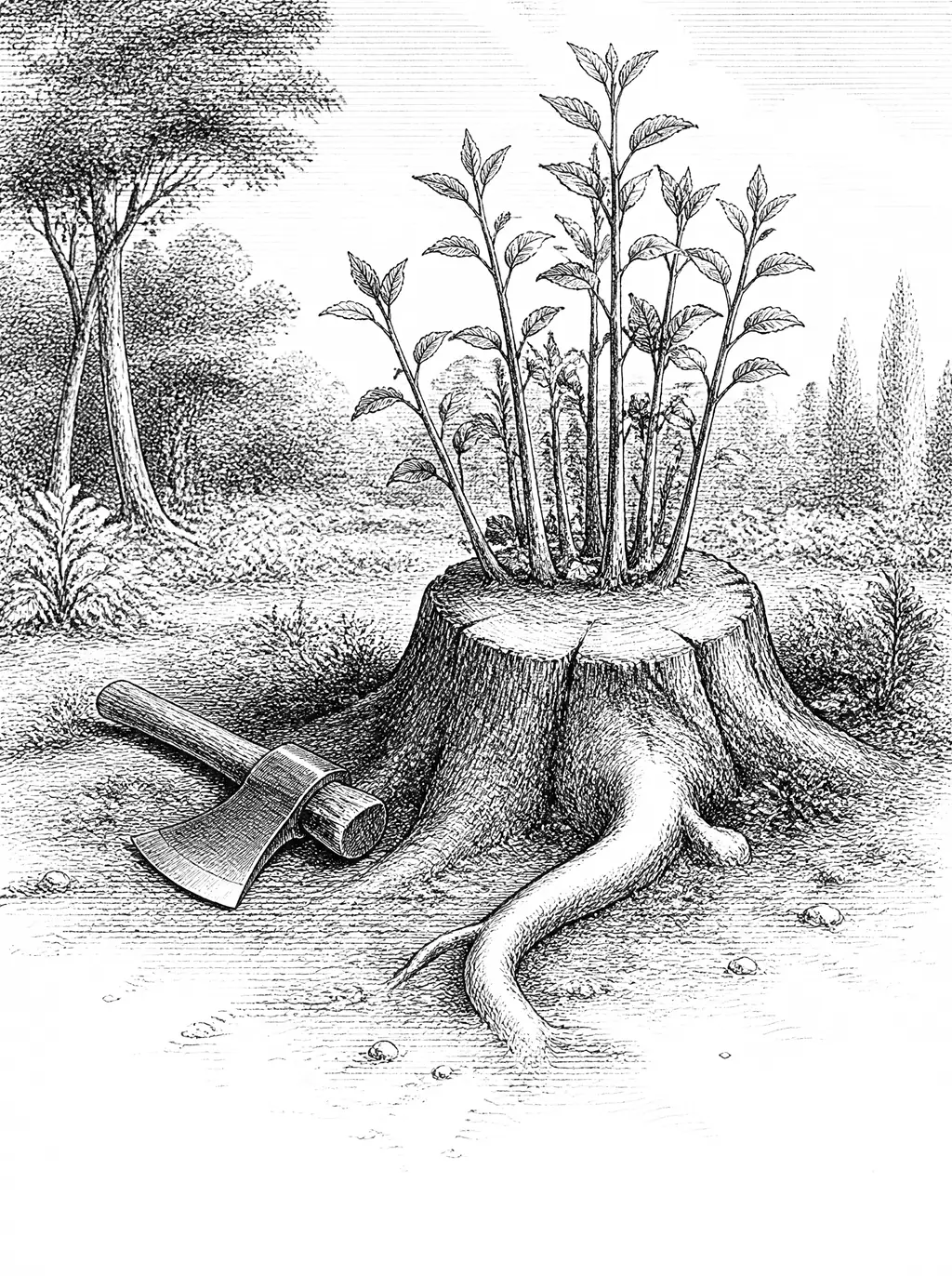
You resolve to want less, and for a while it works: the craving for status, comfort, or approval seems to shrink. Then, without warning, it grows back, often stronger, in a slightly different shape. The Buddha compared this exact pattern to a felled tree whose root survives underground, ready to send up new growth. The image comes from a chapter of the Dhammapada devoted entirely to thirst, and it makes a claim about method, not just about desire. It says you have been cutting in the wrong place, and that no amount of cutting there will ever finish the job.
The world it came from
The Dhammapada is a Pali anthology of 423 verses, part of the Theravāda canon, attributed by tradition to the Buddha and written down in Sri Lanka around the first century BC. The Buddha taught in the Ganges plain in the fifth century BC, among a crowd of wandering teachers who agreed that ordinary life was a trap and disagreed about the way out. Jains starved the body to burn off karma. Brahmin priests offered ritual. Materialists said there was nothing to escape. The Buddha's diagnosis, set out in his first sermon at Sarnath, was that suffering has a cause, and the cause is craving. Chapter 24, on thirst, is that diagnosis turned into images: a creeper, a snared hare, a felled tree.
The idea
Thirst, tanha, the restless craving for pleasure and the restless aversion to pain, is the root feeding ordinary suffering. Managing one craving at a time, like pruning branches, offers only temporary relief, because the root itself, the underlying pattern of grasping, remains alive underground and will simply send up a new shoot in its place. The Pali word means thirst literally. Thirst is not satisfied by drinking; it returns. That is the property the Buddha wants you to notice in wanting itself, whatever the wanting is currently aimed at.
How the reasoning runs
Start from observation. You give up one craving and another appears; you get what you wanted and the wanting moves to a new object. Second, ask what stays constant across the objects. Not the things, which change, but the reaching toward them. Third, name that constant: tanha, thirst, the felt insufficiency that treats every present moment as a means to a better one. Fourth, draw the consequence. If the reaching is the root and the objects are branches, then removing objects is pruning, and pruning makes a tree bushier, not smaller. Fifth, conclude: the only work that reduces suffering is work on the reaching itself, seeing it arise, seeing that it is not you, and not feeding it. The Buddha's eightfold path is that work described as a routine.
Seen in life
You quit sugar in January and felt clean. By March you were buying running shoes you did not need. By June the shoes were in the cupboard and you were refreshing a dating app at two in the morning, and in August you decided the real problem was your job. Each time the craving looked different and each time the story was the same: something just out of reach would finish the feeling of not enough. Look at the sequence rather than at any item in it. The sugar, the shoes, the swipe, the résumé are branches. The sense that this moment is a waiting room for a better one is the root. You can prune for a lifetime. Or you can sit down and watch the root.
Why it matters
This redirects effort away from an endless, exhausting game of whack-a-mole against individual desires, and toward the deeper mechanism generating desire after desire in the first place. Someone who conquers one craving without addressing thirst itself has only rearranged their suffering, not reduced it, and will meet the same root again in a new disguise. This also explains why willpower fails so predictably. Willpower is a saw. It cuts what it can see. The root is underground, and the only tool that reaches it is attention.
“As a tree, even though it has been cut down, is firm so long as its root is safe, and grows again, thus, unless the feeders of thirst are destroyed, the pain of life will return again and again.”
From the source
The Dhammapada states the image directly: “As a tree, even though it has been cut down, is firm so long as its root is safe, and grows again, thus, unless the feeders of thirst are destroyed, the pain of life will return again and again.” This is verse 338, from the chapter on thirst, in Max Müller's 1870 translation. The verse before it says to dig up the root of thirst as a person digs for the fragrant usīra root beneath bīraṇa grass. The verses after it describe thirst running in thirty-six streams and springing up everywhere like a creeper. The chapter's whole argument is botanical.
The pushback
Doesn't eliminating desire altogether risk eliminating motivation and ordinary human warmth along with it, since love, ambition, and curiosity all involve wanting something? Buddhist teaching distinguishes tanha, grasping, restless craving that can never be satisfied, from a wholesome wish or intention, which is not the target of this particular warning at all. Push harder, though. The distinction between craving and wholesome wishing is easy to state and hard to feel from inside. The person who wants to save the forest and the person who wants the promotion both feel urgency. Who decides which wanting is thirst?
The reply
The tradition's test is not the object but the texture. Thirst has a signature: it treats the present as a deficit, it promises that getting will end the wanting, and it does not. A wholesome intention, the wish for the forest to stand or for a friend to be well, can be held without that ache, and can be set down when the situation changes. The Buddha himself kept intentions for forty-five years of teaching. Where the reply is partial is in practice: telling the two apart requires exactly the trained attention that thirst disrupts, so the diagnosis and the cure lean on each other. The tradition's honest answer is that you learn the difference by watching, slowly, and that you will misjudge it often before you get it right.
Where it went next
Buddhaghosa's fifth-century commentary fixed the felled tree in Theravāda teaching, and the diagnosis of craving as the root of suffering is the second of the four noble truths in every Buddhist school, from Sri Lanka to Tibet to Japan. Schopenhauer, who met Buddhist ideas through early European accounts, made a metaphysics out of the same observation: the will wants endlessly and satisfaction is only a pause. In the twentieth century the Burmese vipassanā revival, carried west by S. N. Goenka and by teachers such as Joseph Goldstein and Sharon Salzberg, taught lay people to watch craving arise on a ten-day retreat. Psychologists now speak of the hedonic treadmill, the finding that better circumstances raise satisfaction only briefly; the Buddha described that treadmill in one verse about a stump.
Where this leads
The discipline of desire reaches a strikingly similar diagnosis from Stoic Epictetus, working centuries later and a continent away, redirecting desire away from what cannot be secured and toward what can, a different tradition cutting at what turns out to be a closely related root. Both traditions locate the problem in the wanting rather than the world. They differ on the cure. Epictetus keeps desire and aims it at what is yours. The Buddha wants you to watch desire until it loosens, whatever it is aimed at.