Symposium · Ethics · Pl. 12Epicurus · 341–270 BC
Pleasure Is the Absence of Pain
Not the feast you'd expect
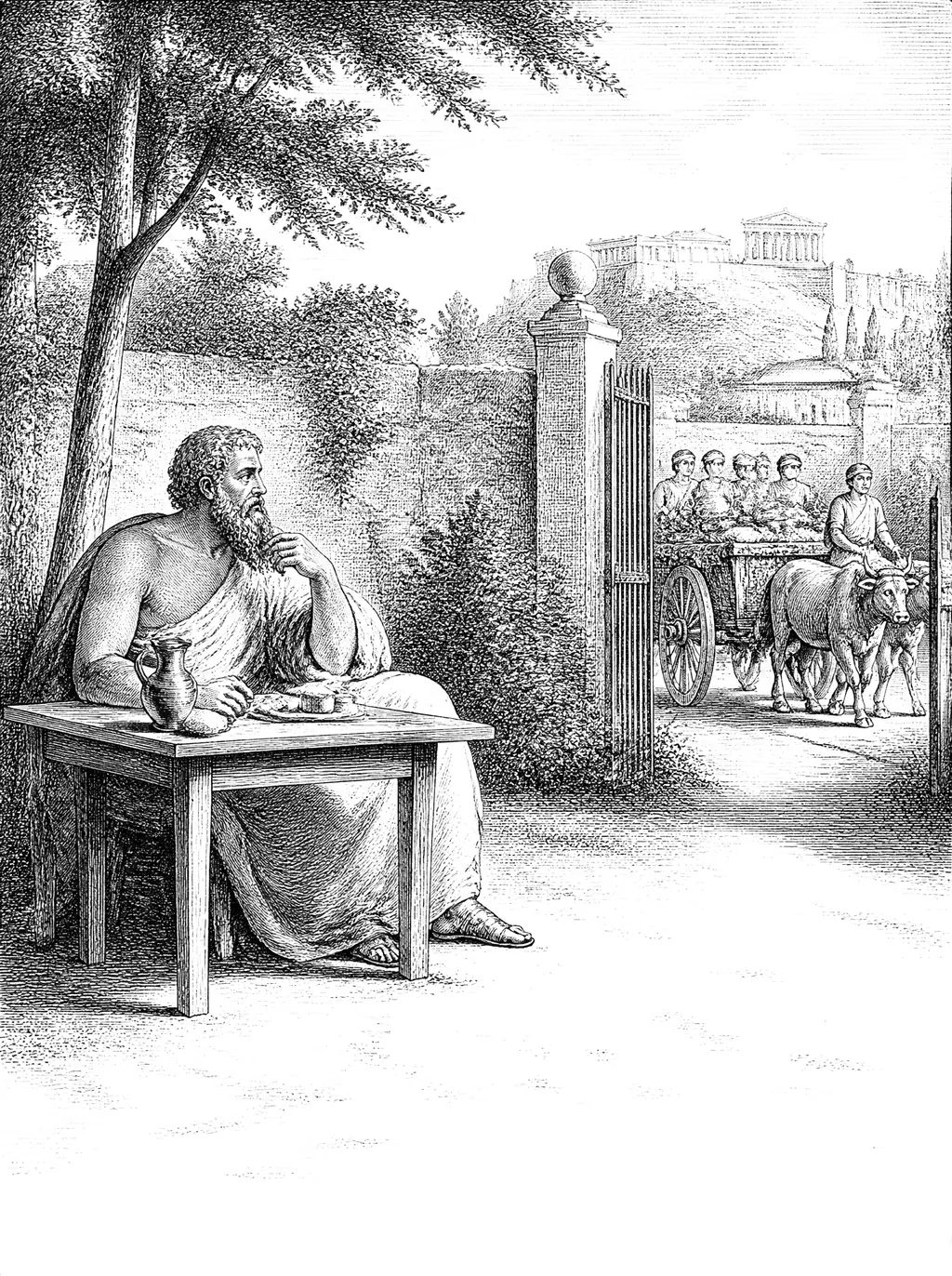
The word epicurean now suggests couches, rich food, and indulgence, a reputation Epicurus himself would have rejected outright. He taught in a modest garden outside Athens, ate simply, and wrote letters recommending plain fare, arguing that corn and water give the most extreme pleasure to a person who genuinely needs them, far more than costly food gives someone already anxious and unsettled. One ancient story has him asking a friend to send a small pot of cheese so that he could feast when he wished. The reputation came later, from rivals who found it easier to mock a glutton than to answer a man who wanted very little.
The world it came from
Epicurus was born in 341 BC on Samos to Athenian parents and grew up in a Greece where the city-states had lost their independence to Macedon. Politics no longer offered a life. He taught first at Mytilene and Lampsacus, then around 306 BC bought a house and garden in Athens and opened a school that admitted women and slaves, which scandalized his rivals. He took his physics from Democritus: atoms, void, and nothing else. Zeno founded the Stoa a few years later, and the two schools argued for centuries. Epicurus's problem was fear, of the gods and of death above all, and his ethics was designed to remove the fear rather than to accommodate it.
The idea
Pleasure is indeed the chief good, but not the pleasure of the debauched or the constant chaser of new sensation. The deepest, most stable pleasure available is a negative one: the removal of pain and disturbance entirely, leaving the body untroubled and the mind at rest. Once that calm is reached, no additional stacking of sensory pleasure actually adds anything further to it. Epicurus sorted desires into three kinds to make this usable. Natural and necessary desires, for food, shelter, and friends, are easily satisfied. Natural but unnecessary desires, for rich food, are harmless if you can take them or leave them. Empty desires, for fame, power, and immortality, have no limit and can never be filled.
How the reasoning runs
Begin with what every animal shows from birth: it seeks pleasure and avoids pain, before any teaching. So pleasure is the natural good. Next, ask what pleasure is at its limit. Pain has a natural ceiling, the point where it is gone. Epicurus argues that pleasure has the same ceiling: once the body lacks nothing and the mind fears nothing, more sensation varies the pleasure but does not increase it. Third, desires without a limit, wealth, status, and safety from death, can never reach that ceiling, and so keep you in pain. Fourth, the fears that drive those desires rest on false beliefs. The gods do not meddle; death is the end of sensation and so nothing to us. Remove the beliefs, and the calm follows.
Seen in life
You get the raise. For a week the new number feels like a change of life. Then the mortgage stretches to fit it, the car is a size larger, and the evening you spend refreshing a listing for a house you cannot quite afford feels exactly like the evenings before the raise. Epicurus would say nothing went wrong with the money. The mistake was expecting an empty desire to fill. Now look at the other side of the week: the meal with the friend who drove an hour to see you, the night you slept through without worry. Those were the pleasures, and they cost almost nothing. The ceiling was already there. You kept climbing past it.
Why it matters
This flips the common assumption that more pleasure always means a better life. If the ceiling is simply the absence of pain, then chasing ever more intense experiences past that point is not progress toward a better life, it is restless motion that can just as easily introduce new disturbances, new anxieties, and new dependencies you did not previously have to manage. It also makes the good life cheap and available. If the highest pleasure needs only bread, water, friends, and a settled mind, then it is open to a slave in the Garden as much as to a king, and the whole apparatus of getting ahead turns out to be a machine for manufacturing the pain it promises to relieve.
“We mean the freedom of the body from pain, and of the soul from confusion.”
From the source
In his letter to Menoeceus, preserved by Diogenes Laertius, Epicurus explains what he actually means by the claim: “We mean the freedom of the body from pain, and of the soul from confusion.” Not, he stresses, continual drinking, feasting, or sensual indulgence. The letter is the only complete statement of his ethics that survives in his own words. In it he tells Menoeceus that a pleasant life is produced not by drinking parties and the enjoyment of boys and women but by sober reasoning, which searches out the causes of every choice and drives away the beliefs that fill the soul with turmoil. Prudence, he says, is worth more than philosophy, because every virtue grows from it.
The pushback
Doesn't defining the highest pleasure as merely the absence of pain drain the word of any positive content, making Epicureanism sound closer to numbness than to joy? Epicurus would answer that untroubled calm is not numbness but the actual condition underneath all the busy chasing, the state people are really seeking, however indirectly, every time they pursue some new pleasure at all. Cicero pressed the objection harder in De Finibus: a person who feels no pain and no pleasure is in a third state, neither, and calling that state the greatest pleasure is a trick of words. The Cyrenaics, rival hedonists, made the opposite complaint. Pleasure is motion, they said, the taste on the tongue, and Epicurus had replaced it with the condition of a corpse.
The reply
Epicurus distinguished two kinds of pleasure. Kinetic pleasure is the motion Cicero and the Cyrenaics mean, the taste while eating. Katastematic pleasure is the settled state afterward, the body at ease and the mind unafraid. He held the second to be the goal and the first a variation on it. That answers the corpse charge: a corpse has no state at all, while the calm person is awake, thinking, and glad to be. Whether it answers Cicero is less clear. If you insist that pleasure must be felt as a positive glow, Epicurus has simply renamed contentment. His defenders say contentment is exactly what people mean when they say they are happy, and that the argument is about a word.
Where it went next
The school outlived Athens. Lucretius turned the physics and the ethics into Latin verse in De Rerum Natura around 55 BC, and Horace called himself a pig from Epicurus's herd. Christian writers attacked the Garden for two centuries and then borrowed its calm for the cloister. In the seventeenth century Pierre Gassendi rescued Epicurus from the charge of godlessness and passed his atomism to the new science. Thomas Jefferson wrote in 1819 that he too was an Epicurean. Bentham and Mill kept the claim that pleasure is the good and dropped the ceiling, which is why the modern word means feasting. Studies of the hedonic treadmill, and the minimalist movements of the last twenty years, have rediscovered the ceiling without always knowing whose it was.
Where this leads
Eudaimonia offers Aristotle's rival account of the whole good life, built around ongoing activity and excellence rather than calm alone, and the disagreement between the two schools shaped centuries of later argument about what happiness actually consists of at bottom. Measure things by use comes at the same problem from the Cynics, who cut the list of needs even shorter than Epicurus did and called the rest a burden. Read the two beside this one and a question appears: is the good life the removal of what troubles you, the exercise of what is best in you, or the discarding of what you do not need? Each answer points at a different afternoon.