Symposium · Eastern Philosophy · Pl. 4Buddha · c. 563 – c. 483 BC
The Mind Precedes All Things
The first two verses
Of everything the Buddha might have opened with, ritual, rebirth, the nature of suffering, the Dhammapada begins instead with a plain claim about ordinary thought, repeated twice for emphasis, once for pain and once for happiness. Whatever follows in the rest of the book builds directly on top of this single starting observation. The Pali opens with the word mano, mind, before anything else is said. Whoever arranged the collection put the claim about thought first because everything else in the book assumes it, and because a reader who doubts it will not be helped by the rest.
The world it came from
The Dhammapada is a Pali anthology of 423 verses, part of the Khuddaka Nikāya of the Theravāda canon. Tradition attributes it to the Buddha, who taught in the fifth century BC in the kingdoms of Magadha and Kosala; the verses were carried orally and written down in Sri Lanka around the first century BC. These are verses one and two, the opening of the chapter called the twin verses, in which each pair sets a dark case against a bright one. The Buddha taught among teachers who located the cause of suffering elsewhere: in fate, in the body, in ritual impurity, or in a cosmic order nobody could touch. His claim that mind comes first was a claim about where the work could be done.
The idea
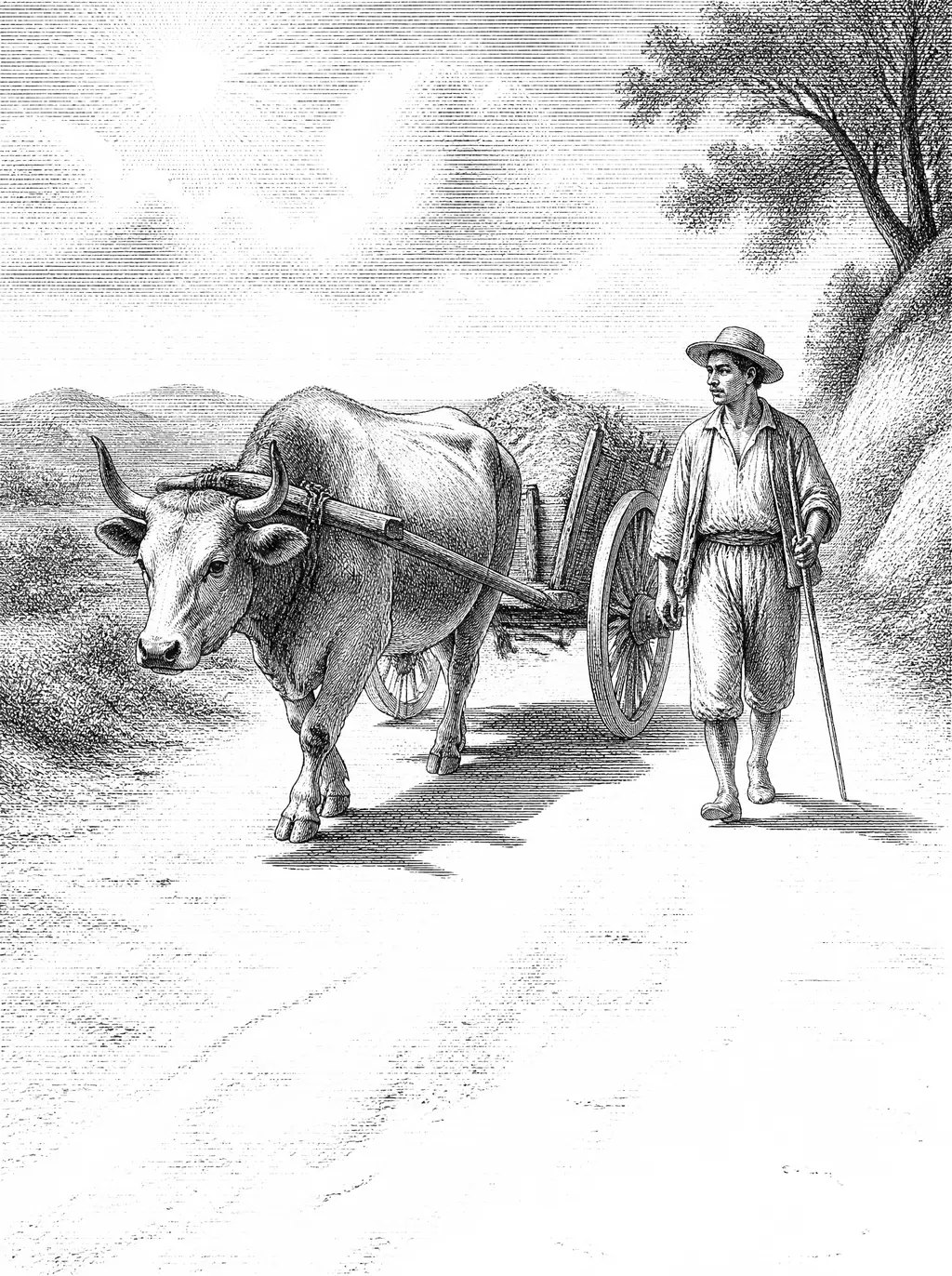
All that you are is the result of what you have thought. Your life is founded on your thoughts and made up of them, so that an evil thought trails pain behind it the way a cart wheel follows the ox that pulls it, and a pure thought trails happiness the way a shadow follows a body without ever leaving it. The claim is causal and it runs in both directions. The mind is not a mirror that reflects a life already made; it is the maker, and it makes pain or happiness by the quality of what it does.
How the reasoning runs
Step one: an action begins as an intention, and an intention is a mental event. Step two: the intention colours the act. The same words, spoken from spite or from care, are different acts, and land differently. Step three: acts have consequences, and the consequences follow the act as the wheel follows the ox. So the consequence is traceable to the mind that started it. Step four: the mind is also where consequences are received. Two people meet the same loss with different minds and suffer differently. Step five: therefore the mind is the first cause on both sides of experience, the doing and the undergoing. If you want to change the life, the text says, you have found the lever.
Seen in life
Two colleagues are told the same thing on the same afternoon: the project is cancelled. One walks out with a story already running, they never valued this, I knew it, and spends the evening composing the resignation she will not send. The other walks out with a different thought, that was a good year's work and it is over, and spends the evening cooking. Same event, same office, same email. By the next morning one of them has slept and one has not. Nothing in the world changed between them except the thought that met the event, and that thought is now, for each of them, the beginning of the next thing that happens. The Dhammapada would say each has already started tomorrow.
Why it matters
This places the actual point of leverage over your life somewhere most people never think to look: not events, which you rarely control, but the quality of the thoughts you keep returning to, which shapes how every event actually lands. Two people can face the identical circumstance and live through entirely different consequences, purely by the thought each one brought to it. It also explains why the Buddhist path is a training of the mind rather than a set of rules. If mind is the source, then discipline of thought is not preparation for the work. It is the work.
“All that we are is the result of what we have thought: it is founded on our thoughts, it is made up of our thoughts.”
From the source
The Dhammapada opens with the claim stated twice: “All that we are is the result of what we have thought: it is founded on our thoughts, it is made up of our thoughts.” Pain follows an evil thought as the wheel follows the ox; happiness follows a pure one like a shadow. These are the opening two verses in Max Müller's 1870 translation. The Pali begins manopubbangama dhamma, mind precedes all things; Müller's all that we are is a loose rendering that later translators tightened. The first verse ends with the cart wheel, the second with the shadow, and the pairing sets the pattern for the whole chapter.
The pushback
Doesn't this put too much weight on private thought and too little on the real, external causes of suffering, poverty, illness, injustice, that no amount of mental reframing actually removes? The teaching is not claiming thought creates every circumstance; it claims thought shapes how a person meets whatever circumstance genuinely does arrive. The harder version: read carelessly, the verse blames the sufferer. If pain follows an evil thought, then the person in pain must have thought badly, and the sick and the poor deserve their condition. That reading has been used, and not only by outsiders.
The reply
The tradition rejects the blame reading and has the text to do it with. The Buddha refused to say that every experience was the result of past action; he listed weather, bodily humours, and accident among the causes of suffering, and he condemned teachers who said everything was karma. What the opening verse claims is narrower: the mind is the first cause of the mental quality of what happens to you, and of the actions you set going. Where the reply is partial is that the text is compact and does not build in the qualification; a reader has to bring it from elsewhere in the canon. The verse is a lever, not a scale of justice, and the difference is the whole ethics.
Where it went next
Buddhaghosa opened his fifth-century commentary with these verses and the story of a blind monk, and they became the first lines a Theravāda novice memorised. Mahāyāna schools pushed the claim further; the Yogācāra philosophers of the fourth century argued that experience is mind-only, a stronger thesis than the verse itself makes. In the twentieth century the verse met Western psychology. Cognitive therapy, built by Aaron Beck in the 1960s on the claim that interpretation shapes emotion, arrived at the same lever independently, through Epictetus rather than the Dhammapada. Mindfulness-based cognitive therapy, developed by Segal, Williams, and Teasdale around 2000, joined the two lineages deliberately. The verse is now quoted on posters, usually shortened to what we think we become, which loses the wheel and the shadow and keeps the lever.
Where this leads
The discipline of desire reaches a related conclusion from the Stoic side of the world, redirecting attention toward what is actually shapeable, your own judgments, rather than toward outcomes that were never fully within a single mind's control to begin with. The two traditions share the lever and differ on the hand. Epictetus wants judgment trained by reason. The Buddha wants mind watched until its habits loosen. Both begin in the same place: not with the event, but with what met it.