Symposium · Logic & Paradoxes · Pl. 10Bertrand Russell · 1872–1970
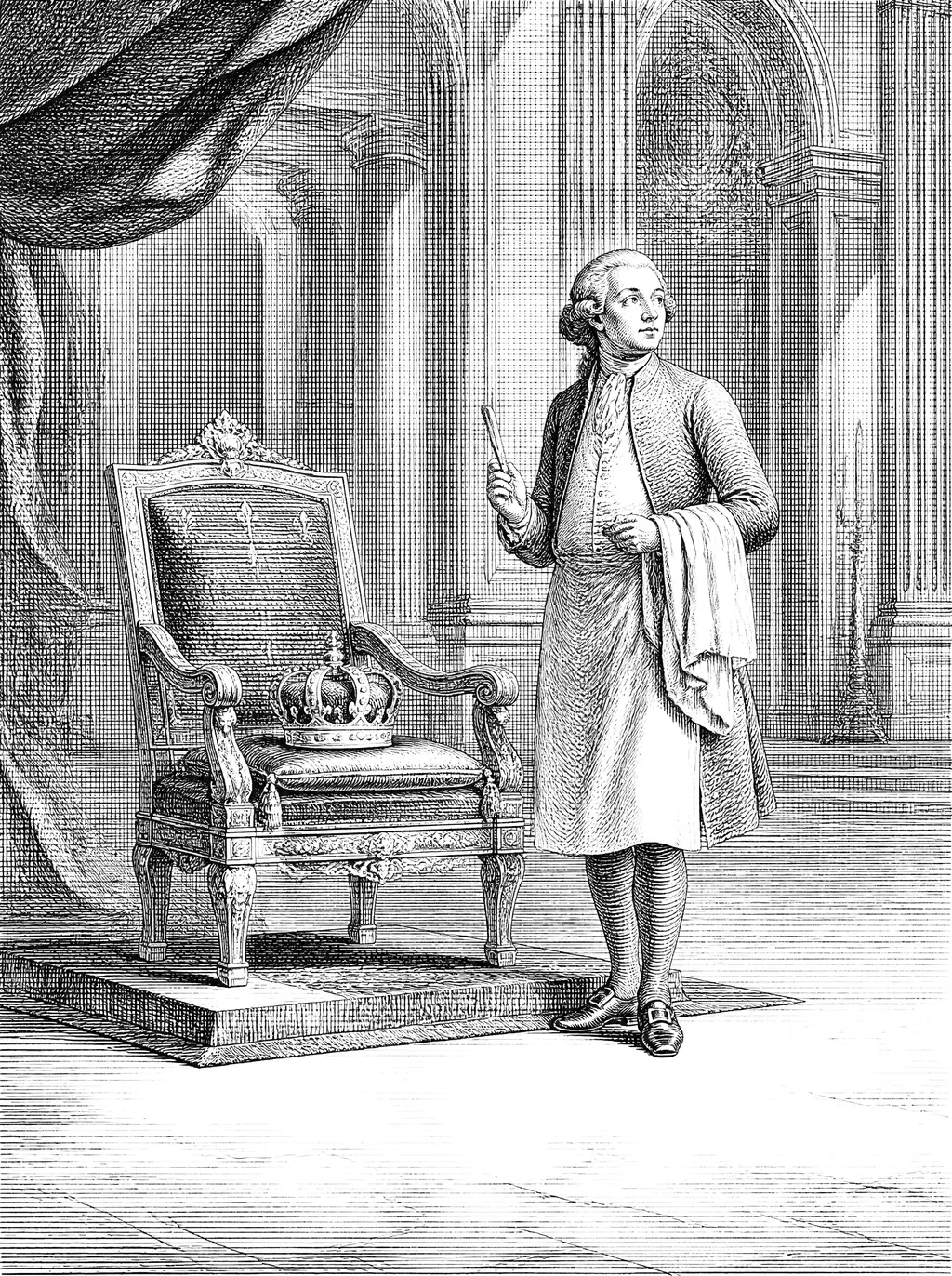
The Present King of France Is Bald
A sentence about nobody
Ordinary grammar lets you build a sentence naming a specific person and claiming something about him, the present King of France is bald, exactly the way you would say the present King of Spain is tall. The grammar works perfectly. The trouble starts the moment you ask whether the sentence is true, since there is no king there to be either bald or not. Russell's answer is that the sentence hides a claim it never states out loud, and that once the claim is brought into the open, the puzzle is over.
The world it came from
Russell published On Denoting in Mind in 1905, while working with Whitehead at Cambridge on the logic that became Principia Mathematica. He was arguing with two people. Alexius Meinong held that the King of France, though he does not exist, is still an object we can think and talk about. Gottlob Frege held that the phrase has a sense but no reference, so the sentence containing it is neither true nor false. Russell had accepted something like Meinong's view in 1903 and now wanted rid of it: a logic for mathematics could not tolerate objects that do not exist. The version quoted here is from his Introduction to Mathematical Philosophy, written in Brixton prison in 1918, where he was serving six months for an article against the war.
The idea
Consider 'the present King of France is bald.' Here 'the present King of France' has a primary occurrence, and the proposition is false. Every proposition in which a description which describes nothing has a primary occurrence is false. Russell's solution is to treat the description as secretly asserting existence: there is an x that is the present King of France, and that x is bald, an assertion that fails at the first clause. Descriptions, on this view, are not names. They are quantified claims in disguise.
How the reasoning runs
Read the F is G as three claims joined together. There is at least one F. There is at most one F. Whatever is F is G. Apply it. There is at least one present King of France: false. The whole conjunction is therefore false, and so the sentence is false, no third value required. Now the trick that saves classical logic. The King of France is not bald can mean two things: there is a King and he is not bald, which is false, or it is not the case that there is a bald King, which is true. Russell calls these the secondary and primary occurrences of the description. Pick a reading, and the law of excluded middle holds.
Seen in life
A tenancy agreement says disputes will be settled by the arbitrator named in Schedule B. Schedule B was never filled in. The tenant claims the arbitrator has ruled in her favor; the landlord claims the arbitrator has ruled for him. Both statements are false in the same way, and for Russell's reason: each asserts that there is exactly one arbitrator named in the schedule, and there is none. A judge does not need a third truth value to handle this. She reads the clause as an existence claim that failed. The same shape appears in a database when a query fetches the manager of a department that has none: the join returns no row, and any statement about that manager's salary is simply false, not undefined.
Why it matters
This shows how ordinary grammar can mislead logical analysis, making a sentence look simple, name plus predicate, when its real underlying structure is a hidden existence claim plus a further claim, which can be picked apart and shown false without needing to invent some strange in-between truth value for missing kings. The larger lesson is that grammar is not logical form. A phrase that looks like a name may be a bundle of claims, and the work of philosophy, on Russell's view, is to find the real structure under the surface.
“Consider 'the present King of France is bald.' Here 'the present King of France' has a primary occurrence, and the proposition is false.”
From the source
Russell walks through the example directly: “Consider 'the present King of France is bald.' Here 'the present King of France' has a primary occurrence, and the proposition is false. Every proposition in which a description which describes nothing has a primary occurrence is false.” Russell continues with the case of secondary occurrence. When the description is inside a larger phrase, such as it is not the case that, the proposition as a whole may be true even though the description describes nothing. That, he says, is how the sentence can be false and its denial true without breaking the law of excluded middle. The chapter on descriptions presents the whole analysis as his way of avoiding the unreal objects that a naive reading of language keeps forcing on us.
The pushback
Doesn't calling the sentence simply false feel wrong, when it seems more natural to say it is neither true nor false, since there is no king for the predicate bald to even apply to one way or the other? This exact disagreement, between Russell's flat falsehood and rival views proposing a real truth-value gap, has never fully settled among philosophers of language. A second objection is that Russell's analysis makes every use of the word the a claim of uniqueness, and yet the table is in the way is true even in a room full of tables.
The reply
Peter Strawson's 1950 paper On Referring is the standard rejoinder. The sentence does not assert that there is a King, he argued; it presupposes one, and when the presupposition fails the question of truth does not arise. Linguists largely took Strawson's side and made presupposition a field. Philosophers of logic largely stayed with Russell, and Stephen Neale's Descriptions in 1990 gave a full defense. Keith Donnellan added in 1966 that descriptions are used two ways, to refer to a particular person and to characterize whoever fits, and Russell's account fits the second better than the first. The uniqueness worry is handled by context: the table means the one salient here. The dispute between falsehood and gap has not closed.
Where it went next
Frank Ramsey called the theory of descriptions a paradigm of philosophy, and for decades it was the model of what analysis could do. Quine used it in 1948 to dispense with names altogether, turning Pegasus into the thing that pegasizes. Strawson, Donnellan, Kripke, and Neale kept the argument alive, and presupposition theory in linguistics grew from the gap Strawson opened. In computing, the problem returns as the null: Tony Hoare called the null reference his billion-dollar mistake, and languages that force a programmer to say whether a value exists before using it are enforcing Russell's first conjunct. SQL answers the King of France with an empty result set, which is his analysis run by a machine.
Where this leads
Russell's paradox shows the same careful analytical instinct turned on a far more consequential target still, the very foundations of mathematics itself, where an equally innocent-looking piece of grammar produced a genuine, system-threatening contradiction rather than a mere philosophical curiosity. The Gettier problem lives on another shelf but shares the method: take a sentence everyone accepts, find the case where it comes apart, and show that the ordinary reading was hiding a claim nobody had examined.