Symposium · Epistemology · Pl. 14Ludwig Wittgenstein · 1889–1951
Whereof One Cannot Speak
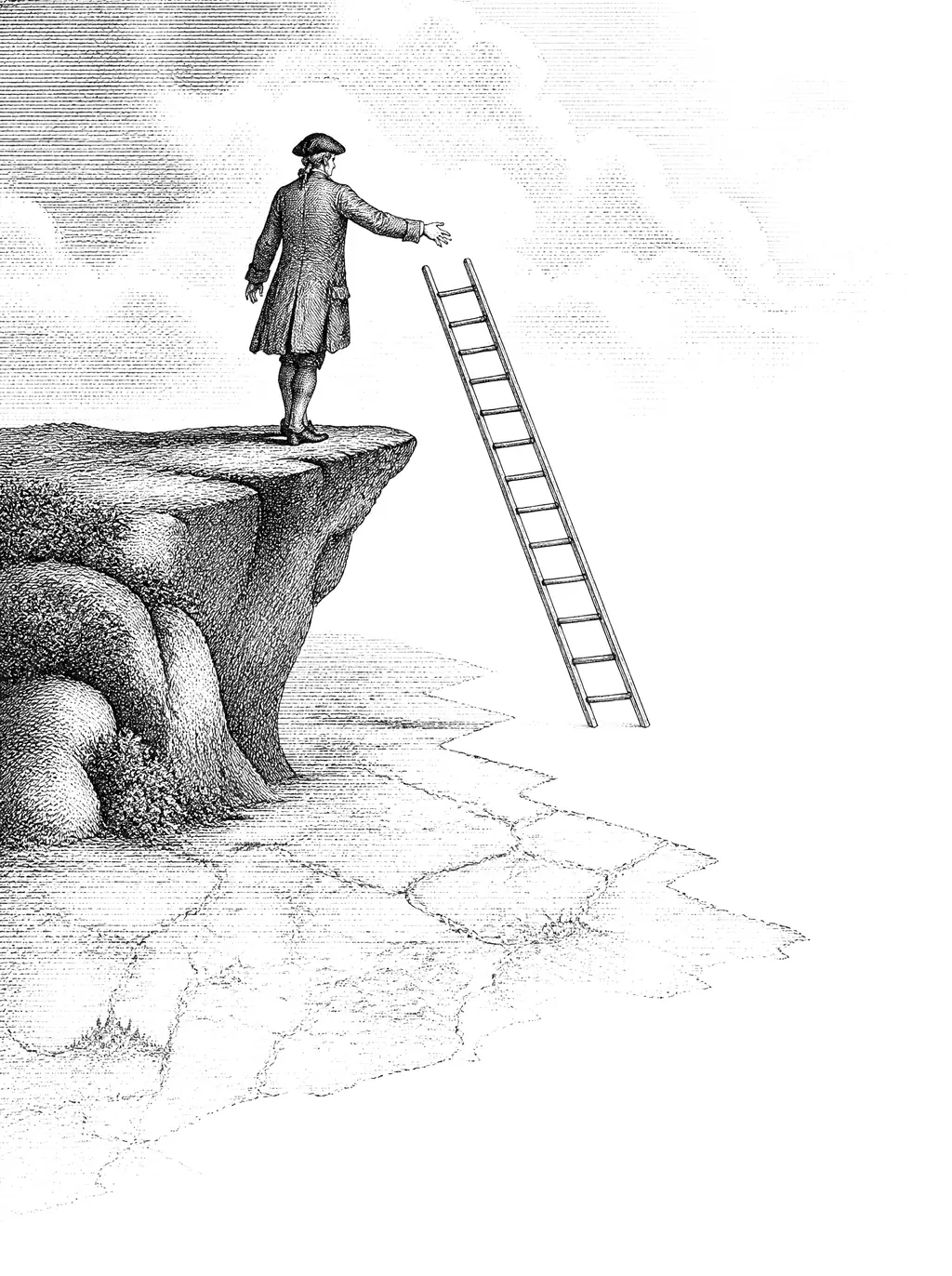
A ladder you climb and throw away
The Tractatus is barely a hundred pages, numbered like a mathematical proof, and it ends by telling the reader that its own propositions, once understood, should be recognized as nonsensical and discarded, the way you climb a ladder and then throw it away after using it to get somewhere higher up. No other book in philosophy asks to be treated this way. It claims to solve every problem it raises, and it says in the preface that the solution shows how little has been achieved. Then comes the final line, nine words in the German, which its author thought was the whole point and which most readers took as a slogan.
The world it came from
Wittgenstein was born into one of the richest families in Vienna, trained as an engineer, and in 1911 walked into Bertrand Russell's rooms at Cambridge to talk about logic. When the war came he volunteered for the Austro-Hungarian army and wrote the book in notebooks at the front, finishing it in 1918 shortly before he was captured in Italy. Russell had wanted a theory of how symbols reach the world. Wittgenstein supplied one, then decided the important part was what the theory left out. He told a would-be publisher that the book had two parts, the written one and the unwritten one, and that the unwritten part was the one that mattered. He gave away his fortune and became a village schoolteacher.
The idea
Language can meaningfully picture facts about the world, states of affairs that could be true or false. Whatever falls outside that picturing relation, ethics, the meaning of life, the mystical sense that anything exists at all, is not something language can state as a fact. It can only be shown, gestured at, or lived, never straightforwardly said. This is not a claim that such things are unreal or unimportant. The Tractatus calls them the higher. The claim is about the reach of sentences. A sentence has sense because it could be otherwise. Value, if it exists, could not be otherwise, so no sentence can carry it, and every attempt produces something that looks like a statement and is not one.
How the reasoning runs
First, a proposition pictures a possible state of affairs; it has sense because it shares a logical form with what it depicts. Second, a picture can be compared with reality, so a genuine proposition can be true or false. Third, what makes sense possible cannot itself be pictured. The form the picture shares with the world is not one more fact in the world; it shows itself in every proposition and is said by none. Fourth, ethics and the meaning of the world are not facts among the facts. If they were, they would be accidents, and an accident cannot be a value. So they are not sayable either. Fifth, the Tractatus itself talks about logical form, so by its own rule it is nonsense. Hence the ladder.
Seen in life
A colleague dies, and the company sends the email. It lists the facts: her years of service, the projects, the date of the memorial, the address for flowers. Every sentence is true and checkable. You read it twice and feel that the thing itself is missing, and you try to name what is missing, and every sentence you draft turns into another fact. She was kind. She was forty-one. Nothing lands. At the memorial someone plays a song she liked and nobody speaks for a while, and that silence carries what the email could not. Wittgenstein would say you have not failed to find the right words. There were no words of that kind to find.
Why it matters
This draws a hard boundary around what philosophy, or any use of language, can actually accomplish. Many of the deepest questions people ask, about value, meaning, and purpose, are not, on this view, questions with factual answers waiting to be stated correctly. Treating them as if they were is itself the confusion Wittgenstein's book is trying to dissolve. The consequence cuts both ways. The scientist who says the universe is meaningless because no measurement finds meaning has made the mistake, and so has the preacher who reads value off the world like a fact. Both are trying to say what can only be shown. The right response to the highest questions, Wittgenstein thought, is a kind of disciplined quiet.
“Whereof one cannot speak, thereof one must be silent.”
From the source
The Tractatus closes with its single most famous line, proposition seven, numbered like the conclusion of a mathematical proof and standing, deliberately, as the final word of the entire short, strange book: “Whereof one cannot speak, thereof one must be silent.” The propositions just before it prepare the ground. The sense of the world must lie outside the world. There are things that cannot be put into words; they make themselves manifest; they are what is mystical. The solution of the problem of life is seen in the vanishing of the problem. The reader is told to throw away the ladder after climbing it. Then the one sentence that survives, standing alone, with nothing after it.
The pushback
If ethics and meaning genuinely cannot be spoken about, why does the book itself spend so many propositions gesturing toward their importance, calling them the things that truly matter? Wittgenstein's defenders reply that showing is exactly what the book is doing throughout: demonstrating the limit by writing right up against it, rather than claiming to describe what lies past the limit in ordinary factual language. A harder objection came from Frank Ramsey, the young Cambridge mathematician who helped translate the book. What we can't say we can't say, he wrote, and we can't whistle it either. If the ladder is nonsense, then so is the instruction to throw it away, and the reader is left with nothing at all, not even a hint.
The reply
The standard reply concedes the paradox and calls it deliberate. The book does not inform you of a truth about the limits of language; it takes you through an exercise after which you see the limits for yourself, and once you see them you no longer need the sentences that got you there. Showing is not a weaker kind of saying. It is a different thing, and the book is an instance of it. That answer is only partial, and Wittgenstein himself seems to have thought so. Within a decade he was back in Cambridge dismantling the picture theory, and the Philosophical Investigations replaces the single boundary with a thousand local ones, drawn by use. He kept the silence, but he stopped trusting the map.
Where it went next
The Vienna Circle read the Tractatus aloud sentence by sentence and built logical positivism on it, taking the limit of language as a weapon against metaphysics. Wittgenstein thought they had kept the fence and thrown away the field, and refused to join them. Russell's introduction to the English edition annoyed him for the same reason. In the 1950s the Investigations spawned ordinary language philosophy, and the early book was filed away as juvenilia. Then Cora Diamond and James Conant argued that the ladder passage means what it says: the whole book is nonsense, on purpose, and that reading now has a name, the resolute reading. Iris Murdoch, Stanley Cavell, and a generation of poets took the final proposition as a discipline rather than a prohibition.
Where this leads
The absurd names one of the very questions this idea places off limits to factual language, the meaning of existence itself, and Camus responds not with silence but by insisting the question still has to be lived all the way through anyway. The two positions are closer than they look. Wittgenstein also says the problem of life is solved when it vanishes, and Camus's Sisyphus finds his answer in the walk down the hill, not in an argument. The method of doubt sits on the other side. Descartes wanted a proposition no deceiver could touch; Wittgenstein wanted to know what a proposition is at all, and concluded that the deepest things were never going to be propositions in the first place.