Symposium · Epistemology · Pl. 6Edmund Gettier · 1927–2021
The Gettier Problem
Three pages, one clean break
For centuries the standard answer to 'what is knowledge' was justified true belief: something is true, you believe it, and you have good reason to. In 1963 Edmund Gettier published a three-page paper with two small stories that made philosophers doubt a definition they had trusted since Plato. He never published another word of philosophy. By one well-worn story he wrote the paper because his department wanted publications before it would promote him, and he chose the shortest thing he could defend. Whether or not that is true, the result is the most efficient paper in the history of the subject: two examples, no theory, and a question nobody has closed.
The world it came from
Gettier was a young assistant professor at Wayne State University in Detroit, where his colleagues included Alvin Plantinga and Keith Lehrer, and where the department talked philosophy at lunch as a sport. The definition he attacked had a long pedigree. Plato's Theaetetus considers knowledge as true belief with an account and leaves the question open; the Meno says true opinion becomes knowledge when tied down by reasoning. Modern versions had just been set out crisply by A. J. Ayer in 1956 and Roderick Chisholm in 1957, and Gettier quotes both. That crispness was his opportunity. A definition stated in three clauses can be tested by a case that satisfies all three and still feels wrong, and Gettier built two.
The idea
Gettier built cases where a belief is true, the person believes it, and the person is fully justified in believing it, yet the belief is true only by luck, through a chain of accidents the person never noticed. In each case, our instinct says the person still does not really know. The structure is always the same. The person starts from good evidence, reasons correctly to a conclusion, and the conclusion happens to be true for a reason unconnected to the evidence. Justification and truth are both present, but they are not touching. Knowledge, whatever it is, seems to require that the reason you believe something and the reason it is true be the same reason, and the old definition never said so.
How the reasoning runs
Take the definition: someone knows a proposition if it is true, they believe it, and they are justified in believing it. Now accept two mild assumptions. First, you can be justified in believing something false, since evidence can mislead. Second, if you are justified in believing one thing and correctly deduce another from it, you are justified in believing the second. Build the case. Smith has strong evidence that Jones will get the job and that Jones has ten coins in his pocket. He deduces: the man who gets the job has ten coins. In fact Smith gets the job, and by chance has ten coins himself. The belief is true, believed, and justified. It is not knowledge. So the definition is incomplete.
Seen in life
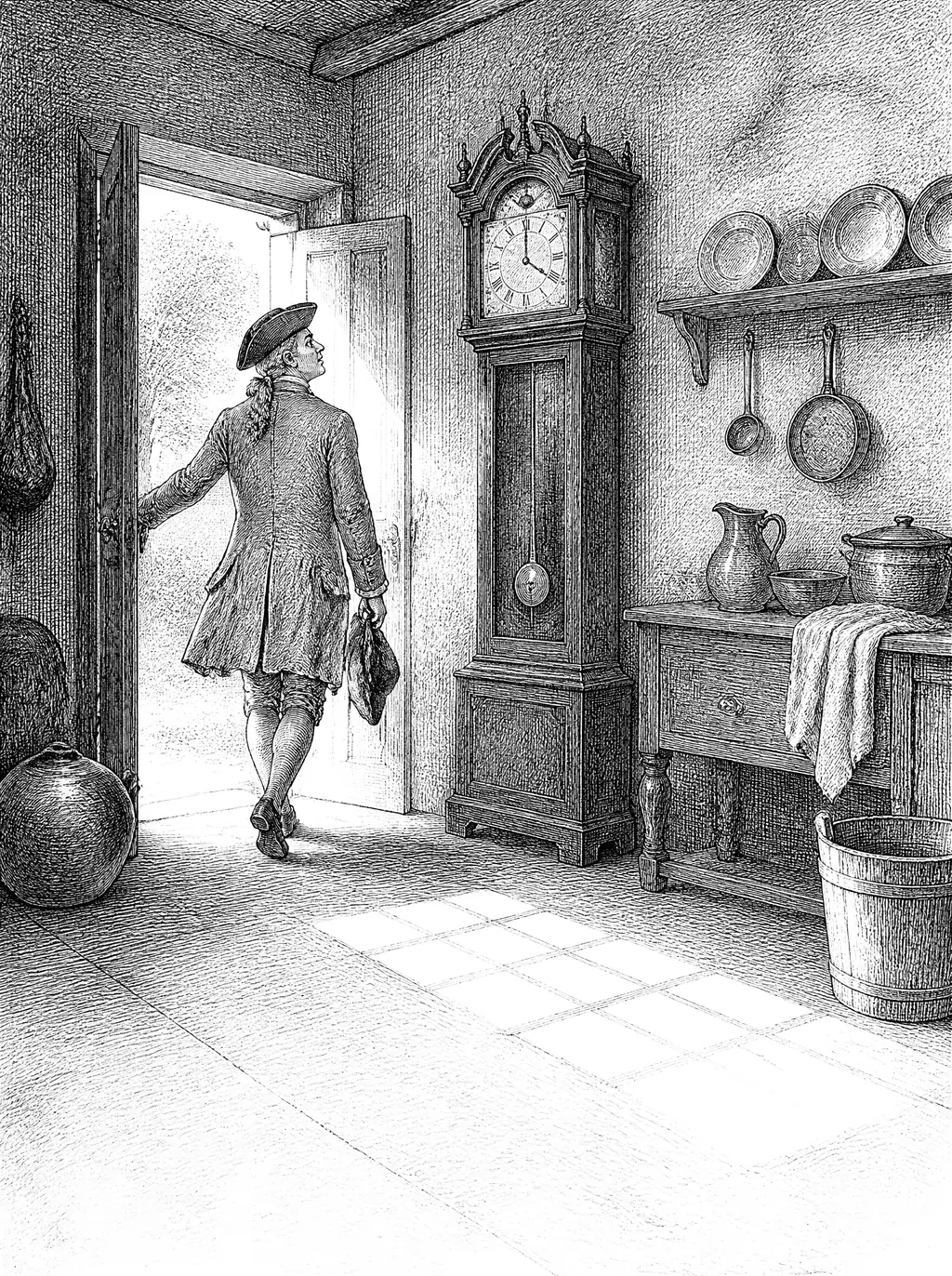
You glance at the kitchen clock on your way out. It says 8:15, you believe it is 8:15, and you have every reason to: the clock has been reliable for years. It is, in fact, 8:15. But the battery died exactly twelve hours ago, and the hands have not moved since. You looked at a stopped clock at the one moment of the day when it happened to be right. Did you know the time? Everything the old definition asked for was there. What was missing was any connection between why you believed it and why it was true. Bertrand Russell told this one in 1948, fifteen years before Gettier, and nobody noticed what it broke.
Why it matters
This means the tidiest available definition of 'knowledge' was wrong, not in some abstract academic sense, but by a working counterexample any reader can follow in a few minutes. A question that looked settled for over two thousand years reopened almost overnight, and it still has no agreed answer. The stakes are wider than a definition. Courts, doctors, and journalists all rely on the difference between a belief that is well-supported and one that is actually connected to the fact, and Gettier showed that the difference is real and hard to state. Every time someone says they were right for the wrong reasons, they are describing a Gettier case, and admitting that being right was not enough.
“Is justified true belief knowledge?”
From the source
In one case, Smith infers a true fact about who has ten coins in their pocket from a false belief about who will get a job. He ends up with a true, justified belief that happens to be correct for the wrong reason entirely — the situation Gettier's title turns into a question: “Is justified true belief knowledge?” The second case is stranger. Smith has good evidence that Jones owns a Ford, and from it deduces the disjunction that either Jones owns a Ford or Brown is in Barcelona, choosing Barcelona at random. Jones's Ford turns out to be rented, and Brown, by pure coincidence, is in Barcelona. The disjunction is true, believed, and justified, and Smith knows nothing. Gettier ends there, without a replacement.
The pushback
Some philosophers argue Gettier cases are rare edge cases that barely threaten ordinary claims to knowledge, since you almost never infer a true belief from a false one by sheer coincidence. Others reply that one clean counterexample is enough to break a definition, no matter how rare the case is. A harder objection questions the instrument. The whole argument rests on the reader's intuition that Smith does not know, and intuitions can vary. Around 2001 experimental philosophers began putting Gettier cases to people outside Western universities and reported that the verdicts differed. If the intuition is a local habit rather than a universal reaction, then the counterexample may only show what English-speaking philosophers were trained to say.
The reply
The rarity objection misreads what a definition is for. A definition claims to cover every case; one case it does not cover refutes it, however unusual, exactly as one black swan refutes all swans are white. The experimental objection was taken seriously and tested. Larger studies in the 2010s, across many languages and cultures, found the Gettier intuition remarkably stable: most people everywhere say the person does not know. So the instrument holds. What the tradition has not managed is the repair. Adding a fourth condition, no false steps, a causal link, reliability, sensitivity, has produced sixty years of counterexamples to the counterexamples. Some philosophers now suspect the fault is in the project of defining knowledge by parts at all.
Where it went next
The paper launched an industry. Alvin Goldman proposed in 1967 that knowledge requires a causal connection between fact and belief, then undercut himself in 1976 with the fake barn case, in which you see a real barn in a county full of painted facades. Robert Nozick asked whether the belief tracks the truth; reliabilists asked whether the process was trustworthy. Linda Zagzebski argued in 1994 that any definition keeping justification and truth independent can be Gettiered, which explains why the repairs kept failing. Timothy Williamson's Knowledge and Its Limits in 2000 gave up on analysis and treated knowledge as basic. Historians found the cases had precursors in the eighth-century Indian philosopher Dharmottara, which suggests the problem was always there, waiting for three pages.
Where this comes from
Plato's cave asks what it would take to really see past illusion. Gettier's cases ask a narrower, sharper version of the same question: even when you do see something correctly, was it insight, or just a lucky accident dressed up as insight? The prisoner who predicts the next shadow and is right has a true belief and a track record, and Plato would say he still knows nothing, because his belief is not connected to the source. Gettier's Smith is that prisoner in a suit. The old dialogue and the new paper agree on the diagnosis and differ on the cure. Plato thought the cure was a long climb toward the sun. Gettier declined to say, and the field has been climbing ever since.