Symposium · Logic & Paradoxes · Pl. 12Arthur Schopenhauer · 1788–1860
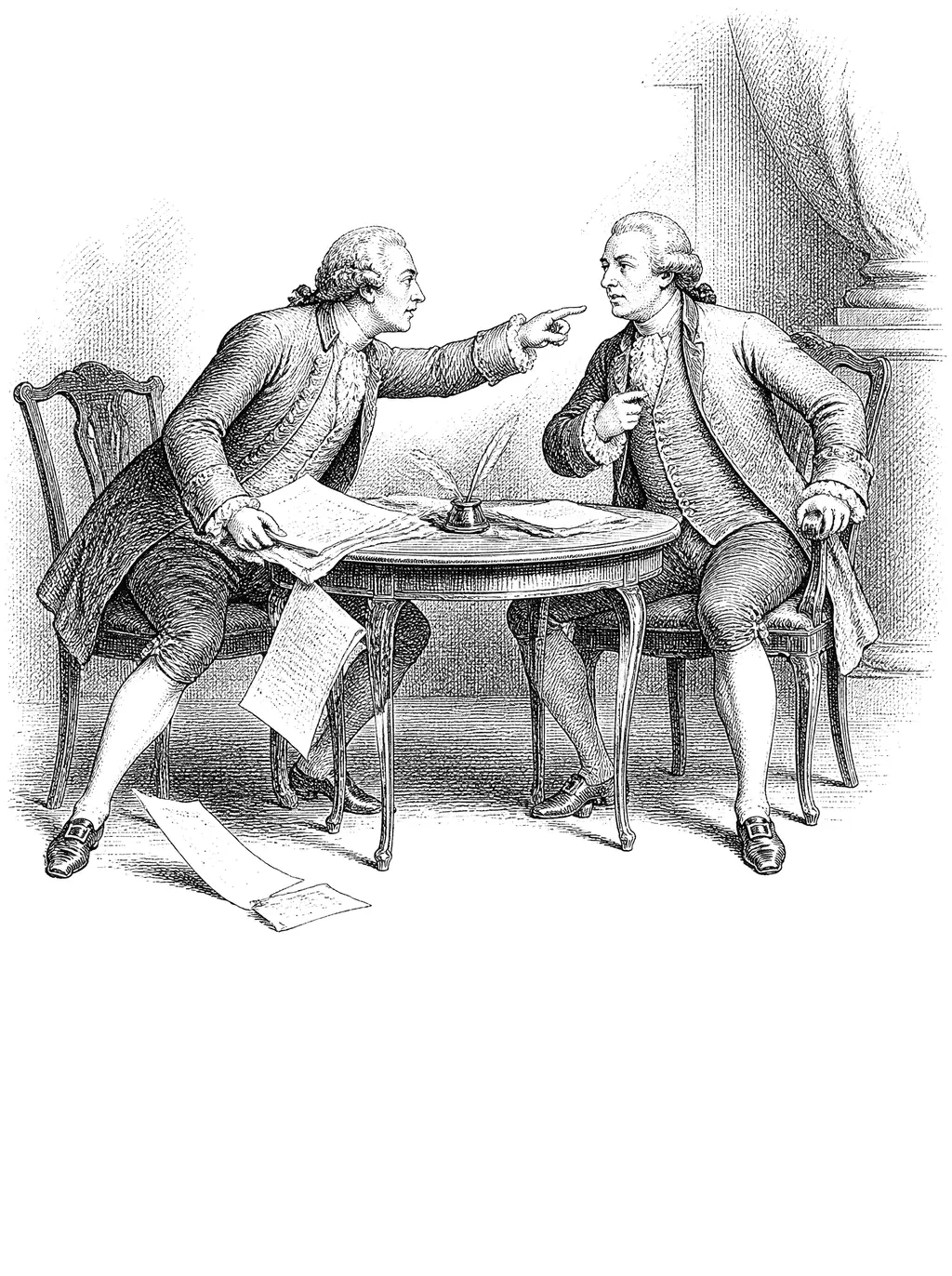
The Last Trick
A guide to fighting dirty, written to expose it
Schopenhauer catalogs the tricks people actually use to win arguments, regardless of who is right, not to recommend them but to make them visible enough to defend against. His final stratagem is the one he calls the last resort, reached for only once every legitimate move has already failed and the argument is plainly lost on the merits. He wrote the manual in the early 1830s and never published it. It surfaced from his papers after his death, and readers have used it ever since as a field guide to what is being done to them.
The world it came from
Schopenhauer wrote the notes that became The Art of Being Right around 1830, after a humiliating decade. His masterpiece, The World as Will and Representation, had sold almost nothing in 1819. In Berlin he scheduled his lectures at the same hour as Hegel's and drew a handful of students while Hegel's hall was full. He had also lost a lawsuit to a seamstress he had shoved down the stairs. The thirty-eight stratagems that resulted draw on Aristotle's Topics and Sophistical Refutations, but the tone is his own: people argue to win, vanity outweighs truth, and an honest reasoner had better know the tricks. The manuscript stayed unpublished until Julius Frauenstädt printed it in 1864, and T. Bailey Saunders's 1896 translation gave it the English title The Art of Controversy.
The idea
A last trick is to become personal, insulting, rude, as soon as you perceive that your opponent has the upper hand. It consists in passing from the subject of dispute to the disputant himself, attacking his person, an appeal from the virtues of the intellect to the virtues of the body, or to mere animalism, once reasoning itself has stopped working in your favor. Schopenhauer numbers it last of thirty-eight. It is the move made when the others have failed, and its aim is not to answer the argument but to end it.
How the reasoning runs
The stratagem has a sequence. First, you notice you are losing: the opponent's point stands and you have no reply. Second, you change the subject from the claim to the claimant. Not the budget is unbalanced, but you have never run anything. Third, you insult, so that the opponent either loses his temper, and with it the audience, or stops arguing to defend himself. Schopenhauer notes the move works because the audience remembers the heat and forgets who was right. His counter-instruction: do not answer the insult, keep to the subject, and let the pivot show. He separates the move from the older argumentum ad hominem, which uses an opponent's own admissions against him and is fair play. The last trick uses the opponent himself.
Seen in life
You are in a code review. You have pointed out that the change drops a database index and will slow the main query. The author replies that you have been on the team six months and always block other people's work. Notice what just happened. Nothing about the index was addressed. The subject moved from the query to you, and if you answer the charge, you have accepted the new subject and the index is forgotten. Schopenhauer's advice is short. Say that the point about tenure may be discussed another time, and ask again about the index. The pivot is visible the moment you name the subject that was dropped, and the trick only works on people who follow it.
Why it matters
Naming this move precisely helps you notice the exact moment a discussion stops being about the claim and starts being about the person making it, a shift that is often camouflaged as passion or bluntness. Once you can see the pivot happening, in others or in yourself, it becomes far harder for the trick to work unnoticed. The manual as a whole teaches the same skill. Each stratagem is a way of winning without being right, and the reader who can name them is harder to beat with any of them, in a meeting, a courtroom, or a comment thread.
“A last trick is to become personal, insulting, rude, as soon as you perceive that your opponent has the upper hand, and that you are going to come off worst.”
From the source
Schopenhauer describes the trick directly: “A last trick is to become personal, insulting, rude, as soon as you perceive that your opponent has the upper hand, and that you are going to come off worst... It may be called the argumentum ad personam, to distinguish it from the argumentum ad hominem.” He explains the distinction at once. The ad hominem, in the older sense he inherits from Locke and the schools, argues from what the opponent has himself conceded. The ad personam leaves the matter entirely and attacks the person. His remedy: reply calmly that the personal remark has nothing to do with the question, return to it, and go on proving the opponent wrong.
The pushback
Isn't pointing out a person's own inconsistency, the genuine argumentum ad hominem, sometimes a perfectly legitimate move, not a fallacy at all, if their own stated commitments really do contradict their current claim? Schopenhauer draws exactly this line himself, treating that narrower move as fair dialectical play, and reserving his contempt only for the wider leap into open personal insult. A second objection: sometimes the person is the point. When a witness testifies, or an expert vouches, their honesty and competence are the evidence, and an attack on them is not a change of subject.
The reply
Modern informal logic agrees with both objections and sharpens them. Douglas Walton's work on ad hominem arguments sorts the family: the abusive form, the circumstantial form that cites the speaker's interests, the tu quoque that cites his conduct, and the fair case where credibility is at issue because the claim rests on testimony. A court impeaches a witness for exactly that reason, within rules. The fallacy is not mentioning the person; it is treating facts about the person as if they settled a claim that does not depend on him. The terms have drifted. Locke coined argumentum ad hominem in 1690 for the fair move, Schopenhauer's sense; today the phrase names the foul one, his ad personam. Keep the distinction and both objections become a rule about relevance.
Where it went next
The Art of Being Right circulates as a list of thirty-eight ways to win an argument and is read by debaters, lawyers, and anyone who argues online. Charles Hamblin's Fallacies in 1970 restarted the academic study of such moves, and Walton's books in the 1990s gave the ad hominem its modern taxonomy. Paul Graham's 2008 hierarchy of disagreement puts name-calling at the bottom and refuting the central point at the top, which is Schopenhauer's last trick and its remedy drawn as a pyramid. Godwin's law, that a long online argument tends toward a comparison with Hitler, records the same pivot as folklore. The manual has outlived the philosophy it was meant to serve.
Where this leads
Petitio principii shows a much quieter kind of unfair argument from the opposite end of the same field entirely, one that wins not through open insult but by smuggling the conclusion itself into a premise no one thought to question closely. The banality of evil, Arendt's phrase, is the other neighbour, and a darker one. Schopenhauer shows what people do when they lose an argument; Arendt shows what people do when they stop arguing altogether and let the procedure think for them.