Symposium · Aesthetics · Pl. 13Arthur Schopenhauer · 1788–1860
Music Copies the Will Itself
One art that skips a step
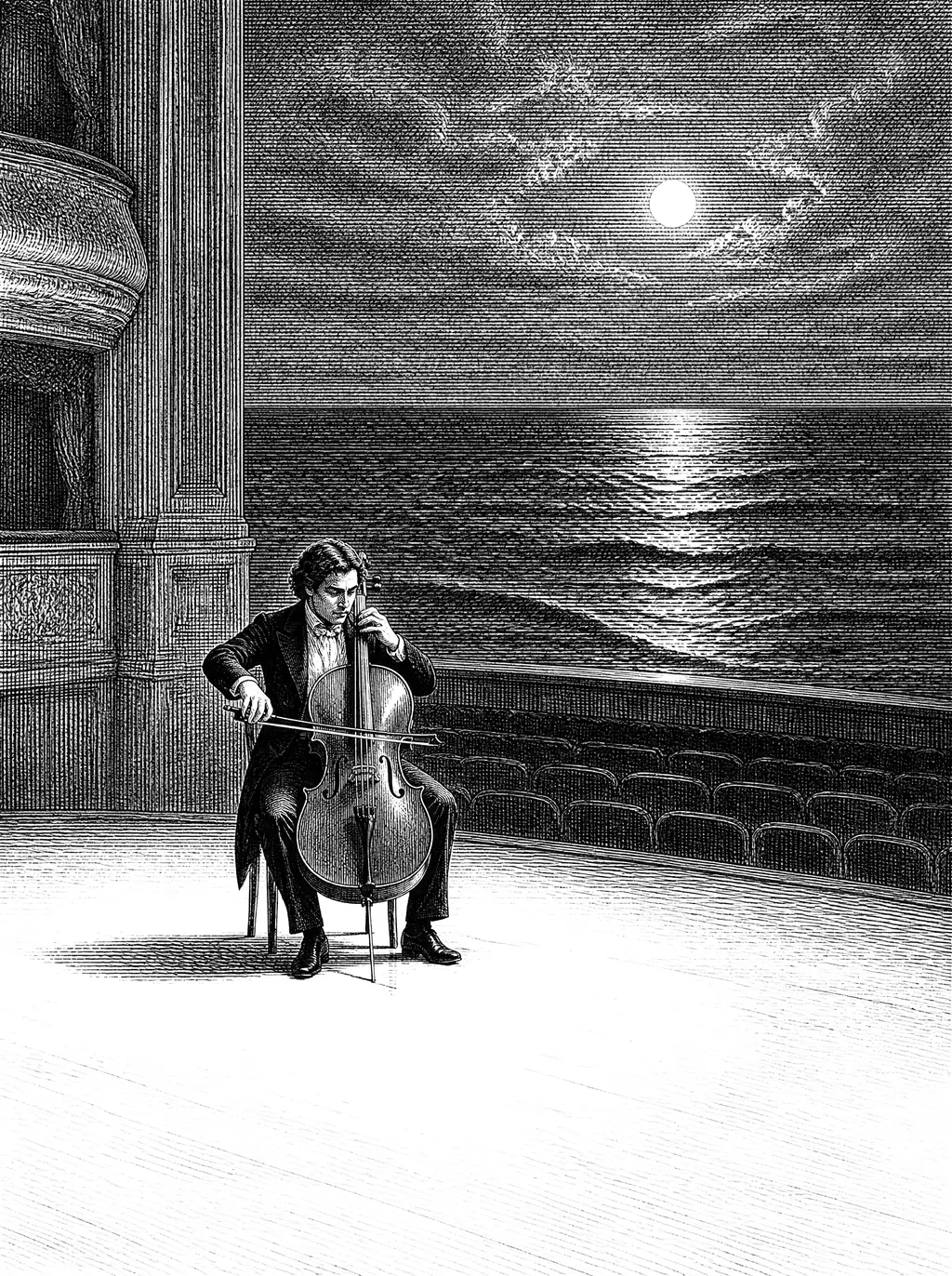
In Schopenhauer's system, painting and poetry represent particular things, and through those things gesture toward the eternal Ideas those things imperfectly express. Music, he argues, does something stranger: it bypasses objects and Ideas alike and speaks directly to the will itself, the same blind, striving force that drives every living thing. That is why, he says, a melody can carry you through longing, struggle, and release without naming a single object. The other arts show you what the will produces. Music plays you the will's own movement, which is why it feels less like watching and more like being moved from inside.
The world it came from
Schopenhauer finished The World as Will and Representation in Dresden in 1818, aged thirty, and it sold almost nothing for decades. The book's third part is a theory of art built on Kant and Plato: the arts show us the eternal Ideas behind particular things, and in contemplating them we briefly escape the will's hunger. Music was the problem case. Kant had ranked it low, as a play of sensations without concepts. Meanwhile Beethoven's symphonies, and E. T. A. Hoffmann's rapturous 1810 review of the Fifth, were making instrumental music the most prestigious art in German culture. Schopenhauer, who played the flute every day and adored Rossini, needed a theory that explained why an art with no subject matter could be the deepest one.
The idea
Music is as direct an objectification and copy of the whole will as the world itself... Music is thus by no means like the other arts, the copy of the Ideas, but the copy of the will itself, whose objectivity the Ideas are. It could, Schopenhauer claims, exist even if there were no physical world at all. Schopenhauer works the analogy out in detail. The bass is the lowest grade of the will's appearance, inorganic matter; the inner voices are plant and animal life; the melody is the conscious human being, striving and resting. Dissonance and resolution are desire and satisfaction. A song does not depict a particular grief. It presents grief itself, stripped of any story, which is why it fits every story you bring to it.
How the reasoning runs
The reasoning runs in four steps. First, the world has two sides: as representation, the objects you perceive; as will, the blind striving that those objects express. Second, the visual and verbal arts work on the representation side. A painting of a storm shows one storm; at best it lets you glimpse the Idea of storm behind it. Third, music represents no object. Strip a symphony of its title and it depicts nothing, yet it still moves you. Fourth, whatever moves you without representing any object must be working on the other side, the will directly. So music is not a copy of things but a parallel to the will itself, a second world running alongside this one.
Seen in life
You are driving at night and a song comes on that you have not heard since a bad year. There is no lyric on the chorus, only a rising line over a held chord, and within four bars your throat closes. Nothing in the music refers to that year. It has no picture of the flat you left or the person you lost. Schopenhauer would say that is exactly the point. The song is not about your grief; it is the shape of grief, tension held past comfort and then let go. Your memories rush in to fill it because the form was already theirs. Turn the radio off and the pictures fade. The shape stays.
Why it matters
This gave music a metaphysical status no other art enjoyed in his system, explaining why a symphony can move listeners who share no language, culture, or story with the composer at all. It profoundly influenced Wagner and later Nietzsche, who each inherited the sense that music reaches something beneath thought that words and images can only gesture toward. It also answers a question most theories of art dodge: why the least representational art is often the one that hits hardest. If art's job were to copy the visible world, music would be a strange failure. On Schopenhauer's account it is the one art that never took the detour through appearances, which is why a film score can tell you what a scene means before a line is spoken.
“Music is as direct an objectification and copy of the whole will as the world itself...the copy of the will itself, whose objectivity the Ideas are.”
From the source
Schopenhauer states the claim without qualification: “Music is as direct an objectification and copy of the whole will as the world itself...the copy of the will itself, whose objectivity the Ideas are.” Music, the elided line says, is by no means like the other arts, a copy of the Ideas. This, he adds, is why music moves listeners so powerfully. The passage is section 52 of the first volume of The World as Will and Representation, the last of the sections on art. Schopenhauer admits that the claim cannot be proved in the ordinary way, since the will is never given to perception as an object. He asks the reader to test it against experience instead: listen, and see whether the account matches what music does to you.
The pushback
Is this a genuine metaphysical insight, or simply an eloquent restatement of the plain observation that music feels emotionally immediate in a way pictures and stories do not quite manage? Schopenhauer's system gives the claim a precise technical home, but critics have asked whether the phenomenon really needs a whole metaphysics of the will behind it. A second objection is sharper. Music has conventions. A minor key sounds sad to you because you grew up inside Western tonality; listeners raised on other systems hear the same intervals differently. If the meaning of a chord is learned, then music is not a direct copy of anything universal. It is a language, and languages are on the representation side of Schopenhauer's own divide.
The reply
To the first charge, Schopenhauer says the metaphysics is not decoration. It predicts what a bare description cannot: why music is the most universal art, why it needs no object, why words set to it feel secondary. The convention objection is harder. He can point to what seems constant across cultures, tension and release, rising and falling, fast and slow, and say the will is expressed there while the surface grammar varies. That saves the core but shrinks it. The claims about bass and melody as grades of the will look like nineteenth-century German harmony dressed as metaphysics. What survives is the modest thesis: music presents the motion of feeling without its objects. The strong thesis, that it copies a cosmic will, rests on the whole system.
Where it went next
Wagner read Schopenhauer in 1854 and never recovered. Tristan und Isolde is a stage work built on the idea that music voices the will's endless longing, and the Ring's leitmotifs owe as much to Book III as to any libretto. Nietzsche's The Birth of Tragedy (1872) borrowed the whole framework, with music as the Dionysian voice beneath Apollonian images, before he turned on his teacher. Mahler and the early Schoenberg absorbed the same air. Thomas Mann's Doctor Faustus is soaked in it. Twentieth-century philosophy of music mostly abandoned the metaphysics but kept the question: Susanne Langer's Philosophy in a New Key (1942) argued that music presents the forms of feeling, which is Schopenhauer without the will.
Where this leads
The Last Trick shows the same restless mind turned toward a far less exalted subject than music, cataloguing the shabby rhetorical tricks people use to win arguments once fair reasoning has already failed them, a considerably darker piece of his broader account of human motivation. Life imitates art asks a question Schopenhauer never faced: what if the feeling music seems to reach was itself put there by earlier music? Wilde would say your grief already had a soundtrack before you felt it. Schopenhauer would answer that the soundtrack works only because it copies something older than any song. Hold the two together and you have the central dispute in aesthetics: does art reveal, or does it teach?