Symposium · Political Philosophy · Pl. 1Hannah Arendt · 1906–1975
The Banality of Evil
A trial that refused to fit the story
Arendt covered Adolf Eichmann's 1961 trial in Jerusalem expecting to confront the kind of fanatical hatred usually assumed to lie behind mass atrocity. Instead she found a man defending himself mainly through bureaucratic language, career advancement, following orders, meeting quotas, apparently untouched by the deeper ideological conviction most observers had assumed such a role would require. What struck her most was his speech. He talked in stock phrases and official formulas, and seemed unable to say anything that was not a cliché. She came to think that this was not a mask over the real Eichmann. It was the real Eichmann: a man who had never learned to think from anyone else's point of view.
The world it came from
Arendt was born in Hannover in 1906 to a Jewish family and studied philosophy with Heidegger and Jaspers. In 1933 she was briefly arrested by the Gestapo, fled to Paris, was interned in a French camp in 1940, and escaped to New York in 1941. Her book The Origins of Totalitarianism appeared in 1951. In 1960 Israeli agents seized Eichmann, the SS officer who had run the logistics of deportation to the death camps, in Argentina. His trial in Jerusalem ran from April to December 1961; Arendt reported it for The New Yorker and published the book in 1963. The book caused a furious controversy, especially over her criticism of the Jewish councils, and cost her several old friendships.
The idea
They were, and still are, terribly and terrifyingly normal. The trouble with Eichmann, Arendt argues, was precisely that so many people were like him: not sadistic monsters, but ordinary, thoughtless bureaucrats capable of participating in atrocity through sheer failure to think seriously about what they were actually doing, rather than through some rare, deep-seated evil intention. Thoughtless is the load-bearing word, and she did not mean stupid. Eichmann was competent. What he lacked was the habit of stopping to consider what his actions meant for the people on the other end of them. Banality names the gap between the smallness of the man and the size of what he did.
How the reasoning runs
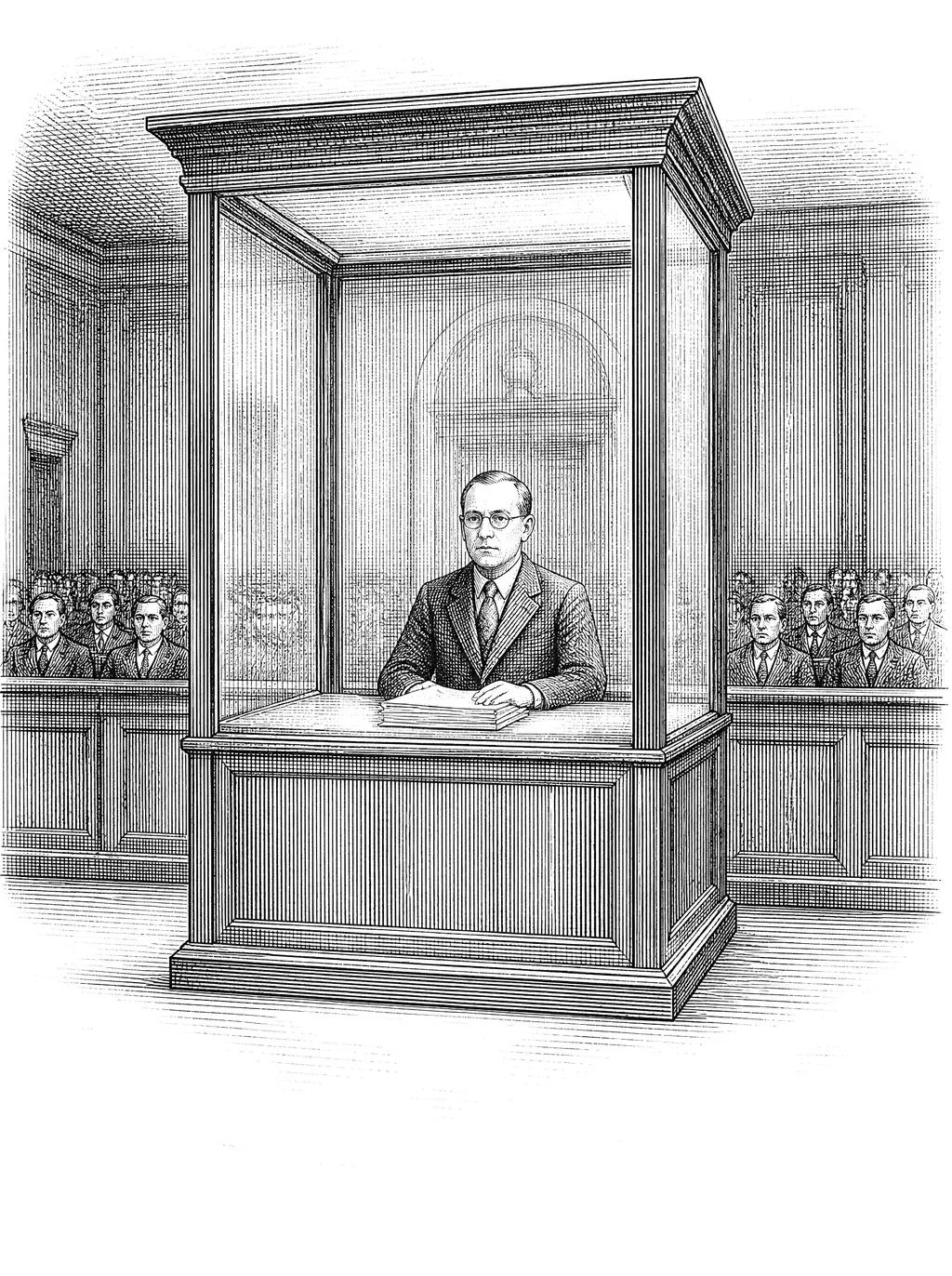
Start with the evidence Arendt saw. Eichmann showed no hatred of Jews that she could detect, no sadism, and no ideological fervor; he spoke in the clichés of his office and was proud of his diligence. Next, the ordinary theory of evil says great crimes need great wickedness, a will bent on harm. That theory does not fit the man in the glass booth. So something else must explain him. Arendt's candidate is the absence of thinking: he never asked what he was doing, only whether he was doing it properly. Third, if that is enough, then the capacity for atrocity is not rare but common, present in anyone who can stop thinking. Therefore the safeguard is not hunting monsters but keeping the habit of judgment alive.
Seen in life
You work in a claims department. A new policy arrives from above: deny first, and let the customer appeal. It is phrased in the language of efficiency, and it is not your policy. You apply it. Months later you learn that one of the appeals came from a man who died waiting. You did nothing that day you had not done a hundred times: opened the file, ticked the box, moved on. Arendt's question is not whether you are a bad person. It is whether, at any point, you stopped and imagined the person on the other end of the form. Banality is what an atrocity looks like from inside a normal job, one box at a time. The scale differs. The mechanism, she argued, does not.
Why it matters
This is genuinely unsettling for a comfortable assumption: that mass atrocity requires monstrous people to carry it out. If ordinary thoughtlessness, not extraordinary hatred, is enough, then the conditions that produce atrocity are far more common and far harder to spot in advance than the monster story lets anyone believe. It also changes where responsibility lives. A world of monsters is one in which most people can relax, since they are not monsters. A world of thoughtless clerks is one in which no one is excused by the ordinariness of their role. Arendt was demanding something from everyone, and that demand is why the phrase is still argued about sixty years later.
“They were, and still are, terribly and terrifyingly normal.”
From the source
Arendt summarizes, in a single unsettled sentence, exactly what struck her most about watching the whole long trial unfold day after day inside that crowded, closely guarded Jerusalem courtroom in 1961: “They were, and still are, terribly and terrifyingly normal.” The book is Eichmann in Jerusalem, published in 1963 from her New Yorker reports, with the phrase banality of evil in its subtitle. She used the phrase only in the closing pages and, in a postscript added later, insisted she meant it as a description of fact rather than a theory. Eichmann, she wrote, was no Iago and no Macbeth. He simply never grasped what he was doing, and that distance from reality, she argued, did more damage than any wicked motive could have.
The pushback
Critics, including many historians, have argued Arendt underestimated Eichmann's actual ideological commitment, based partly on his own carefully managed courtroom performance, and that later evidence shows a more convinced, less merely thoughtless participant than the banality thesis first suggested to her. The strongest version came from Bettina Stangneth in 2011. She used the interviews Eichmann gave to a Nazi journalist in Argentina in the 1950s, in which he speaks as a proud and committed antisemite who regretted only that the killing had not been finished. On that evidence the clerk in the glass booth was a performance, and Arendt, who attended only part of the trial, was taken in by it.
The reply
Arendt's defenders separate two claims. One is about Eichmann: that he was thoughtless rather than fanatical. The Argentina transcripts damage that claim badly, and an honest reader should concede it. The other is about how atrocities are staffed: that most of the people who make them run are ordinary, and that the ordinary can be enough. That claim has held up. Christopher Browning's study of a police battalion of middle-aged German reservists who shot tens of thousands of Jews, most of them not zealots, supports it, and so do the obedience experiments Stanley Milgram began in 1961 with Eichmann explicitly in mind. Arendt may have picked the wrong man for her thesis. The thesis outlived the mistake.
Where it went next
Milgram's experiments at Yale, in which ordinary volunteers delivered what they believed were dangerous shocks because a man in a lab coat told them to, were designed in the year of the trial and published with reference to it. Browning's Ordinary Men in 1992 gave the thesis its historical case study. Arendt herself spent the rest of her life on the question the trial left her with, what thinking is and why its absence is dangerous, in the lectures that became The Life of the Mind. The phrase entered the language and is now applied, often too loosely, to any bureaucratic harm. Stangneth's Eichmann Before Jerusalem in 2011 reopened the argument, and it has not closed.
Where this leads
The categorical imperative asks what a person actually owes each other regardless of orders or personal convenience, a standard Eichmann's own defense, that he was simply following the law, directly and quite famously failed to meet under cross-examination at trial. Eichmann claimed to have lived by Kant, and Arendt noted that he had reduced Kant's demand to obey only the law you could will for everyone into a demand to obey the law of the land. Moral luck presses from another side. Most of the people who would have ticked Eichmann's boxes were never handed the boxes. If the difference between a clerk and a war criminal is the desk one is assigned, then the ordinariness Arendt found is a fact about all of us.