Symposium · Existentialism · Pl. 14Albert Camus · 1913–1960
The Absurd
A question with no answering voice
Ask the universe why you are here, what any of it means, whether your suffering adds up to anything, and you get exactly the same response every time: silence. Camus does not treat that silence as evidence the questions are wrong to ask. He treats it as the defining fact of the human situation, one most people spend their whole lives arranging not to notice. The Myth of Sisyphus, the 1942 essay where he works this out, begins from that silence and asks what an honest person does once they have heard it.
The world it came from
Camus was born in 1913 in French Algeria. His father died at the Battle of the Marne the next year, and his mother, who was deaf and could not read, raised him in a poor quarter of Algiers. At seventeen he caught tuberculosis, which ended his football and nearly ended him. He wrote The Myth of Sisyphus in 1940 and 1941, as France fell and the occupation began, and published it in Paris in 1942 alongside his novel The Stranger. The argument is aimed at thinkers he had read closely: Kierkegaard, Jaspers, Shestov, and Husserl, each of whom, he thought, had seen the absurd clearly and then flinched. He wanted to know what was left if you did not flinch.
The idea
The absurd is not a property of the world by itself, and not a property of the human mind by itself. It is what appears in the collision between the two: a mind that demands meaning, clarity, and reasons, set against a universe that offers none of those things and was never obligated to. Neither side can be argued away, so the collision is permanent. The absurd, then, is a relationship, not a thing. Remove either partner and it vanishes: a universe with no one in it to ask is not absurd, and a mind that stopped asking would not find it so. Camus's first rule is to keep both partners alive.
How the reasoning runs
Start from what you actually want when you ask what life means: unity, clarity, a reason that would settle the matter. Then look at what the world gives back. Science describes and counts, but at its limit it hands you metaphor and hypothesis, not the reason you asked for. Every system that claims to supply one, Camus argues, does so by asserting what it needs to prove. So the demand is real and the silence is real. Two moves remain. You can abolish the demand by killing yourself, or abolish the silence by leaping into a faith the evidence never earned. Camus rejects both as evasions of the same fact. What is left is to live with the contradiction open, which he calls revolt.
Seen in life
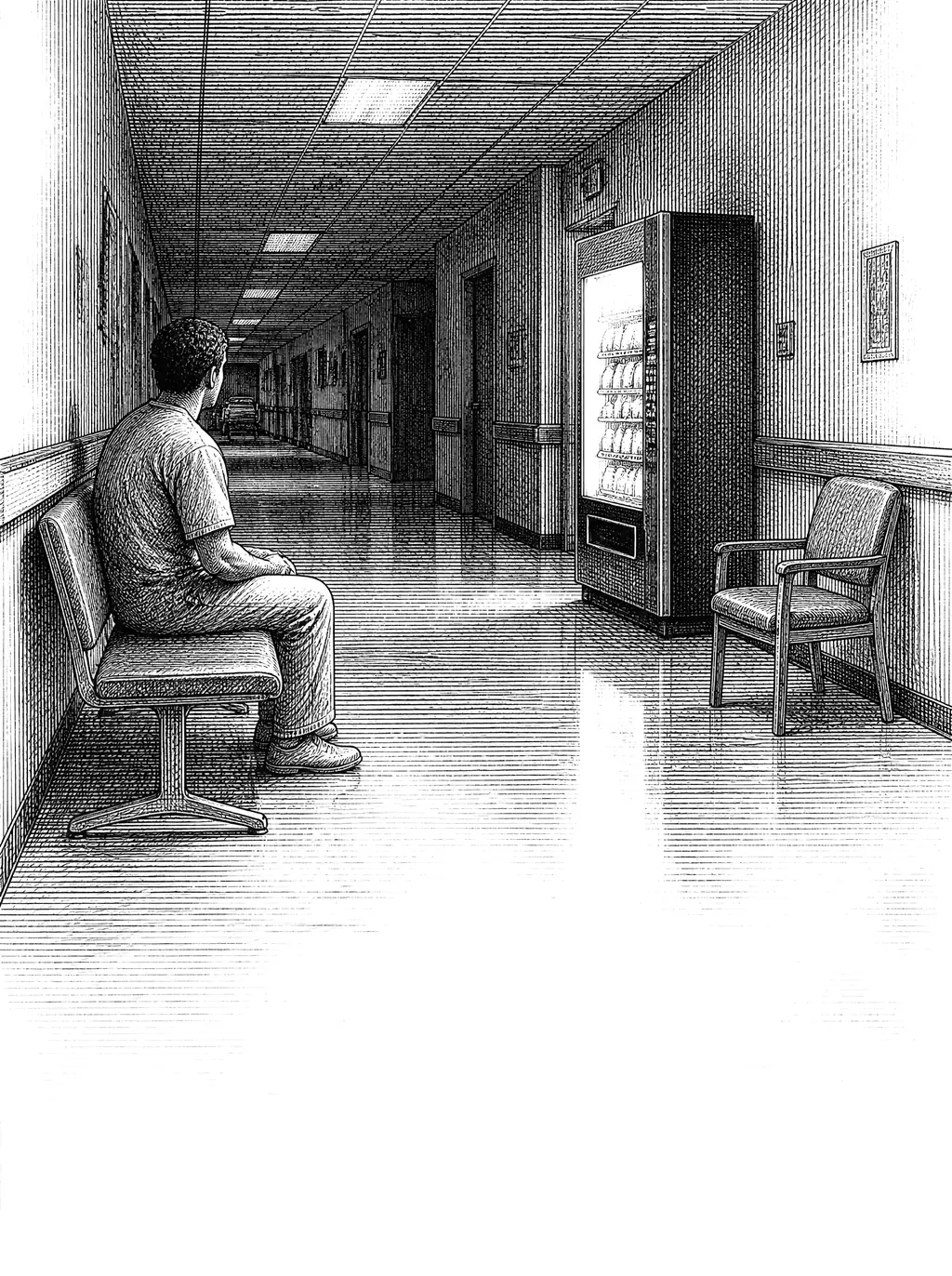
You are at the hospital at three in the morning, and the doctor has just told you that the scan found nothing that explains it. You want a reason. Not a treatment, yet; a reason, some story in which this happens to this person now and it adds up. The corridor is quiet. The vending machine hums. Nobody is withholding the answer from you; there is simply no one whose job it is to have one. That is the absurd, in Camus's exact sense. Notice the two temptations that arrive at once: to decide it must be punishment or a test, or to decide that nothing matters, so why care. He asks you to refuse both and stay in the corridor, awake.
Why it matters
Most people resolve this tension by cheating, either denying the world's silence through religious or ideological certainty, or denying their own hunger for meaning through numb resignation. Camus considered both moves a kind of philosophical suicide, refusing to hold the tension the absurd actually names. His entire project starts by insisting the tension has to be held, not dissolved. The payoff is a strange kind of freedom. Once you stop demanding that the world justify you, you stop waiting for permission, and what you do with the day becomes wholly your own. Nothing is promised, so nothing can be withdrawn.
“The human need and the unreasonable silence of the world.”
From the source
Camus names the collision directly in his essay, describing what the absurd is actually born from: “The human need and the unreasonable silence of the world.” Both halves, he insists, are equally real, and neither one is allowed to simply cancel the other out. The essay treats that sentence as a definition, and everything that follows is an attempt to live up to it. Camus lists the thinkers who reached the same border and then, in his view, crossed it by turning the silence into a God. He calls that move philosophical suicide, the intellectual twin of the physical kind, because both destroy one of the two terms that make the absurd what it is. His own answer keeps the terms apart.
The pushback
Isn't this just restating an old problem, that the universe doesn't hand out meaning for free, in more dramatic language than it needs? Camus would answer that most people already know this and spend enormous energy avoiding a direct look at it; naming the absurd clearly, rather than living around it quietly, is exactly the difficult, honest step he is asking for. A harder objection comes from Thomas Nagel. The absurd, he argued, does not need a silent universe at all. It arises inside us, from our ability to step back and see our own seriousness from outside, and no answer from the sky would cure that. If so, Camus has misplaced the problem.
The reply
To the first objection Camus would say that a familiar truth nobody acts on is not yet understood, and that the drama is in the living, not the phrasing. Nagel is harder to answer. Camus never distinguished clearly between the world's silence and the mind's habit of stepping back, and his heroes, Sisyphus and the conqueror and the actor, can read as men striking poses. The honest reply is partial. Camus was right that most consolations are cheats, and right that the alternative to a cheat is not despair. Whether that alternative deserves the word revolt, or Nagel's quieter word, irony, is a question the essay does not settle and probably cannot.
Where it went next
Sartre reviewed The Stranger in 1943 and read the essay beside it, and for a decade the two men were the public face of French existentialism, though Camus denied the label. They broke in 1952 over The Rebel and never reconciled. Martin Esslin borrowed the word for his 1961 book The Theatre of the Absurd, gathering Beckett, Ionesco, and Genet under it; Beckett's two tramps waiting for a Godot who never comes is the absurd staged. Thomas Nagel's 1971 essay The Absurd rebuilt the problem in analytic terms and swapped Camus's defiance for irony. Camus won the Nobel Prize in 1957 and died in a car crash three years later, an unused train ticket in his pocket.
Where this leads
Is life worth living asks the question the absurd makes unavoidable once you actually sit with it: if the universe will never answer your need for meaning, does anything at all still justify choosing to go on living inside the silence? Sisyphus, pushing his rock with full knowledge that it will roll back, is Camus's picture of what an answer looks like: not a proof, but a way of walking back down the hill. Read the three together as one argument, diagnosis first, question second, and then the only response Camus could stand behind.