Symposium · Philosophy of Religion · Pl. 14Baruch Spinoza · 1632–1677
Scripture Teaches Obedience, Not Truth
A war neither side needed to fight
Spinoza opens his treatise onto a centuries-old war between theologians and philosophers, each accusing the other of trespassing on its territory. Rationalists tried to force Scripture to agree with reason; skeptics tried to force reason to bow to Scripture. Spinoza's solution is to deny that the two were ever actually competing for the same ground in the first place. The Tractatus Theologico-Politicus appeared in 1670 without his name on it. Within a few years it was banned by church and state alike, which tells you how little either side wanted the peace treaty he offered.
The world it came from
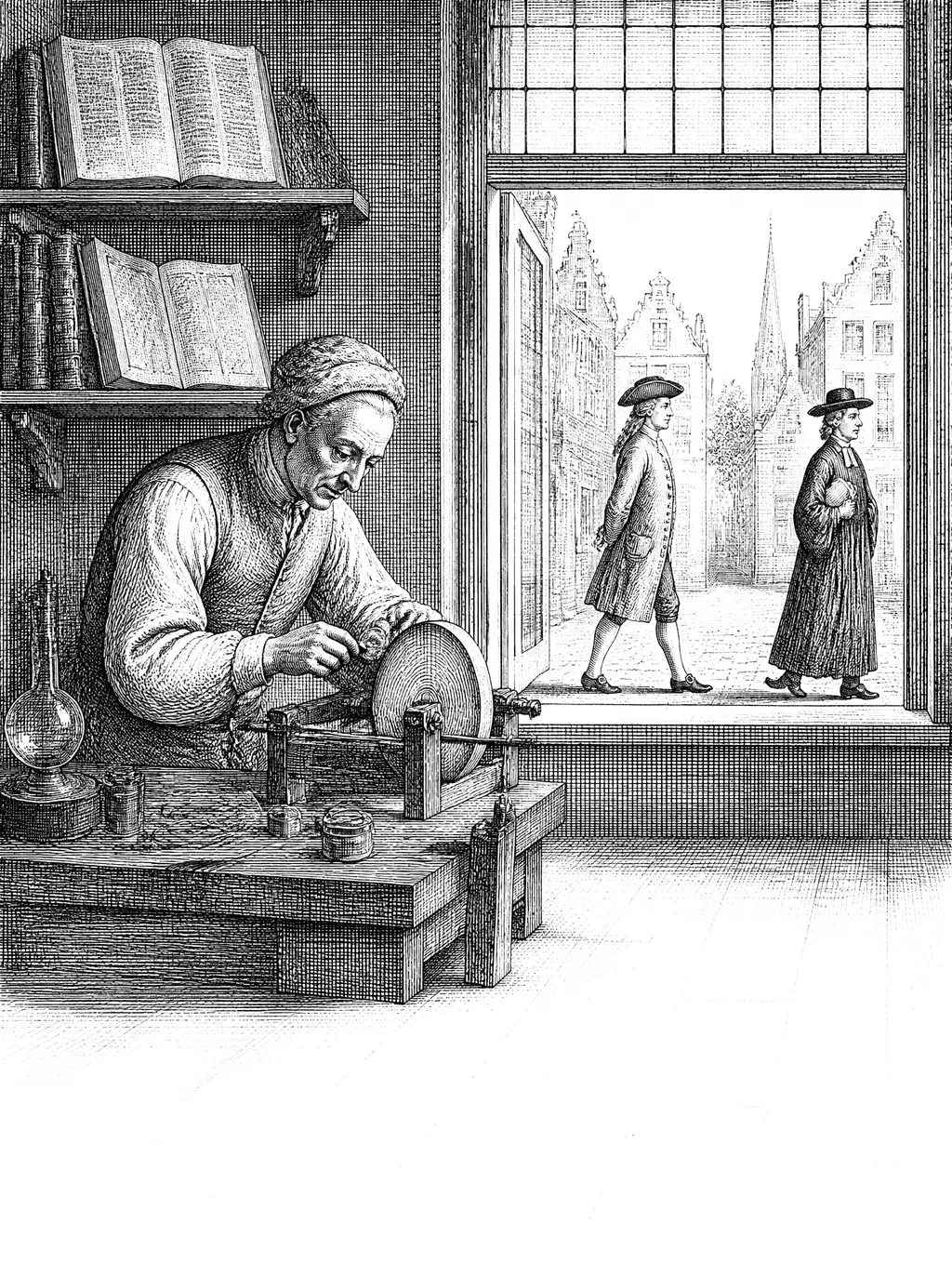
Spinoza was born in Amsterdam in 1632 to a family of Portuguese Jews who had fled the Inquisition. In 1656 his own synagogue expelled him with a ban of unusual severity, and he spent the rest of his life grinding lenses and writing. The Dutch Republic was the freest place in Europe, but not free: Calvinist preachers pressed the government to silence dissent, and in 1672 a mob murdered Johan de Witt, the republican leader Spinoza admired. The Tractatus was written into that fight. Its subtitle promised to show that freedom to philosophize could be granted without harm to piety or public peace. The book was published anonymously in 1670 and banned in 1674.
The idea
We have shown that Scripture does not teach philosophy, but merely obedience, and that all it contains has been adapted to the understanding and established opinions of the multitude. Scripture, on this account, was never in the business of delivering metaphysical or scientific truth at all; it was written to move ordinary, untrained people toward justice and charity, in language they could actually follow. Prophets, on his reading, were people of vivid imagination, not superior intellect. What they taught was simple: love God and your neighbour. Everything else in the text is scaffolding around that.
How the reasoning runs
Spinoza's method is to read Scripture the way you would read nature, from the text alone. Step one: catalogue what the books actually say, in their own language and historical setting, before you decide what they mean. Step two: notice that the prophets contradict each other on physics and even on God's nature, but agree on one thing, that justice and charity are what God requires. Step three: a book whose consistent content is moral must be a moral book; its cosmology is local colour. Step four: reason has its own domain, the demonstration of truth, and needs no permission from theology. Conclusion: neither can judge the other, because they answer different questions. The quarrel was a category error.
Seen in life
You sit in a school board meeting where one parent wants the creation story taught as science and another wants every religious reference removed from the building. Both sides assume the text and the textbook are competing for the same shelf. Spinoza would say they are not. Genesis, on his reading, was written to teach a people to live justly, in the language that people understood, and it does that job whether or not the earth is six thousand years old. The biology teacher is answering a different question. You may find his division too neat, and many believers do. But it explains why the meeting feels like a fight over nothing that either side can win.
Why it matters
This let Spinoza defend both reason and faith at once, without forcing either to answer to the other's standards. Philosophy could pursue truth through demonstration, untroubled by apparent conflicts with a text never meant to teach it; religion could keep its authority over conduct, without needing to double as a science textbook it was never trying to be. It also made Spinoza the founder of modern biblical criticism. Treating the text as a historical document with human authors, sources, and an audience is now ordinary scholarship. In 1670 it was a crime.
“We have shown that Scripture does not teach philosophy, but merely obedience, and that all it contains has been adapted to the understanding and established opinions of the multitude.”
From the source
Spinoza states the separation directly, in the chapter arguing theology owes nothing to reason and reason owes nothing to theology: “We have shown that Scripture does not teach philosophy, but merely obedience, and that all it contains has been adapted to the understanding and established opinions of the multitude.” Neither domain, on this view, can overrule the other. He goes on: reason is the domain of truth and wisdom, theology the domain of piety and obedience. Neither is the handmaid of the other. Faith, he says, grants everyone the freedom to philosophize, so that a person may think what they like about anything without wickedness, and condemns only those who teach opinions that breed hatred and strife.
The pushback
But doesn't Scripture plainly make claims that look like history and cosmology, not just moral instruction, creation, miracles, the age of the world, claims believers have always treated as literally true rather than as obedience dressed up in story form? Spinoza's answer is that these passages are accommodated to a credulous audience's imagination, not asserted as literal fact even where they read that way. A harder objection: if Scripture teaches only obedience, and the content of obedience is decided by reason, then Spinoza has quietly made reason the judge after all. The separation looks like a surrender dressed as a truce.
The reply
Spinoza's answer to the first objection is exegetical. He points to passages where the prophets themselves speak of God with bodies, passions, and changes of mind, and argues that a text this varied cannot be a systematic metaphysics. On the second objection, he half concedes it. Reason does decide what obedience means in practice, and the Tractatus ends by giving the state authority over public religion. What he preserves for faith is not a claim about the world but a way of moving people whom argument will never reach. Whether that leaves faith with anything worth the name is the question his critics pressed from the start, and it is a fair one. The truce favours one side.
Where it went next
The Tractatus made Spinoza the most feared name in Europe for a century; to be called a Spinozist was an accusation. Yet its method won. Richard Simon in France and later German scholars built the historical criticism of the Bible on the ground he cleared. Lessing, Goethe, and the Romantics rehabilitated him. His argument for freedom of thought fed directly into the Enlightenment and, through the Dutch and English debates, into modern arguments for the separation of church and state. Jonathan Israel's Radical Enlightenment (2001) makes him the hidden centre of the whole movement. Biblical scholars still cite chapter seven of the Tractatus as the founding text of their discipline.
Where this leads
One substance, infinite names shows Spinoza's own deeper metaphysical picture underneath this argument, identifying God with the whole of Nature itself rather than a separate personal lawgiver, part of why he could treat Scripture's vivid, anthropomorphic God-language as adapted to popular imagination rather than literal metaphysical description. The first mover gives the opposite strategy. Aquinas thought reason could climb from the world to God, and Scripture could then confirm what reason found. Spinoza cut the ladder in two.