Symposium · Philosophy of Religion · Pl. 1Thomas Aquinas · 1225–1274
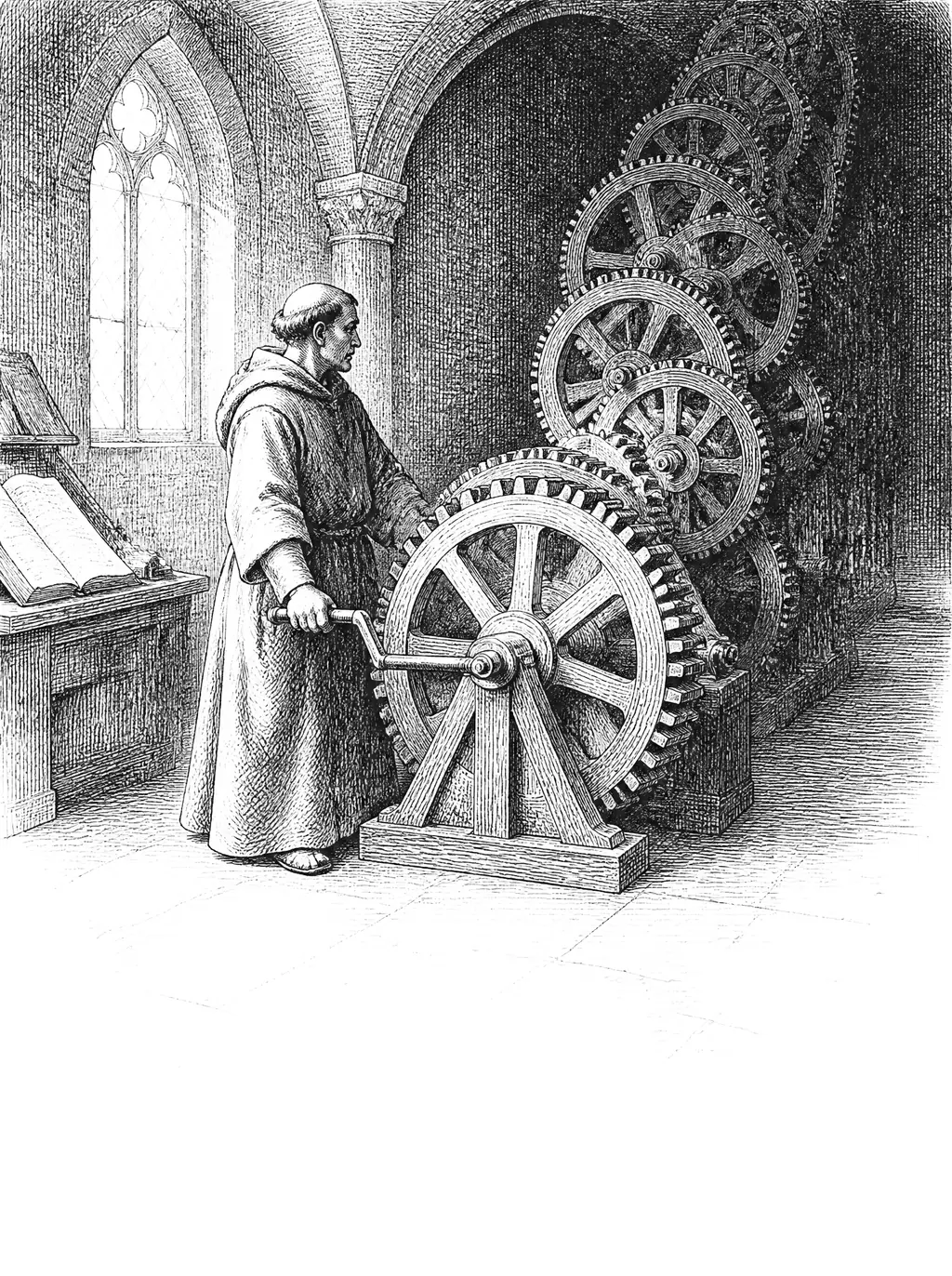
The First Mover
Starting from what anyone can see
Aquinas opens the Summa Theologica's case for God not with revelation but with plain observation: some things in the world are in motion. Whatever moves is moved by something else, that thing by another, and so on. The question is simply whether this chain can stretch back forever, or whether it must stop somewhere definite. The passage is a few hundred words in a work of some two million. Aquinas thought the argument was already Aristotle's; his contribution was to say that the God at the end of it was the one in Scripture.
The world it came from
Thomas Aquinas was born around 1225 near Naples, joined the new Dominican order against his family's wishes, and studied at Paris and Cologne under Albert the Great. His life's work was to meet a crisis. Aristotle's complete writings had reached the Latin West through Arabic and Greek translations in the preceding century, along with the commentaries of Avicenna and Averroes, and the university of Paris had banned some of them for contradicting the faith. Aquinas's answer was to show that reason, meaning Aristotle, and revelation agreed. The Summa Theologica, begun around 1265, was a textbook for beginners. The Five Ways appear in its second question, after he has argued that God's existence is not self-evident and so must be demonstrated from effects.
The idea
It is necessary to arrive at a first mover, put in motion by no other; and this everyone understands to be God. An infinite regress of movers, Aquinas argues, explains nothing, since without a first cause setting the whole chain going, there would be no motion anywhere in the series at all, including the motion happening right now. The motion in question is not only movement through space. It is change of any kind, the passage from what a thing could be to what it is, and Aquinas's claim is that nothing makes that passage on its own.
How the reasoning runs
The First Way has five steps. One: some things are in motion, that is, changing. Two: whatever changes passes from potential to actual, and what is potential cannot make itself actual, since it does not yet have what it would need to. Three: so whatever changes is changed by something already actual, another thing. Four: that other thing, if it too is changing, needs a mover in turn, and here Aquinas insists the series cannot go back without end, not because time has a start but because a chain of dependent movers with no independent one would explain nothing, like a train of carriages with no engine. Five: therefore there is a first mover, moved by nothing, and this is what everyone calls God.
Seen in life
You are at a table where a friend says the universe just is, no explanation needed, and another says something must have started it. You may notice that both are half-quoting Aquinas without knowing it. His point was never about the Big Bang; he thought reason could not prove the world had a beginning at all. His point was about dependence right now. The lamp is lit because the current flows because the turbine turns because the water falls. Ask whether that chain can consist entirely of things that borrow their power. Whether you end at God, at physics, or at a shrug, the question is the one he asked. Believers and non-believers have stood on both sides of it since 1270.
Why it matters
This gave natural theology a model that later thinkers imitated for centuries: start from an observable fact about the world, argue that only an unmoved, uncaused first cause can explain it, and identify that cause with God. It shaped how philosophy and theology would argue about God's existence for the next seven hundred years. The Five Ways also set the terms for the truce between faith and reason that shaped Catholic thought for seven centuries: reason can establish that God is, and revelation is needed to say what God is like. That division is Aquinas's, and it is still official.
“It is necessary to arrive at a first mover, put in motion by no other; and this everyone understands to be God.”
From the source
Aquinas states the conclusion of his First Way directly: “It is necessary to arrive at a first mover, put in motion by no other; and this everyone understands to be God.” This is the first of five distinct arguments he offers, each starting from a different observed feature of the natural world. Motion, he explains, is the reduction of potency to act, and nothing is reduced from potency to act except by something already in act, as fire makes wood hot. Nothing can be in act and potency in the same respect, so nothing moves itself. The chain of movers cannot go to infinity, he says, because then there would be no first mover and so no motion at all.
The pushback
Why must the chain of movers stop at all, rather than continuing forever, or looping back on itself in some way modern physics might allow us to imagine? Aquinas's answer rests on the claim that a genuinely infinite regress of movers could never actually get anything moving in the first place, a premise later philosophers have contested at length. A second objection asks about the last step. Even if there is a first mover, why is it God? An unmoved mover need not be one, or personal, or good, or the God of any scripture. The argument, at best, reaches something, and the name is added afterwards.
The reply
Thomists answer the first objection by distinguishing two kinds of series. A chain ordered in time, fathers and grandfathers, might go back forever; Aquinas allowed that. A chain ordered in dependence, where each member acts only because another acts on it now, cannot, because a series of borrowed powers with no lender has no power in it at all. Whether physics offers such a series without a lender is where the debate now sits. On the second objection they concede the point: the Five Ways establish only a first cause, and the following questions of the Summa argue, one attribute at a time, that such a cause must be simple, one, and good. A reader who stops at question two is right to say the name came early.
Where it went next
The Five Ways became the backbone of Catholic natural theology, and Leo XIII's encyclical of 1879 made Thomism the church's official philosophy. Kant's Critique of Pure Reason (1781) argued that every such proof secretly depends on the ontological argument and cannot succeed, and Hume's Dialogues had already asked why the chain must stop. Twentieth-century Thomists, Gilson, Maritain, and later Edward Feser, defended the argument against both. The kalam cosmological argument, revived by William Lane Craig, is a cousin that Aquinas would have rejected, since it needs the universe to have begun. Bertrand Russell dismissed the first-cause argument on the grounds that if everything needs a cause, so does God; Thomists reply that Aquinas never said everything needs a cause, only what changes.
Where this leads
The light in the heart shows a very different route to religious conviction taken centuries earlier by Al-Ghazali, who arrives at certainty not through a chain of causes and observed motion, but through a personal experience he describes as illumination, arriving after formal argument had exhausted itself entirely. Anaxagoras's nous is the pre-Socratic ancestor. Anaxagoras posited a mind that set the cosmos in motion and then, Socrates complained, made no use of it. Aristotle took the unmoved mover from that hint, and Aquinas took Aristotle.