Symposium · Metaphysics · Pl. 13Baruch Spinoza · 1632–1677
One Substance, Infinite Names
Erasing the gap
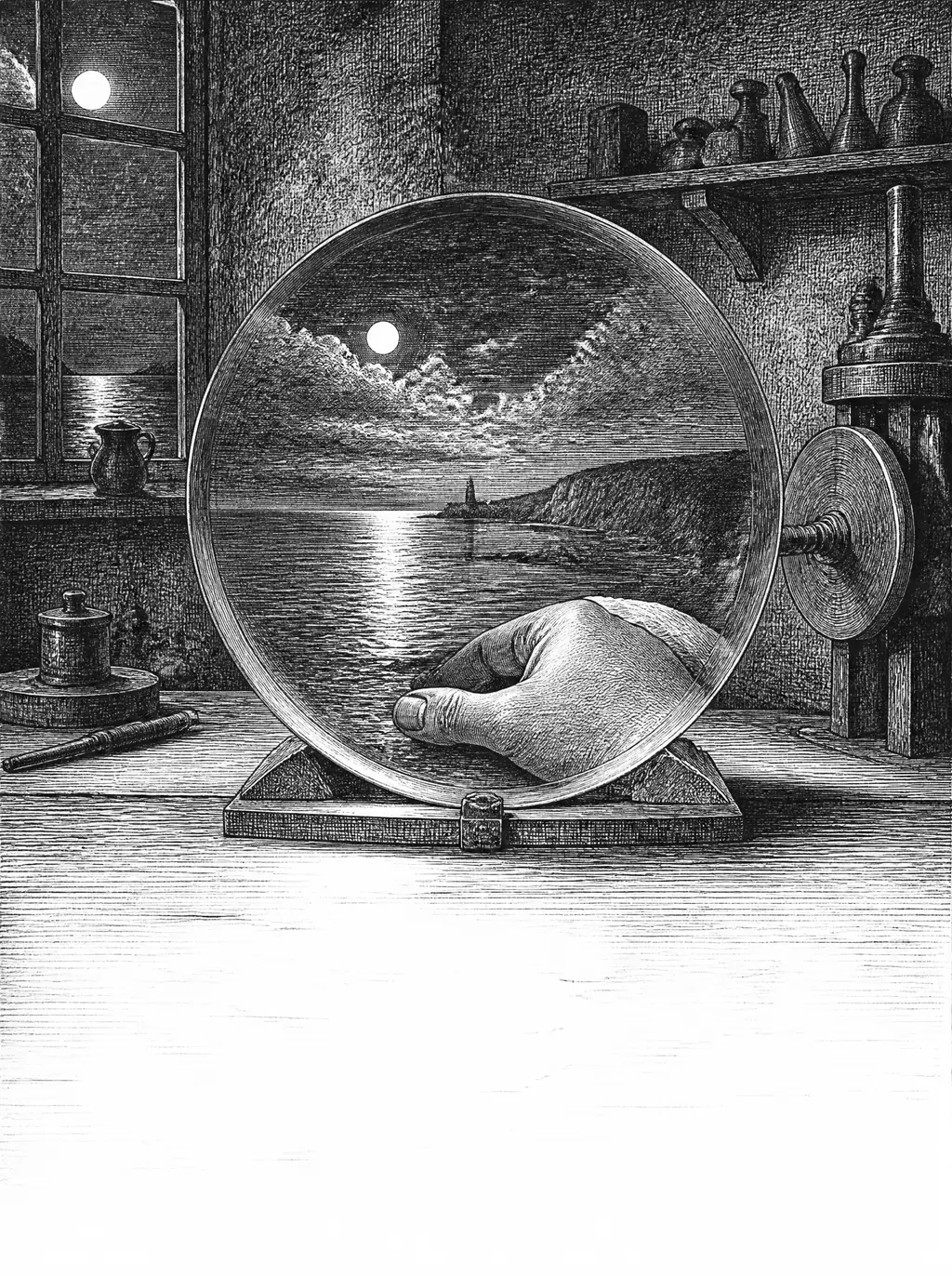
Traditional theology pictures a creator standing outside creation, separate from the world the way an architect stands apart from a building. Spinoza's geometric proofs, moving step by step like a mathematical demonstration, arrived somewhere far stranger: no such gap exists, because nothing exists outside the one infinite substance that both is and contains everything there is. He paid for the thought before he had finished it. At twenty-three he was expelled from the Jewish community of Amsterdam with a curse of unusual ferocity, for opinions the document does not name. He spent the rest of his life grinding lenses and writing, and the book that holds the argument appeared only after his death, with the author's name reduced to initials.
The world it came from
Spinoza was born in Amsterdam in 1632 to a family of Portuguese Jews who had fled the Inquisition. In 1656 the community expelled him. He supported himself as a lens grinder, refused a professorship at Heidelberg to keep his independence, and lived quietly in Rijnsburg, Voorburg, and The Hague. His philosophical starting point was Descartes, whose work he had taught and summarised. Descartes had defined a substance as a thing that needs nothing else in order to exist, and then counted three: God, mind, and matter. Spinoza took the definition seriously and noticed that only one thing could satisfy it. The Ethics, finished around 1675 and published by friends in 1677, works out what follows in the form of Euclid's geometry.
The idea
Besides God no substance can be granted or conceived. Everything that exists, matter, mind, every finite thing, is not created by God from outside; it is a mode, an expression, of the single infinite substance Spinoza calls God, or equally, Nature. There is only one thing in the deepest sense, wearing every possible name and shape at once. That one thing has infinitely many attributes, of which we know two: thought and extension. Your mind and your body are not two things interacting, as Descartes had struggled to explain. They are one mode of substance, grasped under two attributes. The order of ideas is the same as the order of things. God does not choose or plan; God is the necessity by which everything follows.
How the reasoning runs
Definition: a substance is what exists in itself and is conceived through itself. Step one: two substances with the same attribute could not be told apart, since substances are known through their attributes, so there cannot be two. Step two: one substance cannot produce another, because the effect would then be conceived through its cause and would not be a substance at all. Step three: substance therefore exists necessarily, from its own nature, since nothing else could bring it about. Step four: God, defined as the substance with infinitely many attributes, exists. Step five: since God has every attribute, no other substance could have any attribute left to it. So God is the only substance, and everything else is a mode of God.
Seen in life
You are standing on a beach at night, and the usual thought arrives: how small I am, how vast all that is, how separate. Spinoza asks you to try the opposite thought and see whether it is truer. The tide, the pull of the moon, the neurons producing the feeling of smallness, and the feeling itself are not a spectator and a spectacle. They are one system, following from its own nature, and the part of it that is briefly you is looking at the rest. Nothing is watching from outside. Spinoza called the calm that comes from seeing this the intellectual love of God, and meant by it something like what you might feel on that beach once the sense of separation drops away.
Why it matters
This collapses the usual distinction between the sacred and the ordinary, the divine and the merely physical. If Spinoza is right, studying nature directly, a leaf, a law of motion, a thought, just is studying God directly, with no separate, holier category standing above or apart from the physical world you can actually observe and measure. It also removes the machinery that religion had used to frighten and console: no personal judge, no miracles, no providence directed at you in particular. What replaces it is the demand to understand. Everything that happens follows necessarily, so blame and regret are confusions, and freedom is knowing the causes that move you. Einstein, asked whether he believed in God, answered that he believed in Spinoza's God.
“Besides God no substance can be granted or conceived.”
From the source
Spinoza proves the claim step by step in the Ethics: “Besides God no substance can be granted or conceived.” The corollary follows immediately: God is one, that is, only one substance can be granted in the universe, and that substance is infinite. This is Proposition 14 of Part I, and it arrives after thirteen propositions, eight definitions, and seven axioms, each demonstration ending with the letters QED. The form is not decoration. Spinoza believed that the way to reach truths about God was the way Euclid reached truths about triangles, and that a reader who accepted the definitions was bound to accept the conclusion. The next proposition states the consequence: whatever is, is in God, and nothing can be or be conceived without God.
The pushback
Doesn't identifying God with nature simply strip God of everything traditionally associated with divinity, personality, will, moral concern for individual creatures, leaving a technical label for the physical universe rather than a genuine deity? Spinoza's contemporaries raised exactly this objection, and many concluded, despite his careful geometric proofs, that his God was atheism dressed in respectable language. A second objection targets the proof itself. The argument stands on the definition of substance, and a definition can be refused. Leibniz, who visited Spinoza in 1676, accepted that a substance must be independent but denied that there could be only one; he made room for infinitely many simple substances, each a world unto itself. Grant Descartes's definition and Spinoza follows; refuse it and the geometry hangs in the air.
The reply
Spinoza's reply to the atheism charge is that the personal God of tradition was the invention of people who imagined God in their own image, with plans, moods, and favourites. Removing those features is not removing God; it is removing the superstition. A God who is the whole of what is cannot be smaller than the God of the churches. To the objection against the definition, the tradition has no clean reply, and Spinoza offers none. Definitions in the Ethics are presented as evident; a reader who does not find them so is simply asked to read the book again. That is a weakness in method, and Leibniz's monads show that the definition can be refused by someone who understood it perfectly.
Where it went next
For a century Spinozist was an insult, roughly meaning atheist. Then in the 1780s a quarrel in Germany over whether Lessing had been a Spinozist made him respectable, and Goethe, Herder, Schelling, and Hegel all claimed him; Hegel wrote that to be a philosopher one must first be a Spinozist. Nineteenth-century Romantics found in him a religion of nature. Einstein named his God as the one he believed in. In the twentieth century Gilles Deleuze called him the prince of philosophers, and Antonio Damasio's Looking for Spinoza found in his account of mind and body an anticipation of modern neuroscience. Pantheism, the word for God-equals-nature, was coined after his death to describe what he had done.
Where this leads
To be is to be perceived approaches ultimate reality from an entirely different angle, denying matter any existence independent of a perceiving mind at all, a metaphysics as far from Spinoza's single infinite substance as the era's philosophy managed to travel. Blessedness is virtue is the destination the Ethics is driving toward: Part I proves the one substance so that Part V can show what a life looks like when it is understood as a mode of it. The metaphysics is in service of a way of living. Spinoza's God is not a conclusion to be admired; it is the thing you have to see clearly before fear and hatred lose their grip on you.