Symposium · Stoicism · Pl. 1Epictetus · c. 55–135 AD
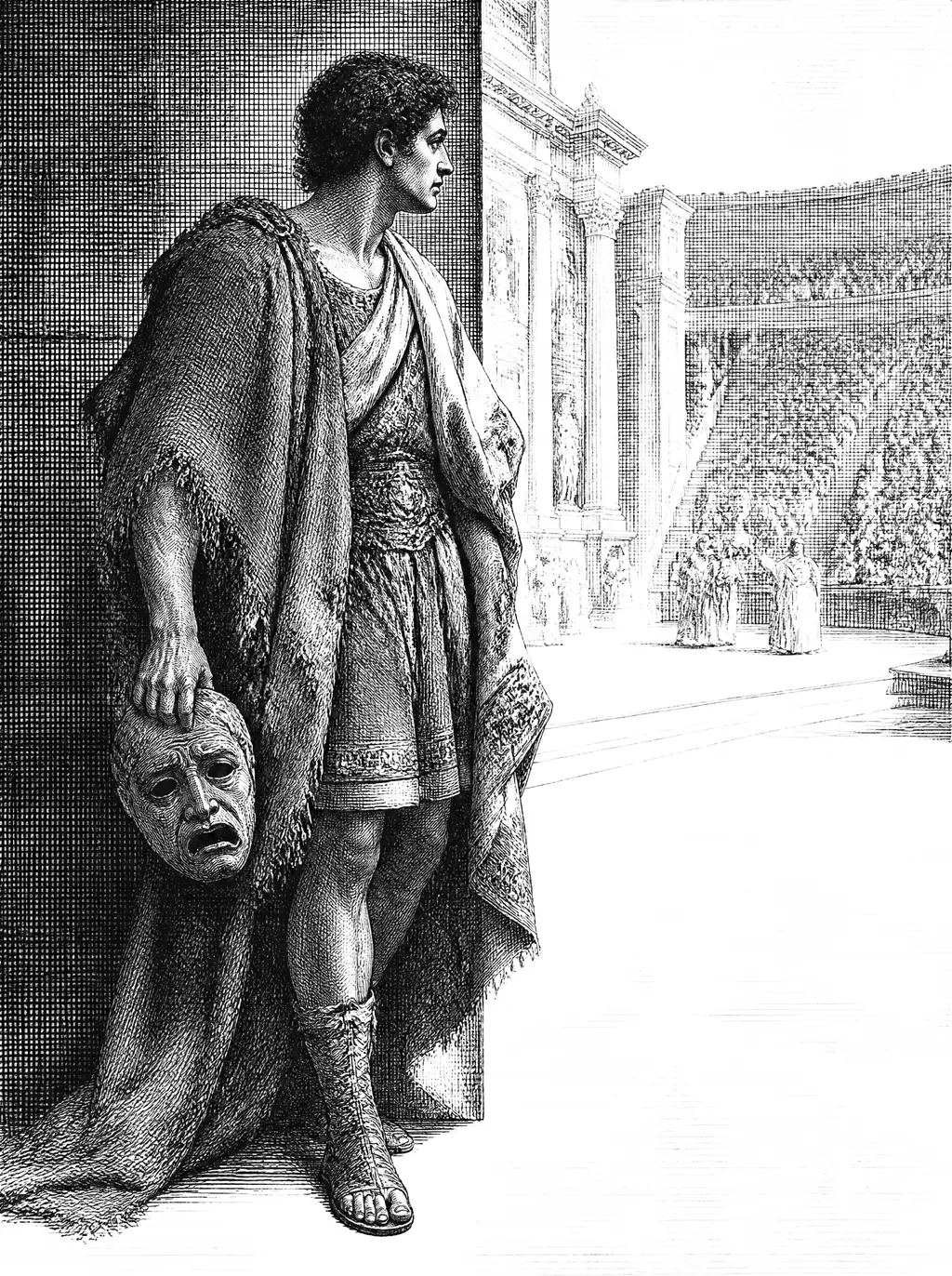
You Are an Actor in a Play
A part, not a plot
You wanted a bigger role, or a shorter run, or a different theater entirely. Epictetus was born a slave and later exiled by imperial decree, a life he did not choose a single scene of, yet he built an entire philosophy around one distinction: the part is not yours to pick, but how you act it absolutely is. The theater was the most public place in Rome, and everyone knew what happened to an actor who refused his lines. Epictetus lifted the image out of the theater and applied it to a whole life. The playwright is not you. The theater is not yours. What is left over is the only thing that ever was.
The world it came from
Epictetus taught at Nicopolis in Greece from around 93 AD, after Domitian expelled the philosophers from Rome, and his students were mostly young men of good family on their way to careers in the imperial service. They would be handed roles they had not chosen: a province, a posting, a marriage, a fall from favor. The stage image was already old. Plato had called human beings puppets of the gods, and the Cynics compared life to a play. Nero, the emperor of Epictetus's youth, had performed on stage in person, to the horror of the senate. Epictetus's students needed a way to hold a role without being owned by it. He gave them the actor.
The idea
Think of your life as a role in a play written by someone else, long or short, comfortable or hard, a beggar's part or a king's. The playwright assigns the part; you do not audition for it and cannot trade it in. Your entire job, the only job that was ever actually yours, is to act the given part as well as it can be acted. Notice what the image does not say. It does not say the play is good, or that your part is fair, or that the audience will applaud. A great actor in a small part is still a great actor. The measure moves entirely from the role to the playing.
How the reasoning runs
Step one: separate two things the word life runs together, your circumstances and your conduct in them. Step two: ask which of the two you chose. Your birth, your body, your era, your parents, most of your opportunities: none were chosen. Your conduct, at every moment, was. Step three: notice that praise and blame make sense only for what a person chose. Nobody blames an actor for the part; everyone judges the performance. Step four: therefore your whole moral task, the only thing you can rightly be judged on, is the performance. Wishing for a different part is not a moral act at all. It is a wish about something that was never up to you, and it eats the attention the part needs.
Seen in life
You are the second child, the one who stayed. Your brother moved abroad and calls on birthdays; you are the one who drives your mother to appointments and sorts her pills into the weekly box. Some evenings the unfairness of the casting is all you can see. Epictetus does not tell you the casting was fair. He asks a different question: given this part, how is it being played? Resentfully, so that your mother feels like a burden? Or with the kind of attention that makes the thirty minutes in the car the best part of her week? The part is fixed. The playing is not, and the playing is what she will remember.
Why it matters
This splits your situation from your performance in it, and only one of those two was ever within your control. You cannot audition for a healthier body, richer parents, or a kinder century to be born into. You can audition, every single day, for how skillfully and honestly you play the exact part those circumstances handed you. It also removes the most common excuse for a poor performance: the part. Nobody needs a better role to act well tonight. The role in hand is the only one on offer, and it is enough to be judged on, which is either a frightening thought or a freeing one, depending on how you have been playing it.
“For this is your duty, to act well the part that is given to you; but to select the part, belongs to another.”
From the source
In chapter XVII of the Enchiridion, right after comparing your life to a role of whatever length the author chooses, Epictetus states the whole division in one line: “For this is your duty, to act well the part that is given to you; but to select the part, belongs to another.” The chapter is only a few lines long, and it begins with the image: remember that you are an actor in a play, and the author chooses the length. If he wants it short, it is short; if long, long. If he wants you to play a beggar, a cripple, a ruler, or a private citizen, play that well. Epictetus offers no consolation about the part. He offers a job.
The pushback
Doesn't this risk excusing real injustice, treating an unfair or brutal role as something to simply perform well rather than resist or change? Epictetus would separate the two: acting your current part well can include working, within your power, to reach a better one. It never means pretending the part was fair, only refusing to waste your one lever, your own conduct, while you work on it. A second worry is quieter. If everything is assigned, who is the playwright, and why trust him? Epictetus assumes a rational, providential author. Take that away and a role handed out by nobody, for no reason, is not a role. It is just what happened.
The reply
The injustice worry has a real answer in Epictetus's own life. He was born enslaved, freed, and exiled, and he never taught that any of those were fair. He taught that fairness was the wrong lever to pull on first. Play the part well, and the part itself sometimes changes; play it badly while protesting, and you have lost both. The playwright worry is answered only partly. Epictetus believed in a providential author, and the belief does real work in the image. Strip it out and you keep less, but not nothing: a role with no author is still the only role you have, and how you play it is still the only thing you decide.
Where it went next
The image outlived the philosophy that made it. Shakespeare gave it to Jaques in As You Like It around 1599, all the world's a stage, and the seven ages speech is Epictetus's chapter with the moral removed. Calderón built a whole play on it in the 1630s, The Great Theatre of the World, with God as the author handing out parts. Erving Goffman made it sociology in the 1950s: we all perform ourselves, front stage and back. The Stoic use survives too. Modern Stoic writers reach for the actor whenever they need to explain how to serve a cause, a company, or a family you did not design, and the answer is still the same: act the part well.
Where this leads
Of providence asks the harder version of this question directly: if a wise ruler of the universe assigns the parts, why do good people so often get the hardest ones, and does that unfairness break the whole picture or just complicate it? The two ideas sit close for a reason. The actor image only comforts if there is a competent author, and Seneca's essay is the tradition's attempt to argue that there is one. The dichotomy of control is the same image without the theater: the same line, drawn between what is handed to you and what you do with it, and the same insistence that only the second was ever yours.