Symposium · Eastern Philosophy · Pl. 11Bhagavad Gita · composed c. 2nd century BC – 2nd century AD
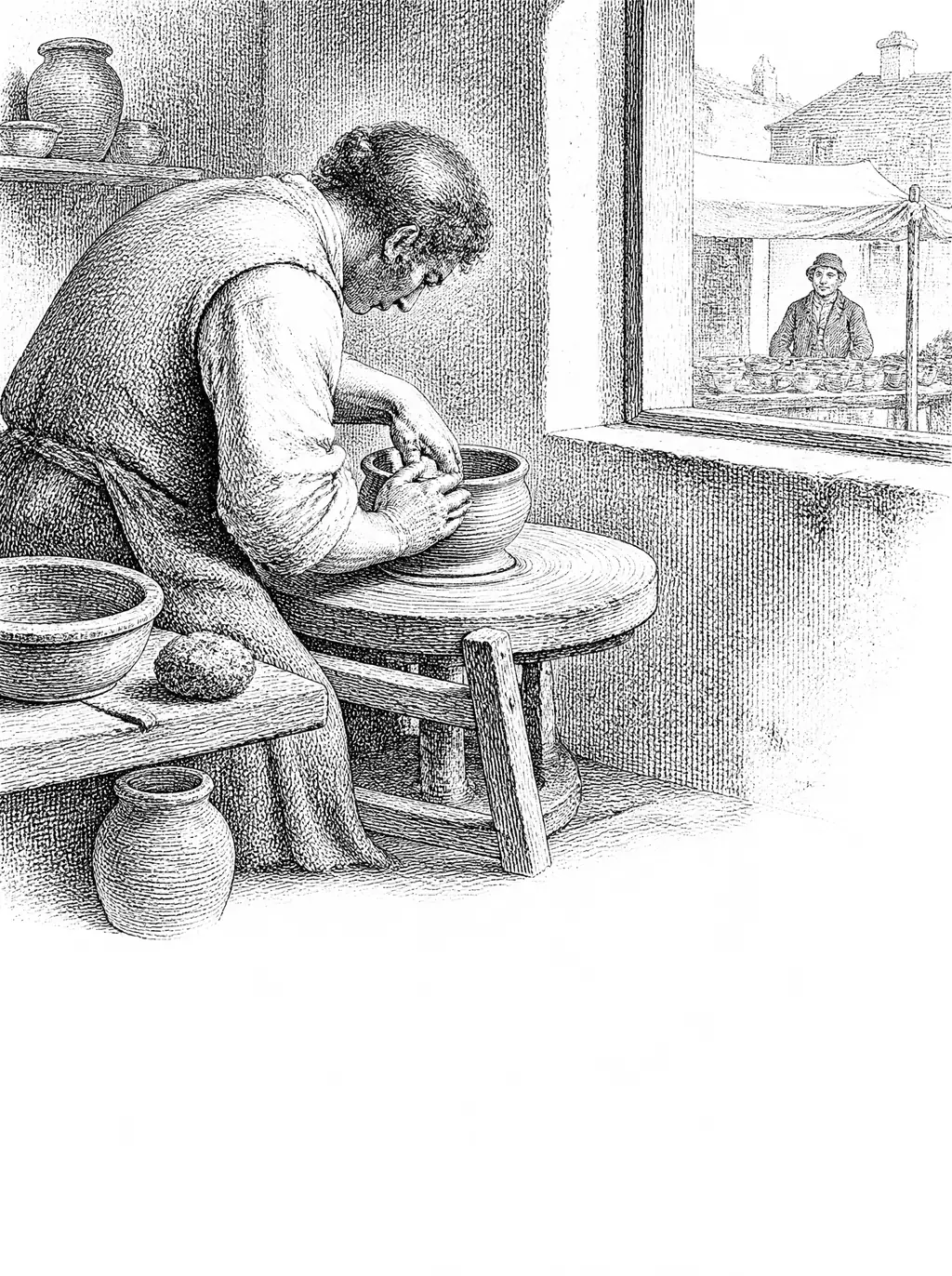
Better One's Own Duty, Poorly Done
A strange kind of comfort
Arjuna wants certainty before he acts, some guarantee the path he takes will actually work. Krishna refuses to offer that guarantee, and instead redirects the whole question. The measure of the act, he says, was never going to be whether it succeeds by someone else's standard, but whether it was genuinely Arjuna's own task to do. The verse is a hard one to like. It refuses the comfort of a guarantee and offers instead a definition of what a wasted life looks like: a good performance of the wrong part, applauded by people who never noticed the part was borrowed.
The world it came from
The Bhagavad Gita, seven hundred verses inside the Mahabharata, was composed in the centuries around the start of the common era, in a society ordered by varna, the four hereditary classes, and by dharma, the duty that came with one's station. The Gita's answer to the renunciant movements of its day is that the way out runs through your own duty, not around it. This verse is 3.35, in the chapter on the discipline of action, and it is repeated almost word for word at 18.47. Svadharma, one's own duty, is the term in play. Arjuna is a kshatriya, a warrior by birth, wavering toward the life of a beggar-monk. Krishna tells him a poor warrior beats a good ascetic, if being a warrior is his.
The idea
It is better to do your own task imperfectly than to perform another's task well. To die while performing your own duty is no misfortune; it is the person who wanders after other roads, chasing tasks that were never really theirs, who ends up truly lost, however impressive their borrowed performance looks from outside. The Sanskrit says it starkly: better one's own duty, though lacking in quality, than another's duty well performed. Death in one's own duty is better. Another's duty brings fear. Every clause pushes the same way.
How the reasoning runs
First, note what Arjuna proposes: to abandon the fight and live as a renunciant, a role that looks holier. Second, ask whose role that is. It belongs to someone else; Arjuna would be borrowing it, and he would be borrowing it out of fear, not calling. Third, see what borrowing does. A person acting outside his own nature acts without the instincts, the training, and the standing that make the act his; he performs rather than does. Fourth, the alternative: acting in your own duty, even badly, keeps you whole, because the act and the actor match. Fifth, the verse's hardest claim: the measure is not the outcome. Dying in your own duty is not a misfortune, because the integrity of the act was the point.
Seen in life
You are a good teacher who took the administrative job because it paid more and looked like progress. You are competent at it. Everyone says so. Three years in, you are hollow in a way you cannot name, and the people who were made for that job, the ones who love a spreadsheet and a policy meeting, are visibly better at it than you will ever be. Meanwhile the classroom you left is being run, imperfectly, by someone who cannot wait to get there in the morning. The verse is not telling you the classroom pays better or that you were failing upstairs. It is saying that the imperfect thing that was yours had a rightness the polished thing that was not yours can never have.
Why it matters
This reframes failure itself. A mediocre attempt at your own genuine calling carries a kind of integrity a polished performance of someone else's role cannot match, however much applause the borrowed performance earns. It shifts the real measure of a life's work away from comparison and toward fit, whether the task was actually yours to carry. The verse also removes an alibi. It is easy to hide from your own task inside someone else's, especially when the borrowed task looks nobler. Krishna says the nobility is not transferable.
“This is better, that one do his own task as he may, even though he fail, than take tasks not his own, though they seem good.”
From the source
Arnold's translation renders the teaching directly: “This is better, that one do his own task as he may, even though he fail, than take tasks not his own, though they seem good. To die performing duty is no ill; but who seeks other roads shall wander still.” This is Gita 3.35 in Arnold's 1885 rendering; he expands the Sanskrit, which is a single compressed verse. The line returns at 18.47, where Krishna adds that work born of one's own nature incurs no fault, and a few verses later that duty comes with the nature one is born to. That last claim is the one later readers have fought over.
The pushback
Doesn't this risk locking people into roles assigned by birth or circumstance, discouraging anyone from ever reaching beyond an inherited station? The verse sits inside a caste-based worldview that later readers, including many in India, have pushed back against directly; the durable insight, separated from its original social frame, is narrower: alignment matters more than imitation. The Gita is explicit: chapter 18 assigns duties to the four classes by their natures. B. R. Ambedkar, who led India's untouchables, argued that the poem was written to defend that order, and that its philosophy of duty cannot be pulled free of it.
The reply
The tradition has three replies, and none is complete. The first, Gandhi's, reads svadharma as the calling a person discovers, not the caste they are born to, and treats the varna verses as description of a fallen society rather than command. The second, from modern teachers, keeps the psychological core, alignment over imitation, and sets the social frame aside as a product of its time. The third simply accepts the text and the order it defends, which is what Ambedkar objected to. The honest reading is that the verse's insight and its social setting arrived together, and that separating them is the work of the reader, not something the poem does for you. A person can reject inherited station and still ask which task is genuinely theirs.
Where it went next
Shankara in the eighth century and Ramanuja in the eleventh both commented on the verse within their larger readings of the poem. Tilak, in Gita Rahasya, made svadharma a call to political action against British rule. Gandhi reread it as the discovery of one's own calling and made the term part of his everyday vocabulary. Ambedkar's critique, in his essay on Krishna and his Gita, remains the sharpest dissent and is still taught alongside the text in India. Outside India the psychological version travelled: the idea that a mediocre pursuit of your own work beats an excellent imitation of someone else's is now a commonplace of vocational advice, usually without the Sanskrit. Existentialists reached a similar place by a different road, and called the borrowed life bad faith.
Where this leads
You are an actor in a play reaches a related conclusion from Stoic Rome: the part itself is not fully up to you to select, but playing your own given part well, rather than coveting someone else's, is the entire actual job. Epictetus says the playwright assigns the part; Krishna says nature and birth do. Neither lets you pick. The difference is that the Gita adds a warning about envy: the other actor's part will look better, and reaching for it is how you get lost.