Symposium · Stoicism · Pl. 13Seneca · c. 4 BC – 65 AD
Why Bad Things Happen to Good Men
A question worth asking
Seneca's student Lucilius puts the oldest complaint in philosophy to him directly: if a benevolent providence really governs the world, why do good men suffer so much, while plenty of scoundrels live out comfortable, undisturbed lives? Seneca does not brush the question aside. He treats it as fair, and answers it as the whole subject of an essay. The essay is short, and it does not blink. It was written by a man who had been exiled, had served a murderer, and would shortly be ordered to die.
The world it came from
Seneca probably wrote Of Providence late in his life, after he had withdrawn from Nero's court in 62 AD and knew that withdrawal might not save him. Lucilius, the friend it answers, was a Roman official governing Sicily, and the question he sent was the oldest in theology: the book of Job had asked it centuries before, and Epicurus had turned it into an argument against caring gods altogether. Stoic doctrine made the problem sharper, not easier. If the whole cosmos is governed by a rational providence, then every misfortune of a good person is part of the plan, and Lucilius wanted to know what kind of plan that could be. Seneca answered as a man who would be ordered to die three years later.
The idea
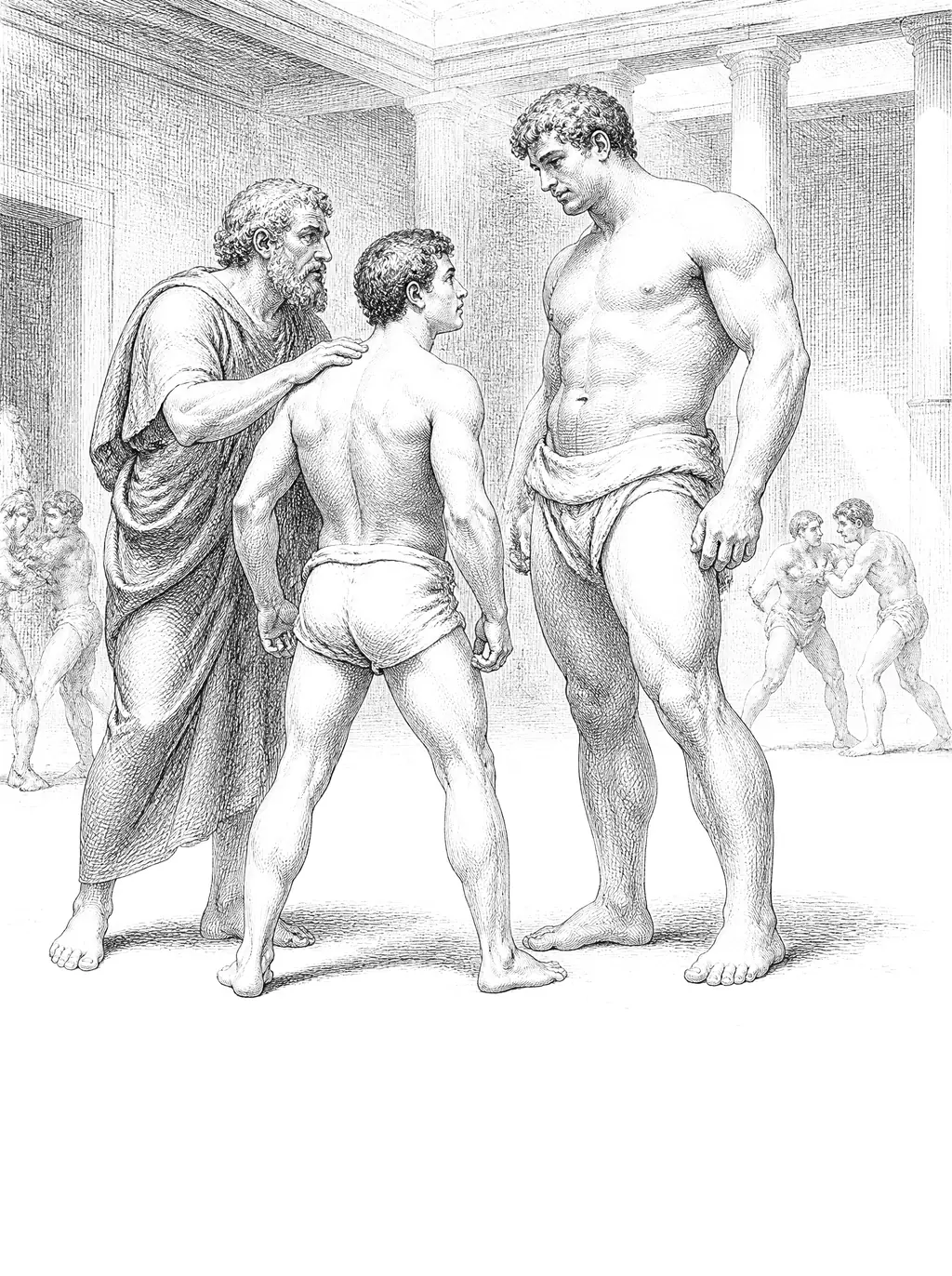
Hardship is not proof that providence has abandoned good people. It is closer to the opposite: a wise trainer sends the strongest opponents against the students who can actually withstand them. Difficulty is assigned the way a good coach assigns a hard opponent, as a mark of the strength providence already sees in you, not as punishment for some failure. Seneca adds a second image: a father, not a mother. Providence is not indulgent. It loves good people the way a strict father does, by setting them work, and the work is the proof of the love, not the withdrawal of it.
How the reasoning runs
Seneca's argument has four steps, and all four depend on one Stoic claim: nothing is truly good except virtue, and nothing truly bad except vice. Step one: therefore loss, pain, and death are not evils; they are indifferent things that a good person can use well or badly. Step two: virtue is a skill, and skills are built and shown only against resistance. A soldier who never fights is not brave. Step three: so a providence that wanted good people to be fully good would have to send them resistance. Step four: hence hardship for the good is not neglect but attention, the training a wise coach assigns to the athlete he rates highest. The scoundrel's easy life is the real punishment: nobody thought him worth testing.
Seen in life
Your friend, the most decent person you know, has had the worst two years of anyone you know: a redundancy, a parent's long illness, and now a diagnosis of her own. You find yourself saying it is not fair, and it is not. Seneca would agree, and then ask what you mean by the worst. If you mean the most painful, yes. If you mean the most damaging, look at her. She is more patient than she was, more direct with people she loves, harder to frighten. The events did not do that; her response to them did. Seneca's claim is not that she was lucky. It is that the two years have shown something about her that an easy decade never could.
Why it matters
Without this idea, adversity reads only as evidence that the universe is careless or hostile, which tends to produce either despair or resentment. With it, the same hardship becomes legible as something closer to selection: proof that you were judged capable of carrying it, whether or not that judgment feels like comfort while you are living through it. The idea also tells you what to do with the next hardship. Not ask why me, which has no answer, but ask what this is asking of me, which usually does, and which turns a complaint into a task you can begin today.
“You have asked me, Lucilius, why, if the world be ruled by providence, so many evils befall good men?”
From the source
Seneca opens the essay by naming the exact question sent to him and that he intends to answer in full: “You have asked me, Lucilius, why, if the world be ruled by providence, so many evils befall good men?” — Of Providence. His first move is to deny that the good suffer evils at all: the things Lucilius calls evils, exile, poverty, bereavement, are hardships, and hardships are what virtue is for. Then he gives the images: the trainer who picks the strongest opponent for his best athlete, the general who sends the bravest men on the hardest mission, the father whose strictness is his love. Cato's death at Utica is his closing example, a spectacle he says the gods themselves would stop to watch.
The pushback
This can sound uncomfortably close to telling suffering people their pain is secretly a compliment, which can feel dismissive from the outside looking in. Seneca's case only works for someone who already accepts the Stoic premise that hardship builds virtue and virtue is the only real good; take that premise away, and the comfort collapses along with it. A modern reader adds the obvious question Seneca never faces. Some hardships do not train anyone. A child who dies of the plague learns nothing from it, and neither, in any useful sense, does the parent. Coaching is a poor image for a world that also contains that.
The reply
Seneca's reply to the dismissiveness charge is to aim the essay at the sufferer, not the bystander: it is written for Lucilius to read about his own life, and it says the good person will choose hardship as an athlete chooses the harder opponent. Told to someone else, it is unkind; adopted for yourself, it can let you stand up. The child's death has no full answer in the essay, and the tradition is honest enough to admit it. The Stoics held that some events serve the whole in ways no part can see, and that a rational person trusts the whole. That is a faith, not an argument. Seneca would say so, and then say the rival faith, in a careless universe, is no better founded.
Where it went next
Seneca's coach became the Christian father. The Letter to the Hebrews says that the Lord disciplines those he loves, and the church fathers who read Seneca, some of whom believed he had corresponded with Paul, folded his essay into a whole theology of suffering as instruction. Boethius wrote The Consolation of Philosophy in a death cell around 524 AD on the same question and reached a similar answer. Leibniz coined the word theodicy in 1710 for the project Seneca had started without a name. Voltaire mocked it in Candide in 1759, after the Lisbon earthquake, and most modern philosophy of religion is still arguing about the child Seneca did not mention.
Where this leads
The wise man cannot be harmed shows what the training described in this essay is meant to produce: a person for whom the difficulties assigned by providence no longer have the power to damage what actually matters about them, whatever else they cost. The obstacle is the way is the same idea run from the inside. Seneca explains why the hardship was sent, and Marcus tells you what to do with it once it arrives, which is the more useful half if you have stopped believing anyone sent it. Together they are the Stoic answer to bad luck: it was assigned, and it is material.