Symposium · Existentialism · Pl. 1Søren Kierkegaard · 1813–1855
Get Rid of the Crowd
Willing hands, wrong hands
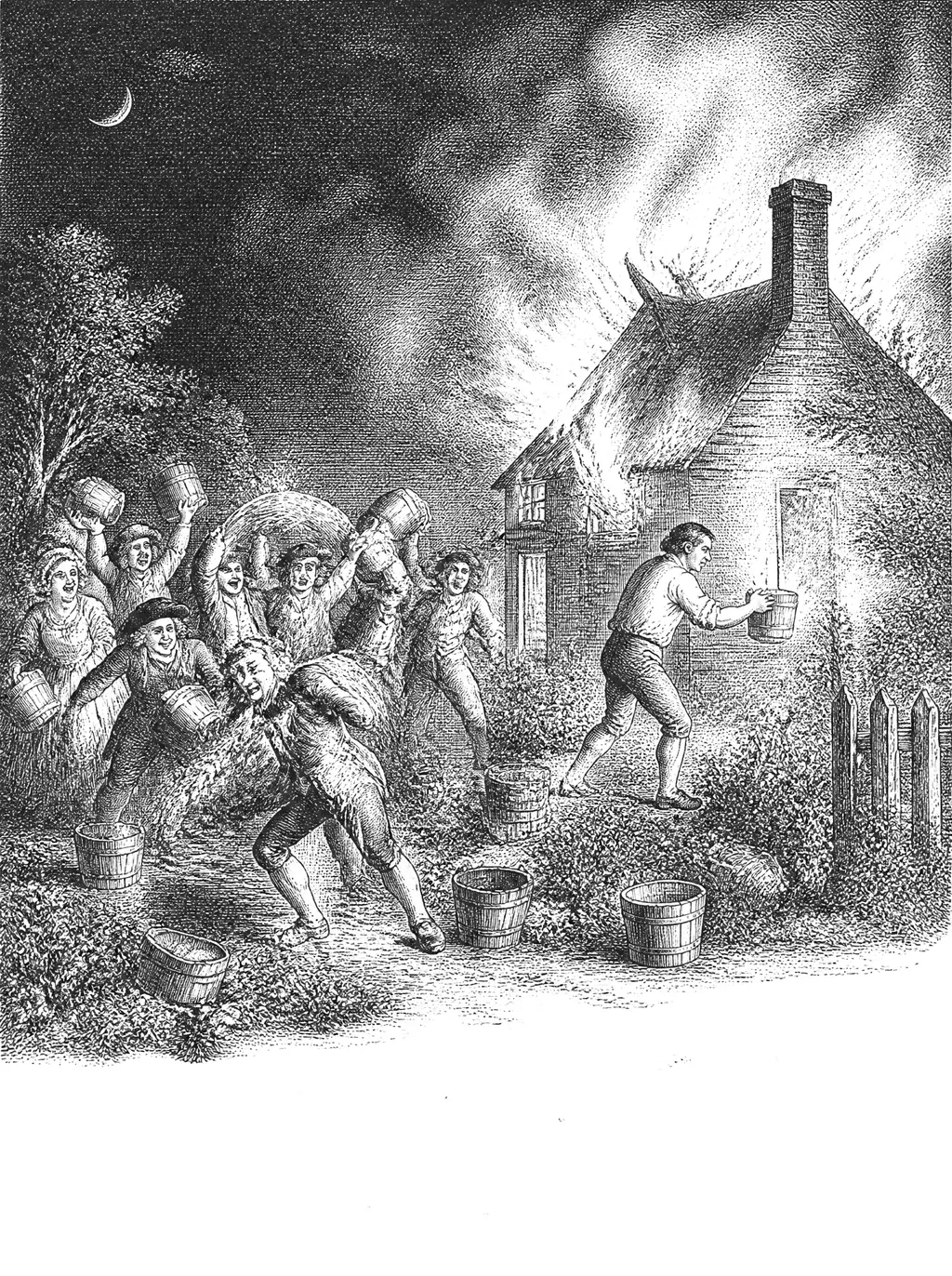
Kierkegaard imagines a serious task, one person genuinely called to carry it out, suddenly surrounded by a crowd of well-meaning volunteers eager to pitch in. He compares them to bystanders who grab buckets at a fire with real enthusiasm and no real competence, more likely to spread the danger than contain it, however good their intentions look from a distance. He wrote it in 1855, in the last months of his life, in a pamphlet series he paid for himself. The crowd he had in mind was the entire Danish church.
The world it came from
The Moment, or The Instant, was a series of pamphlets Kierkegaard published between May and September 1855, the final act of a campaign against the Danish state church that had begun the year before. Bishop Mynster, the family's pastor and the face of official Christianity, had died in 1854, and his successor Martensen had eulogized him as a witness to the truth. Kierkegaard, who thought Mynster a comfortable functionary, exploded. He had already been the target of the crowd himself: in 1846 the satirical paper The Corsair had mocked his trousers and his gait for months, and Copenhagen had laughed. He collapsed in the street in October 1855 and died in November, at forty-two. The pamphlets were the last things he wrote.
The idea
For any truly serious undertaking, the crowd is not a resource, it is a hazard. Joining forces with people who mean well but lack the seriousness the task demands does not multiply your strength; it dilutes your responsibility until no one in particular is actually accountable for anything. Real seriousness, Kierkegaard insists, only ever happens in a single person at a time. His slogan, from 1847, was that the crowd is untruth. Not that it is always wrong, but that the way it holds a belief, by numbers rather than by anyone's answering for it, is the wrong way to hold anything that matters.
How the reasoning runs
Start with what a serious task is: one that someone must answer for, with their whole life, whatever the outcome. Second, notice what happens when a crowd adopts it. Responsibility is divided among the members until each holds a fraction too small to feel; no one is the one who did it. Third, the crowd substitutes feeling for action. It sympathizes loudly, and the sympathy feels like participation, so the work stops. Fourth, the crowd's approval becomes the measure of the cause, and a cause measured by approval has lost the thing that made it serious, which was its indifference to approval. Therefore the person genuinely called to the task must first get free of the crowd, not to be alone, but to be someone in particular.
Seen in life
You post about something that matters to you, and by evening a thousand people have agreed. It feels like something has happened. Kierkegaard's question is whether anyone, including you, is now more responsible for the thing than they were that morning. Count the people who will still be at it in a year. Count the people who will be at it when it stops being popular. His fire brigade is the picture: a crowd of volunteers with buckets, all sincere, all in the way, and the one person who actually knows where the water is cannot get through them. The crowd's sympathy is real. It is also, he says, the most efficient way ever devised for a cause to be applauded to death.
Why it matters
It is tempting to treat consensus and popularity as proof that you are on the right track, since so many people cannot all be wrong at once. Kierkegaard's whole life's work argues the reverse: numbers and truth have nothing necessarily to do with each other, and outsourcing your convictions to whatever the crowd currently believes is how convictions quietly disappear. It also protects the one thing Kierkegaard thought a person could not delegate: standing before God, or before the truth, as a single individual, with nobody in the row beside you to share the answer or take the blame.
“The thing of supreme importance is to be rid of the crowd; for the effect of the crowd is to hamstring the whole cause by robbing it of its seriousness while heartfelt sympathy is pretended.”
From the source
In The Present Moment, Kierkegaard writes of the person actually called to a serious task: “The thing of supreme importance is to be rid of the crowd; for the effect of the crowd is to hamstring the whole cause by robbing it of its seriousness while heartfelt sympathy is pretended.” The passage continues with the fire. When a fire breaks out, he says, the sensible thing is not to call in as many people as possible but to get rid of the crowd, whose willingness to help only obstructs the one person with the competence to act. The English is Lee Hollander's 1923 rendering. The Danish title, Øieblikket, means the instant, and the pamphlets were sold cheaply, at Kierkegaard's own expense.
The pushback
Isn't dismissing the crowd just an elitist excuse to ignore other people's input and go it entirely alone? Kierkegaard is not arguing against community or cooperation as such. His target is narrower: the moment a crowd's shared feeling substitutes for the individual responsibility a serious task actually requires, whatever the crowd is doing stops being the real work at all. There is also a political problem. If the crowd is untruth, what becomes of democracy, which counts heads on purpose? Kierkegaard wrote during Denmark's transition to constitutional rule, and he did not hide his contempt for it.
The reply
Kierkegaard would answer the charge of elitism by pointing out who he thought the crowd was: not the poor, whom he addressed as individuals and often preferred to the professors, but anyone, of any rank, who lets a number do their believing for them. A bishop can be a crowd of one. The political objection has only a partial reply. He distinguished, in principle, between counting heads to settle who governs, which is a practical matter, and counting heads to settle what is true, which is untruth. But he wrote the distinction sourly and never developed it, and a reader who wants a theory of how single individuals can also be citizens will not find one in him. He was not interested in the problem.
Where it went next
Nietzsche never read Kierkegaard, though Georg Brandes urged him to in 1888, and his contempt for the herd arrived independently. Heidegger's das Man, the anonymous they that lives everyone's life for them, is Kierkegaard's crowd translated into ontology. Ortega y Gasset's Revolt of the Masses in 1930 and David Riesman's Lonely Crowd in 1950 turned the diagnosis into sociology. In theology, Karl Barth and Dietrich Bonhoeffer inherited the attack on comfortable Christendom, and Bonhoeffer's cheap grace is Kierkegaard's complaint restated. The phrase the crowd is untruth is now quoted by people at every point on the political spectrum, each convinced the other side is the crowd, which is roughly what Kierkegaard would have predicted.
Where this leads
Bad faith names a related evasion from the other direction: hiding inside a role or a group's expectations is one more way of letting the crowd, rather than your own choice, quietly decide who you are, day after day, without you ever noticing the handoff. The leap of faith is the positive form of the same conviction. Abraham has no crowd; nobody can join him on the mountain, and nobody's sympathy would help. Getting rid of the crowd is the preparation for the only kind of decision Kierkegaard thought worth making.