Symposium · Philosophy of Religion · Pl. 12Karl Marx · 1818–1883
The Opium of the People
Comfort with a cost
Building on Feuerbach's claim that God is a human projection, Marx pushes the question further: why does humanity need this particular projection so badly? His answer locates religion's appeal not in simple error, but in the genuine suffering of people living under conditions that badly need softening. The essay was written in Paris in late 1843 and printed in early 1844 in a journal that lasted one issue. Marx was twenty-five. The phrase he coined has been quoted, misquoted, and painted on walls ever since.
The world it came from
Marx wrote the essay in Paris in the winter of 1843 to 1844, aged twenty-five, newly married and newly exiled after the Prussian censors shut the newspaper he edited. It appeared as the introduction to a planned critique of Hegel's Philosophy of Right, in the Deutsch-Französische Jahrbücher, a journal that ran for a single double issue. The argument he was joining was German. Feuerbach had published The Essence of Christianity in 1841; the Young Hegelians spent the following years debating religion because politics was too dangerous to debate directly. Marx's move was to say that the criticism of religion was finished, and that the real work was the criticism of the conditions that produce it.
The idea
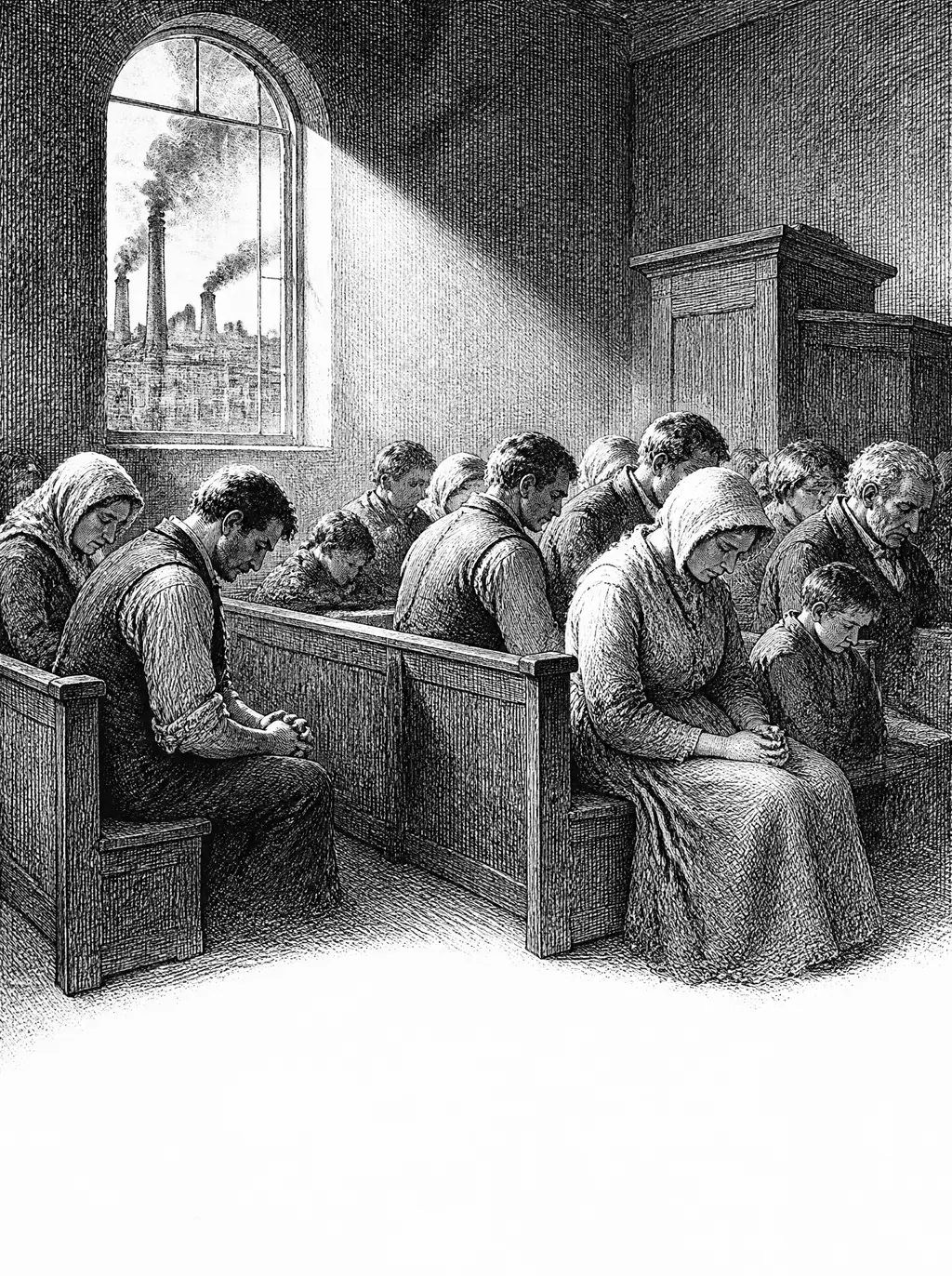
Religion, Marx argues, genuinely eases real suffering, the way a painkiller does, expressing real distress and protesting against it at the same time, while leaving the underlying social and economic causes of that suffering completely untouched and unaddressed. It is, in his famous phrase, “the opium of the people.” Read the sentences around the phrase and the picture is more tender than the slogan suggests. Religion, Marx says, is the sigh of a creature in distress, the heart of a world that has no heart, the spirit of conditions that have none. Opium relieves pain. It also keeps you in bed.
How the reasoning runs
Take the steps in order. First, Feuerbach is granted: God is a human projection, so religion is something people make. Second, ask why they make it. Marx answers that people do not project a perfect world out of idle error but because their actual world is painful, and religion is where the pain is expressed and consoled. Third, therefore religion is a symptom, and criticising the symptom on its own is pointless; you do not cure a fever by arguing with the thermometer. Fourth, the demand to abandon illusions about your condition is really a demand to abandon a condition that requires illusions. So the critique of religion turns into the critique of law, politics, and economics. Heaven was never the target.
Seen in life
A friend who works double shifts at a warehouse tells you that church on Sunday is the only hour in the week when she feels like a person. You could hear that as Marx's opium: comfort that makes an unlivable schedule livable, and so keeps it in place. You could also hear it as her protest, the one place she insists on a dignity the job denies. Marx's sentence contains both readings, which is why it is worth reading in full. Notice what he does not do. He does not sneer at her, and he does not tell her to stop going. He asks what kind of week makes that hour so necessary, and whether the week could be changed.
Why it matters
This shifted the critique of religion away from purely intellectual objections about God's existence and toward a social diagnosis of what conditions make religious consolation so needed in the first place. It framed religion as both a genuine comfort and a quiet obstacle to changing the conditions that made that comfort necessary at all. It also handed later critics a test. If religion is a response to suffering, then a society that reduces suffering should see it fade, and one that does not should see it persist. Whether the twentieth century confirmed that prediction is still argued over.
“It is the opium of the people.”
From the source
Marx delivers the verdict in his introduction to a critique of Hegel's philosophy of right, closing a longer reflection on religious suffering with a single compressed verdict: “It is the opium of the people.” The line has outlived nearly everything else he wrote on the subject. The sentences before the phrase are the ones that matter. Religious suffering, he writes, is at once an expression of real suffering and a protest against it. He compares religion to a sigh, to a heart, and to a spirit, in each case the tender thing a hard world lacks. To abolish religion as illusory happiness is, for him, to demand real happiness instead. The phrase everyone remembers is the hinge, not the whole door.
The pushback
Doesn't reducing religion to a social painkiller ignore believers who report their faith as a source of active resistance and moral courage against injustice, rather than passive acceptance of a heartless world exactly as it stands? Marx's own phrase actually calls religion a protest as well as a sigh, a tension his later followers have not always preserved. A second objection: the theory explains too much. If wealth and comfort should have thinned religion out, the persistence of belief among the affluent, and its revival in prosperous societies, is a problem the diagnosis did not predict.
The reply
Marx's own text gives the first reply: the protest is in the sentence, and liberation theology in Latin America, the Black church in the American civil rights movement, and Solidarity in Poland all drew on faith as a weapon rather than a sedative. A Marxist can say those are the protest side of the sigh showing its strength. The second objection bites harder. Marx expected religion to wither as its social roots were cut, and it has not withered on schedule. Followers answer that alienation takes forms other than poverty, so the need for consolation persists under affluence. That keeps the theory alive at the cost of making it harder to test. The diagnosis captures something real about religion and does not capture all of it.
Where it went next
The phrase became a slogan under Lenin, who quoted it as the cornerstone of Marxist thinking on religion, and Soviet states turned the diagnosis into a policy of suppression that Marx's essay never proposed. Sociologists took the softer version: Durkheim and Weber both asked what social work religion does, and the secularisation thesis of the mid-twentieth century is Marx's prediction in academic dress. Liberation theologians in the 1970s read the same passage and kept the protest while dropping the sedative. Today the line is a stock argument in any debate about whether belief answers a need or a truth, and Freud's The Future of an Illusion (1927) is its closest psychological cousin.
Where this leads
Consciousness of God is self-consciousness shows Feuerbach laying the philosophical groundwork Marx builds directly on top of, arguing first that religious belief projects humanity's own best qualities outward onto an imagined divine being, before Marx asks what specific social conditions make that particular act of projection feel so necessary. Against the crowd sits on the opposite shore. Kierkegaard also thought comfortable religion was a sedative, and his cure was not a changed society but a lonelier, more demanding faith. Both agree that the easy consolation is the enemy.