Symposium · Existentialism · Pl. 2Jean-Paul Sartre · 1905–1980
Bad Faith
The too-perfect waiter
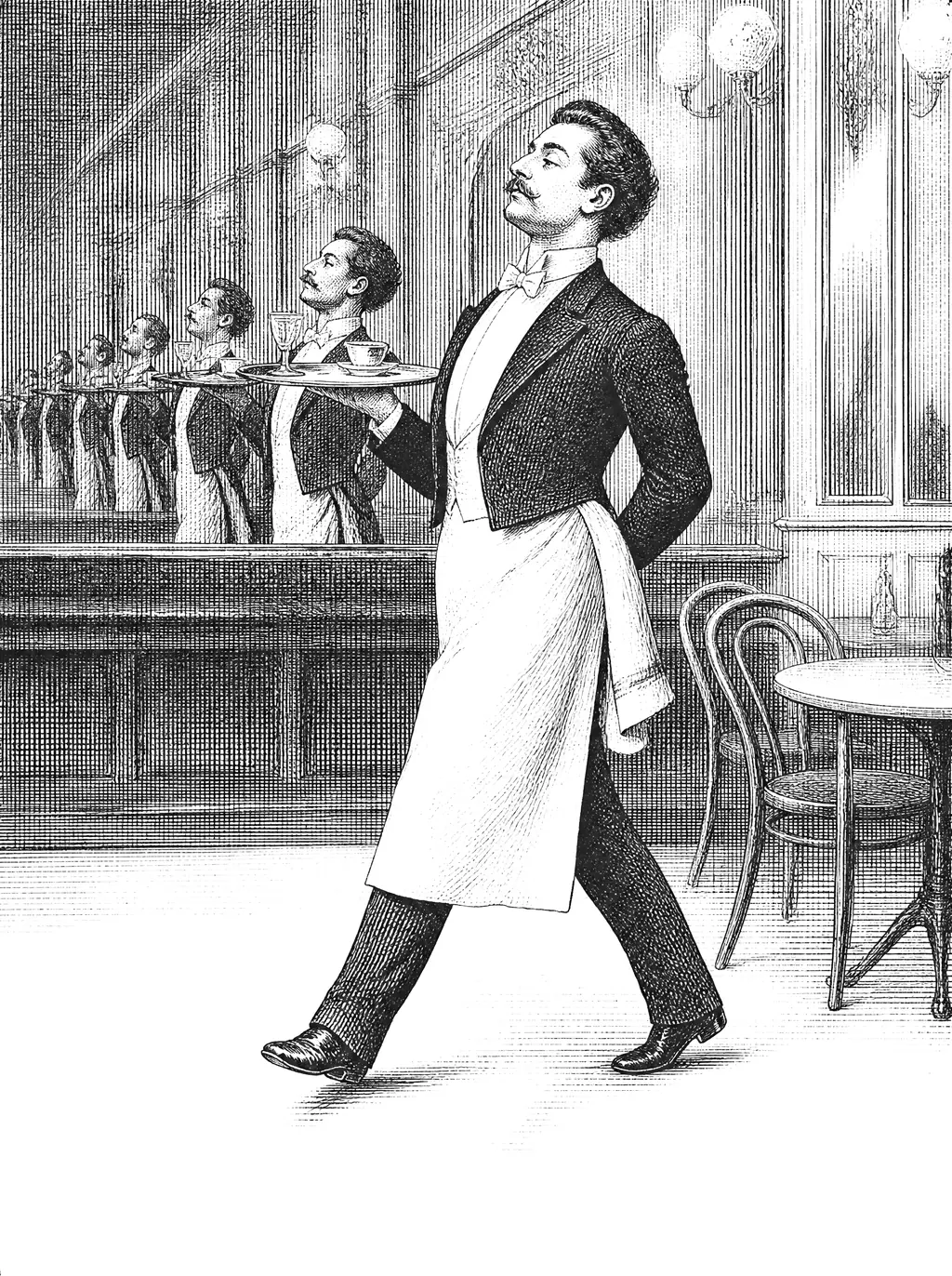
Picture a waiter whose movements are a little too crisp, a little too exactly what a waiter should be. Sartre watched a man like this in a Paris café and saw something closer to performance than to work, a person hiding inside the role he was playing. The scene appears in Being and Nothingness, published in occupied Paris in 1943, and it has outlived the six hundred pages of ontology around it. Everyone who reads it recognizes the waiter, and most readers, on a bad day, recognize themselves. That recognition is the argument; the rest of the chapter explains what you just saw.
The world it came from
Sartre wrote Being and Nothingness between 1941 and 1943, after nine months as a prisoner of war and during the German occupation of Paris, much of it at a table in the Café de Flore because the café was heated. The book's target was the Freudian picture of the mind as divided into a conscious part and an unconscious censor. Sartre rejected the censor: if part of the mind must know what to hide, the lie is already conscious. Bad faith was his replacement for repression, a lie told by a single consciousness to itself. The waiter, and a woman on a first date who leaves her hand in a man's grasp while talking of higher things, are his two famous cases.
The idea
Bad faith is lying to yourself about your own freedom. It wears two favorite disguises: pretending you are only your role or your past, a mere waiter, a mere coward, or pretending you are pure open possibility with no settled facts about you at all. Sartre's terms for the two sides are facticity and transcendence: what you are, as a matter of record, and what you are not yet, as a matter of possibility. A human being is both at once, and neither one can be dropped without a lie. Bad faith is the refusal to be both, in either direction.
How the reasoning runs
Start with the ordinary lie. A liar knows the truth and hides it from someone else; no puzzle there. Now try to lie to yourself. The same consciousness must know the truth to hide it, and must not know it to be deceived. Freud splits the mind; Sartre says the split only moves the problem, because the censor must know both. His alternative: bad faith does not hide a truth but exploits an ambiguity. You are your facts, and you are also the freedom that outruns them. Bad faith collapses one into the other, treating a fact as a destiny or a freedom as a fog, so that the uncomfortable one can be denied. No censor is needed, only a refusal to look at both at once.
Seen in life
You have been meaning to leave the job for three years. Ask why you have not, and listen to the answer. It is the mortgage, the market, your age, the fact that you are not the kind of person who takes risks. Every item is true, and Sartre would grant it. Then he would point out the shape of the list: it is entirely made of facts about you, and it contains no verb of which you are the subject. That is the waiter's move. He has dissolved himself into the role of waiter; you have dissolved yourself into a set of circumstances. The freedom is still there. The list is the proof, because a stone does not need to explain why it stays.
Why it matters
Both disguises trade a hard truth for a comfortable lie. You are free, and you are also this particular person with this specific history, and holding both at once is uncomfortable. Bad faith resolves the discomfort by quietly dropping one side to feel solid ground again. The cost of the lie is not moral only. A person who denies their freedom stops noticing their choices, and a person who denies their facts keeps making the same ones. Either way, the life goes on being lived by something other than the one living it, and the one living it has agreed not to look.
“a certain art of forming contradictory concepts”
From the source
In Being and Nothingness, Sartre describes bad faith as “a certain art of forming contradictory concepts” — a way of holding a fact about yourself and its denial together in the same breath, so that neither one can be pinned down long enough to be challenged directly. The waiter is the example everyone remembers. His movement is a little too precise, a little too rapid; he bends a little too eagerly; he is playing at being a waiter in a café, Sartre says, the way a child plays at being a soldier. What he is trying to be is a waiter the way an inkwell is an inkwell, and no human being can be that. Hazel Barnes's 1956 translation supplied the English.
The pushback
A fair complaint: doesn't calling something bad faith just mean 'a way of living I happen to disapprove of'? Sartre's answer is narrower than that. He means one specific move: denying a freedom that, underneath the denial, you still know perfectly well that you have. There is a deeper puzzle, and Sartre raised it himself. How can anyone lie to themselves at all? To hide something you must know it, and to be fooled you must not. Either bad faith is impossible, or it is not really a lie, and in that case the word deceives.
The reply
Sartre's answer to the first objection is the definition itself: bad faith is not a lifestyle he dislikes but a specific structure, the denial of a freedom the denier still relies on to do the denying. To the paradox he offers the distinction between reflective and pre-reflective consciousness: you can be aware of something without having made it an object of thought, and bad faith lives in that gap. Critics have found the answer too quick. If the pre-reflective awareness is real, the paradox seems to return one level down. Herbert Fingarette and others rebuilt the theory in the 1960s around what a person refuses to spell out, which is close to Sartre's view and more careful. The gap in the reply is a real one.
Where it went next
Beauvoir turned bad faith on the situation of women in The Second Sex and, in The Ethics of Ambiguity in 1947, made it the center of an existentialist ethics Sartre never wrote. Frantz Fanon used it for the colonized man who believes the image the colonizer holds of him. In analytic philosophy, Herbert Fingarette's Self-Deception in 1969 took the paradox seriously and answered it with the idea of refusing to spell something out. Erving Goffman's sociology of everyday performance, from 1956, describes the same waiter without the verdict. The word authenticity, which Sartre used sparingly, became the pop-culture inheritor of the idea, usually stripped of the facts and left with only the freedom, which is bad faith of the second kind.
Where this comes from
This is the shadow side of existence preceding essence. If you genuinely build yourself through choice, with no fixed nature underneath to fall back on, bad faith is the daily temptation to pretend that you didn't, and never really could. Hell is other people is the same evasion staged. The characters in No Exit each need the others to confirm a picture of themselves they know to be false, and the room is built so that nobody can ever leave the picture. Bad faith with an audience is what the play calls hell.