Symposium · Aesthetics · Pl. 1Aristotle · 384–322 BC
The Point of Pity and Fear
A different question about the same tears
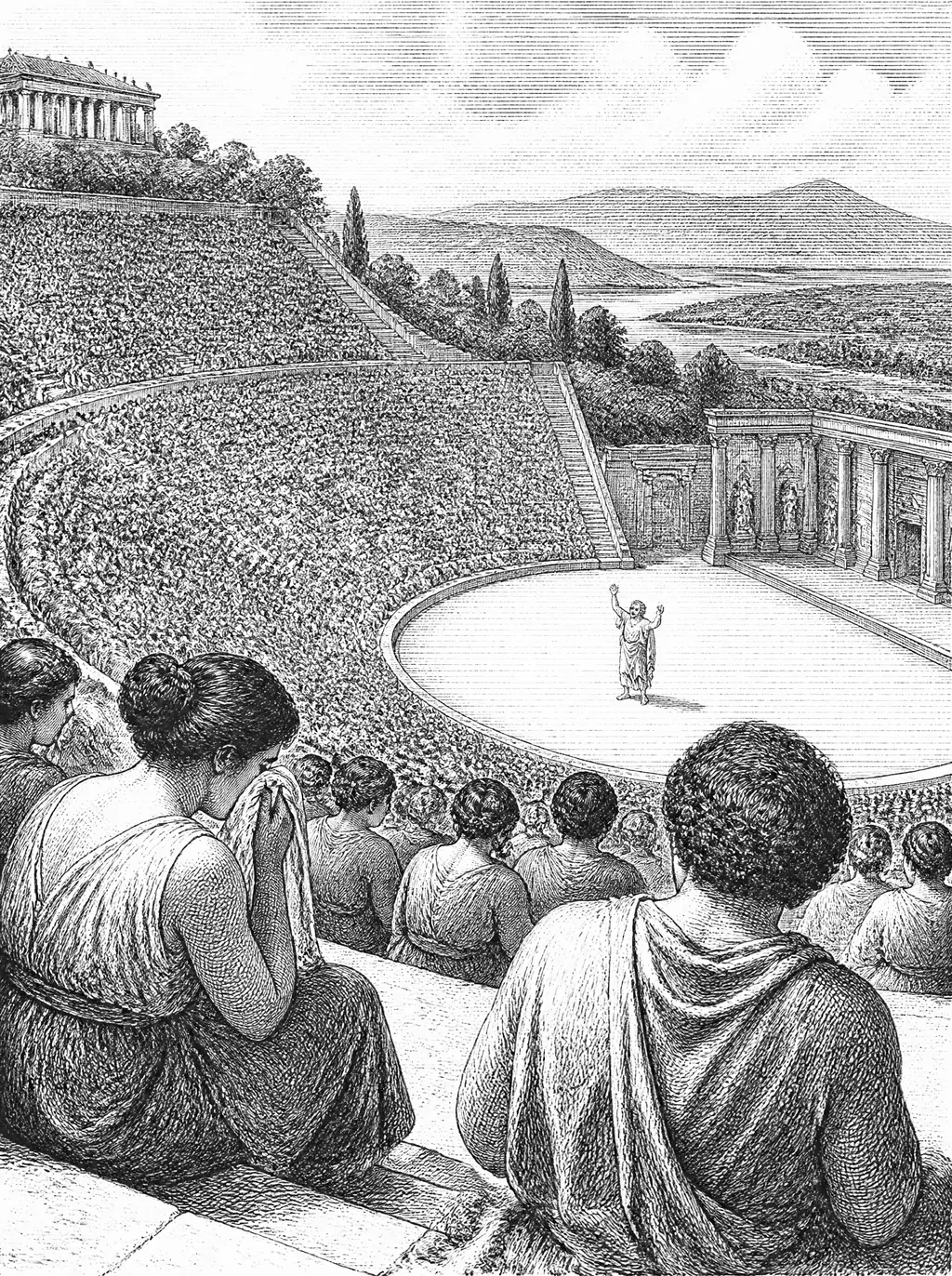
Plato had worried that tragedy overfed the emotions and weakened the soul's rational rule over itself. Aristotle, his student, took the same raw material, an audience moved to pity and fear by staged suffering, and asked instead what useful work those emotions might be doing, rather than simply condemning the whole spectacle as dangerous excess. The setting was the theatre of Dionysus in Athens, where tens of thousands sat through three tragedies in a day, wept openly, and went home. Plato's worry was that they went home weaker. Aristotle looked at the same crowd and thought they went home cleared, and he wanted to say exactly what had happened to them.
The world it came from
Aristotle wrote the Poetics in Athens around 335 BC, probably as lecture notes for his school at the Lyceum, a generation after the great tragedians were dead. Sophocles and Euripides had died in 406, and by Aristotle's time the plays were classics, revived at festivals and taught to the young. Plato's Republic, written some forty years earlier, had banished the tragic poets from the ideal city for feeding the appetite for grief. Aristotle had spent twenty years in Plato's Academy and knew the argument from inside. His own biology gave him a different instinct: the body regulates itself through discharge and balance, and medicine speaks of purgation, katharsis, as a cure. The Poetics applies that vocabulary to an audience in the theatre.
The idea
Tragedy is an imitation of an action that is serious, complete, and of a certain magnitude, through pity and fear effecting the proper purgation of these emotions. Katharsis names this process: watching Oedipus or Antigone lets an audience discharge and clarify emotions that, left to build up unexamined in ordinary life, might otherwise curdle into something far worse. Pity and fear are not chosen at random. We pity someone who suffers undeservedly, and we fear for someone like ourselves. A tragedy works when the hero is neither a villain nor a saint but a person of standing brought down by a mistake, so that the audience can feel both at once. The plot is engineered to produce that pair, and katharsis is what the pair does when it lands.
How the reasoning runs
The reasoning can be rebuilt from the Poetics. First, tragedy is an imitation, and people take pleasure in imitations even of painful things, because recognising and understanding is itself pleasant. Second, the specific pleasure of tragedy comes through pity and fear, so a play should be built to raise them: a plot with reversal and recognition, a hero who falls through error rather than vice. Third, if the play does its work, the audience leaves not overloaded with emotion but relieved and steadied, as the body is after a fever breaks. Fourth, that outcome is good for the person and for the city, so the emotions Plato feared are not to be starved but exercised. So tragedy is defensible, and its aim, katharsis, is a benefit, not a danger.
Seen in life
You put on a film you know will wreck you. Two hours later you are on the sofa with a wet face, and you feel oddly light. The dread you had been carrying about a parent's health has not gone, but it is no longer a fog; it has a shape, and you have been through it once. Aristotle would say the film did its job. It gave you a stranger to pity, a fate close enough to fear, and a form that carried both to an end. You did not learn anything. You were purged, or clarified, or both, and the proof is that you can face Monday. People who reach for a sad film on a bad night are running his theory on themselves.
Why it matters
This reframes tragic drama as a kind of emotional exercise rather than a moral hazard, giving art a genuine psychological function that ordinary life alone cannot supply on its own. It let later thinkers defend fiction, horror, and other unsettling art on the grounds that feeling difficult emotions safely can itself be a form of health. It also set the terms for every later argument about harmful art. Whenever someone claims that violent games breed violence or sad songs breed sadness, and someone else replies that they release it, the two sides are Plato and Aristotle. The Poetics did not settle the question, but it made the second answer available, and it has been the default defence of difficult art ever since.
“Tragedy, then, is an imitation of an action that is serious, complete, and of a certain magnitude...through pity and fear effecting the proper purgation of these emotions.”
From the source
Aristotle states the definition directly: “Tragedy, then, is an imitation of an action that is serious, complete, and of a certain magnitude...through pity and fear effecting the proper purgation of these emotions.” Everything else in the Poetics, plot, character, spectacle, is organized around producing that one specific, carefully targeted effect. The definition opens chapter six of the Poetics, in S. H. Butcher's translation. Katharsis appears in the definition and is never explained anywhere in the surviving text. A passage in the Politics promises a fuller account in the treatise on poetry, which suggests the explanation was in the lost second book, or in a section that did not survive.
The pushback
What exactly does purgation mean here, medical purging, moral clarification, or simple emotional release, and does tragedy really leave audiences healthier rather than merely entertained for an evening? Scholars have argued over the precise sense of katharsis for over two thousand years without reaching final agreement, and this single ambiguous word carries the whole theory's weight. The empirical version is harder. Psychologists who have tested the release model, mostly with anger and aggression rather than pity, have generally found that venting an emotion tends to rehearse it rather than discharge it. If that holds for grief and fear too, then tragedy does not empty the tank; it fills it, and Plato was closer to the truth than his student.
The reply
The tradition has two answers and cannot choose. The medical reading, revived by Jacob Bernays in 1857, says katharsis is a discharge like a purge, and takes the empirical objection on the chin. The clarification reading, argued by Martha Nussbaum, says the audience's pity and fear are not vented but educated: you leave knowing better what deserves them, and the psychology of venting does not touch that claim. The second reading fits the Aristotle who thought the virtues are trained by feeling the right things toward the right objects. It fits the word katharsis less well. The honest position is that Aristotle's one word licenses both readings, the release theory is in trouble as psychology, and the clarification theory is the one that still stands.
Where it went next
The Poetics vanished from Western Europe for a thousand years and returned through Arabic and then Italian humanists in the sixteenth century, when it became the law of drama. French classicism turned its remarks on unity into rules; Corneille and Racine argued with it in their prefaces. Lessing rescued the emotional reading in the Hamburg Dramaturgy. Bernays's 1857 essay made katharsis medical again and reached Freud through his wife's family, so that the cathartic method of early psychoanalysis is Aristotle by way of Vienna. Brecht built epic theatre as a deliberate refusal of katharsis, wanting audiences alert rather than purged. Nussbaum's The Fragility of Goodness (1986) restored the ethical reading. The word has left philosophy and entered everyday speech, where it means, roughly, a good cry.
Where this leads
The test of art is infection shows Tolstoy building an entirely different theory of what art is for, judging it not by whether it purges emotion cleanly but by whether it genuinely transmits feeling from one person to another, a standard that would rank plenty of Aristotle's own tragedies as failures. Art is a shadow of a shadow is the argument Aristotle was answering. Plato had ranked the tragic poet three removes from truth and expelled him; Aristotle kept the poet and gave the audience's tears a function. Read the two together and you have the oldest quarrel in aesthetics, whether art feeds the emotions or governs them, set out by teacher and student.